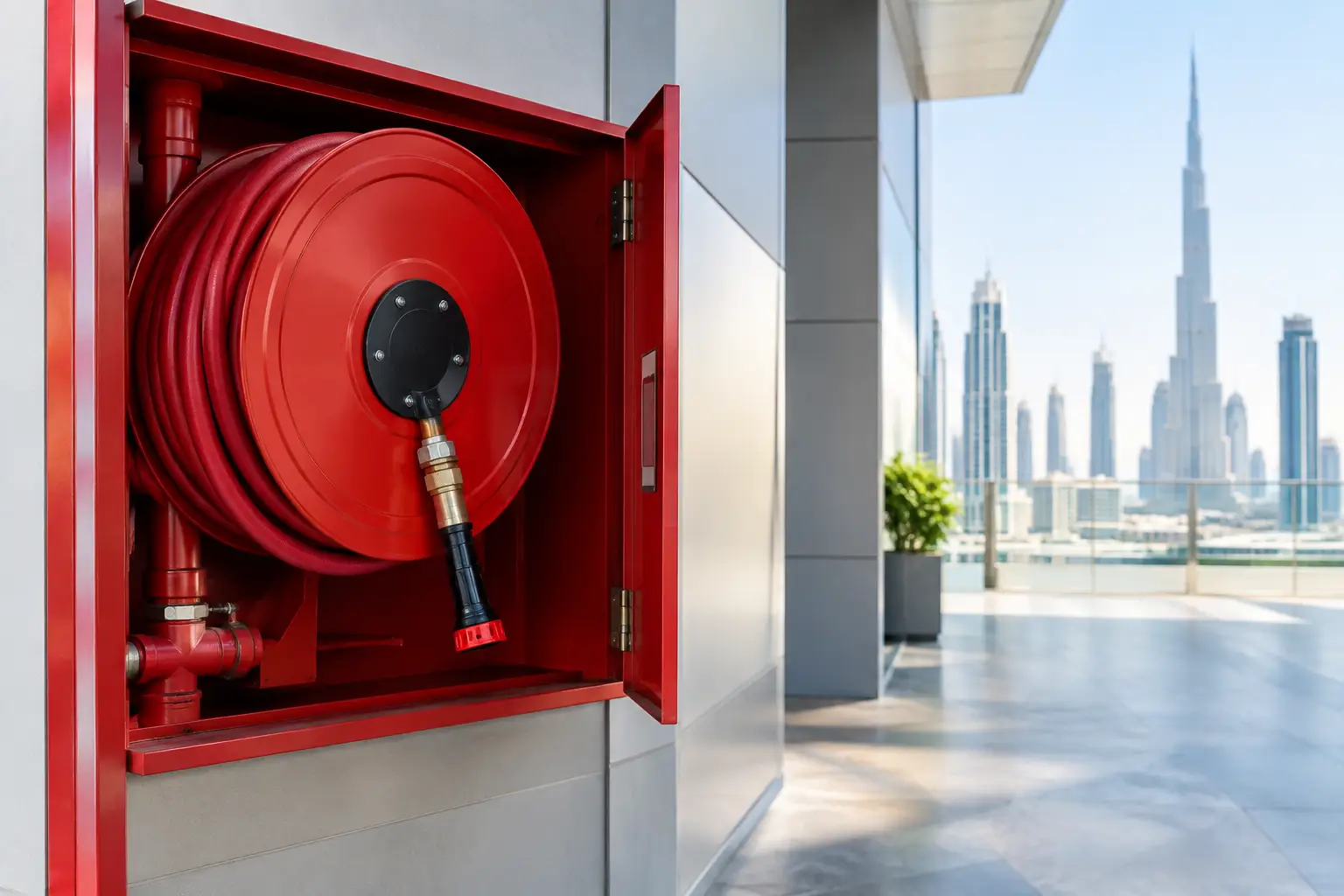
Guide to Fire Hose Reels for UAE Projects
A fire hose reel becomes relevant only when it can be reached, operated, and supplied with adequate water at the point of need. That is why a guide to fire hose reels should begin with project coordination, not with a catalog choice. For contractors, MEP teams, and facilities managers, the objective is straightforward: install an approved first-response firefighting system that passes inspection, remains serviceable, and does not create late-stage handover delays.
Fire hose reels are a common part of active fire protection in commercial buildings, warehouses, residential towers, schools, retail spaces, and fit-out projects. Yet the reel itself is only one part of the system. Hose length, coverage, water supply, cabinet arrangement, isolation valves, signage, and installation height must all align with approved drawings and the requirements of the relevant authority having jurisdiction.
What a fire hose reel is designed to do
A fire hose reel provides a controlled supply of water for occupants or trained personnel to tackle small, early-stage Class A fires involving ordinary combustible materials such as paper, wood, textiles, and some plastics. It is not a replacement for firefighting crews, fire extinguishers, sprinklers, or standpipe systems. It is a first-response measure intended to limit fire spread while evacuation and emergency procedures begin.
A typical installation includes a swing arm or fixed reel, semi-rigid hose, stop valve, nozzle, hose guide, water inlet connection, and a cabinet or wall-mounted enclosure where required. In many buildings, the reel is fed from a dedicated fire water network. The system must provide the design flow and pressure at the most hydraulically remote reel, not merely at the pump room or riser connection.
This distinction matters during procurement. A reel can be manufactured to a recognized standard and still be unsuitable for a particular project if its hose diameter, hose length, nozzle type, cabinet dimensions, or operating pressure does not match the approved fire strategy.
Guide to fire hose reels: selecting the right configuration
The correct fire hose reel is determined by the approved design, building use, and authority requirements. Do not select based only on cabinet appearance or the lowest unit rate. A low-cost mismatch can lead to rejected material submittals, replacement work, and delayed testing.
Reel type and mounting arrangement
Wall-mounted reels are commonly used in service corridors, parking areas, plant rooms, and other locations with sufficient clear wall space. Recessed or semi-recessed cabinets are often specified for finished corridors and public-facing areas where the equipment needs protection without obstructing circulation. Surface-mounted cabinets may be practical where wall recesses are not possible, but the projection must be coordinated with architectural finishes and escape routes.
Swing-arm reels allow the hose to be pulled in multiple directions and can improve access from a corridor or landing. Fixed reels may suit locations where the operating direction is predictable. The right choice depends on the hose route, door swings, nearby equipment, and clear access for users.
Hose length, diameter, and coverage
Hose length should be selected from the approved layout, not guessed from floor area. The hose must reach the intended coverage zone while allowing a practical route around corners, doors, and obstructions. Excessive hose length can reduce handling ease and affect hydraulic performance; insufficient length creates coverage gaps.
The hose diameter and nozzle arrangement must also match the system design. Pressure loss increases across long hose runs and fittings, so a specification that performs well near the pump may not meet required discharge performance at the remote end. The fire protection consultant or approved shop drawing should define the design criteria.
Cabinet and environmental protection
Cabinets protect the reel from impact, dust, weather, and unauthorized interference. Internal installations may require a painted steel cabinet, while exposed areas can call for more corrosion-resistant materials and finishes. For coastal or high-humidity sites, material selection deserves particular attention. Corrosion around hinges, locks, hose connections, and mounting points can affect both appearance and serviceability.
Cabinet doors must open fully without clashing with walls, doors, electrical panels, or fixed equipment. Fire hose reel signage should remain visible after ceilings, wall cladding, and wayfinding elements are installed. These details are often missed when fire equipment is ordered before final coordination.
Start with approved drawings and submittals
Before placing a bulk order, compare the bill of quantities against the latest approved fire fighting drawings, material submittal, and project specification. Check whether the project calls for complete hose reel assemblies, cabinets only, replacement hoses, landing valves, hoses, nozzles, or related fire fighting accessories.
Confirm the manufacturer, model, standard certification, cabinet material, finish, inlet size, hose specification, nozzle type, and mounting method. If the project requires a particular approved brand or civil defense listing, maintain that requirement through purchase order, delivery, and installation. Substitutions without documented approval can create a serious handover risk.
For large projects, it is also wise to batch materials by floor, zone, or block. This reduces site handling and makes it easier for supervisors to verify that each location receives the correct handed cabinet, mounting configuration, and accessory set.
Installation details that affect inspection outcomes
Installation quality determines whether the system is usable under pressure. Reels should be installed at the location and height shown on approved drawings, with clear operating access and no permanent obstruction. The mounting surface must be structurally suitable for the loaded weight of the reel, hose, cabinet, and water-filled components.
The inlet connection should be made using compatible pipework and fittings, with proper support to avoid placing stress on the reel valve. Isolation valves, where specified, must remain accessible. The hose should wind smoothly without kinking, twisting, or rubbing against sharp cabinet edges. The nozzle must sit securely in its bracket while remaining quick to release.
Coordinate early with architectural, electrical, and HVAC trades. A cabinet can be correctly installed yet become inaccessible after a decorative wall panel, access-control reader, duct enclosure, or storage unit is added. During fit-out work, protect installed reels from paint overspray, dust, and impact, but do not cover or block required signage.
Testing, commissioning, and routine inspection
Fire hose reel systems require more than a visual check at handover. Testing should follow the approved method statement and applicable project requirements. This generally includes verifying water supply availability, checking for leaks, operating the valve and nozzle, confirming hose condition, and demonstrating that the hose can be extended and rewound correctly.
Pressure and flow testing must be completed by qualified personnel using the project-approved criteria. Results should be recorded as part of commissioning documentation. If testing identifies inadequate performance, the cause may lie in pump settings, pipe sizing, valve position, pressure-reducing devices, blockage, or system balancing rather than in the reel itself.
After handover, facility teams should maintain an inspection schedule. A practical routine checks that cabinets are visible, doors are operable, hoses are undamaged, nozzles are present, valves are accessible, and seals or tags remain intact. Any hose showing cracking, flattening, corrosion at couplings, or signs of leakage should be assessed and replaced as required.
Procurement checks before delivery to site
For contractors managing deadlines, fire hose reel procurement should protect the construction sequence as well as the compliance file. Ordering at the last minute can hold up corridor finishes, fire fighting pressure tests, authority inspections, and occupancy milestones.
Before release, verify these four points:
- The item description matches the approved submittal, including reel type, hose length, cabinet configuration, finish, and nozzle.
- Required certificates, warranty details, test documentation, and product data are available with the delivery package.
- Quantities are separated by building, floor, or zone where phased installation is planned.
- Delivery timing is coordinated with secure storage, installation readiness, and the availability of the fire fighting team.
A reliable wholesale partner should be able to support both the complete project requirement and the urgent replacement items that emerge during testing. For sites across Dubai, Sharjah, Abu Dhabi, Fujairah, and Ras Al Khaimah, direct site delivery can reduce the time lost when crews are waiting for a missing cabinet, hose, valve, or fitting.
Yasu Trading Co. LLC supports contractors with jobsite-ready fire and safety materials alongside the plumbing fittings, tools, fasteners, sealants, and related construction supplies needed to complete installation work. Consolidated procurement helps reduce supplier coordination while keeping material specifications and delivery schedules under control.
The best time to resolve a fire hose reel issue is before walls are closed and inspection dates are fixed. Treat each reel as part of a coordinated fire protection system, verify the approved specification before purchase, and keep documentation organized from delivery through commissioning. That approach keeps the equipment ready for use and the project ready for handover.