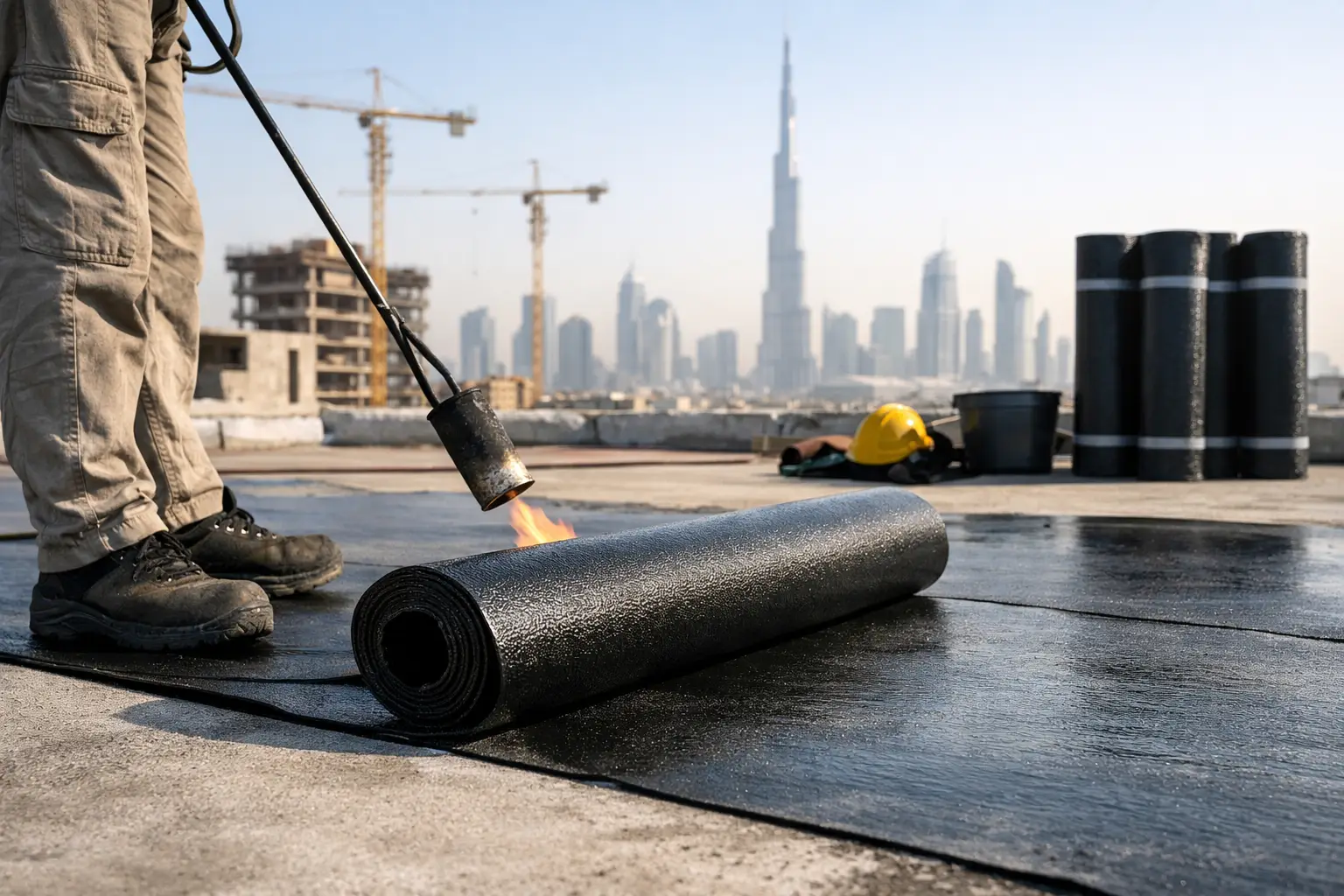
Guide to Waterproofing Membranes for UAE Sites
Waterproofing failures rarely begin when the ceiling stain appears. They begin earlier, with a membrane selected for the wrong exposure, an unprepared substrate, an unsealed penetration, or a rushed handover between trades. This guide to waterproofing membranes is written for contractors and procurement teams that need systems to perform under UAE heat, water pressure, movement, and demanding project schedules.
For a basement, roof, wet area, podium, or water tank, the right answer is not simply to buy a product labeled waterproof. The membrane, primer, protection layer, sealants, drainage arrangement, and installation method must work as one specified system. Getting that decision right before materials reach the site is less expensive than opening finished floors or repairing occupied spaces.
What Waterproofing Membranes Do
A waterproofing membrane is a continuous barrier that resists water entering a building element. Depending on the application, it may need to withstand ponding water, hydrostatic pressure, UV exposure, thermal cycling, chemicals, or structural movement. It is typically supplied as sheets, rolls, liquid coatings, cementitious compounds, or self-adhesive layers.
The membrane is only one part of water management. Roofs also require correct falls, properly detailed drains, and termination details. Below-grade structures need drainage and protection against backfill damage. Bathrooms need floor falls, sealed penetrations, and compatible tile adhesive and grout. A good product cannot compensate for poor detailing around the edges.
For procurement, the first question should be: where will the water load come from, and what will the membrane face after installation? That answer determines the membrane family, thickness, accessories, and quality-control requirements.
Guide to Waterproofing Membranes by Application
Bituminous sheet membranes
Torch-applied and self-adhesive bituminous membranes remain common for roofs, foundations, retaining walls, and podium decks. They offer dependable coverage over large areas and are available in grades reinforced with polyester or fiberglass. Modified bitumen systems can handle movement better than basic bitumen, but their performance still depends on correct overlaps, priming, heat application, and termination details.
Torch-applied products require trained applicators and controlled hot-work procedures. This can be a concern on occupied properties, near combustible materials, or in tight fit-out areas. Self-adhesive sheets reduce flame risk, although substrate dryness and primer quality become even more critical. For exposed roofs, confirm whether the system needs a UV-resistant cap sheet or a protective finish.
Liquid-applied membranes
Liquid membranes are practical where the substrate has complex geometry: pipe penetrations, upstands, parapets, corners, drains, and irregular details. Polyurethane, acrylic, and hybrid liquid systems form a continuous layer without sheet laps. They are frequently used on roofs, balconies, wet areas, and repair work.
Their advantage is detail coverage. Their trade-off is application control. Thickness can vary if the crew does not follow the manufacturer’s required coverage rate, number of coats, recoat window, and curing time. Procurement teams should request the specified wet and dry film thickness, compatible primer, reinforcing fabric where required, and the approved topcoat for exposed applications.
Cementitious waterproofing
Cementitious waterproofing is commonly used for internal wet areas, water tanks, lift pits, basements, and concrete structures. It is compatible with mineral substrates and can be applied by brush, roller, or spray depending on the system. Flexible two-component cementitious products are generally better suited to areas subject to minor movement than rigid coatings.
This category is not automatically suitable for every condition. A cementitious layer may be appropriate behind tile in a bathroom but unsuitable as an exposed roof finish. If it is used in a potable-water tank, the approval and curing requirements must match the project specification. Confirm that the selected system is compatible with the intended tile adhesives, grouts, plumbing fittings, and sealants.
PVC, TPO, and EPDM sheet systems
Synthetic sheet membranes are often specified for large commercial roofs and specialized applications. PVC and TPO sheets are typically heat-welded, while EPDM uses seam tapes or adhesives. These systems can offer consistent factory-controlled thickness and efficient coverage over broad roof areas.
The installation quality at seams, corners, terminations, and penetrations is decisive. Wind uplift design, insulation compatibility, mechanical fixing layout, and edge restraint must be reviewed as a system. Do not substitute one sheet type for another based on roll price alone. The approved accessories and welding method are part of the warranty position.
Specify for Site Conditions, Not Just the Drawing
Before issuing a purchase order, review the waterproofing location with the applicator and consultant. The specification should identify the substrate type, expected water pressure, exposure condition, movement requirement, and finishes installed above the membrane. A roof beneath pavers needs a different protection strategy from an exposed roof. A basement wall needs different protection from a shower floor.
Four details cause a disproportionate number of failures:
- Construction and movement joints that need approved joint treatment and compatible sealants.
- Pipe sleeves, floor drains, and service penetrations that require reinforced detailing.
- Upstands and wall-to-floor junctions where the membrane must turn up to the required height.
- Terminations at parapets, doors, expansion joints, and edges where water can track behind the system.
These details should be resolved before application begins, not after the main membrane has been installed. Coordinate early with plumbing pipes and fittings, electrical conduits, drainage components, and sanitary ware teams. Late service penetrations are a common cause of avoidable rework in bathrooms, kitchens, plant rooms, and roof areas.
Substrate Preparation Controls the Result
A membrane adheres only as well as the surface beneath it. Concrete should be sound, clean, and free from laitance, sharp projections, loose particles, oil, curing compounds, and standing water unless the chosen system permits damp application. Honeycombs, cracks, tie holes, and surface voids should be repaired using a compatible repair material before priming.
Moisture testing matters, particularly for liquid and self-adhesive systems. Applying to a damp slab when the product requires a dry substrate can lead to blistering or adhesion loss. On roofs, check slope before waterproofing starts. No membrane should be expected to solve poor drainage geometry or permanent ponding that exceeds the system’s design conditions.
Primers are not optional extras when the manufacturer specifies them. They control adhesion, reduce dusting, and help create a uniform bond. Use the approved primer and observe its drying time. Mixing brands without written compatibility confirmation may compromise performance and warranty support.
Installation Checks That Protect the Schedule
Waterproofing should be treated as a hold-point activity, not a hidden trade. Once screed, tile, insulation, backfill, or pavers cover the membrane, inspection becomes difficult and repairs become disruptive.
Require the applicator to record substrate acceptance, ambient conditions, primer use, membrane batch numbers, overlap dimensions, and detail treatment. For sheet systems, inspect seams continuously rather than relying only on a final walk-through. For liquid systems, monitor material consumption against the designed coverage rate to verify thickness.
Testing should match the application. Wet areas often require a flood test before tiling. Roofs may require controlled ponding tests where structurally suitable and permitted by the specification. Water tanks can require extended curing and testing before commissioning. Below-grade applications need inspection before protection boards and backfilling begin.
Do not release following trades until test results are accepted. A one-day delay for a proper flood test is usually preferable to weeks of demolition after finishes are installed.
Procurement Checklist for Waterproofing Materials
When requesting a project quote, provide the area in square feet or square meters, substrate type, application location, anticipated finish, and required compliance standard. Include drawings or detail sketches for penetrations, joints, drains, and upstands. This enables the supplier to calculate not only membrane quantity, but also primers, joint tapes, corners, protection boards, drain accessories, and compatible sealants.
Confirm product origin, technical data, batch traceability, storage conditions, and manufacturer warranty requirements. Rolls and liquid components must be stored away from excessive heat, direct sun, moisture, and damage. Materials delivered too early and left exposed on site can create avoidable quality risks.
For active projects across Dubai, Sharjah, Abu Dhabi, Fujairah, and Ras Al Khaimah, staged deliveries can reduce site congestion while keeping critical materials available before each waterproofing zone is released. Yasu Trading Co. LLC can support project-based sourcing with municipality-compliant building materials, compatible construction hardware, and site-focused delivery coordination.
The best waterproofing decision is the one that stays intact after the finishes are installed and the project is handed over. Specify the complete system, protect the installation sequence, and make every penetration and termination visible in the plan before water finds it first.