A Contractor's Guide to Gypsum Plasterboard Price in Dubai
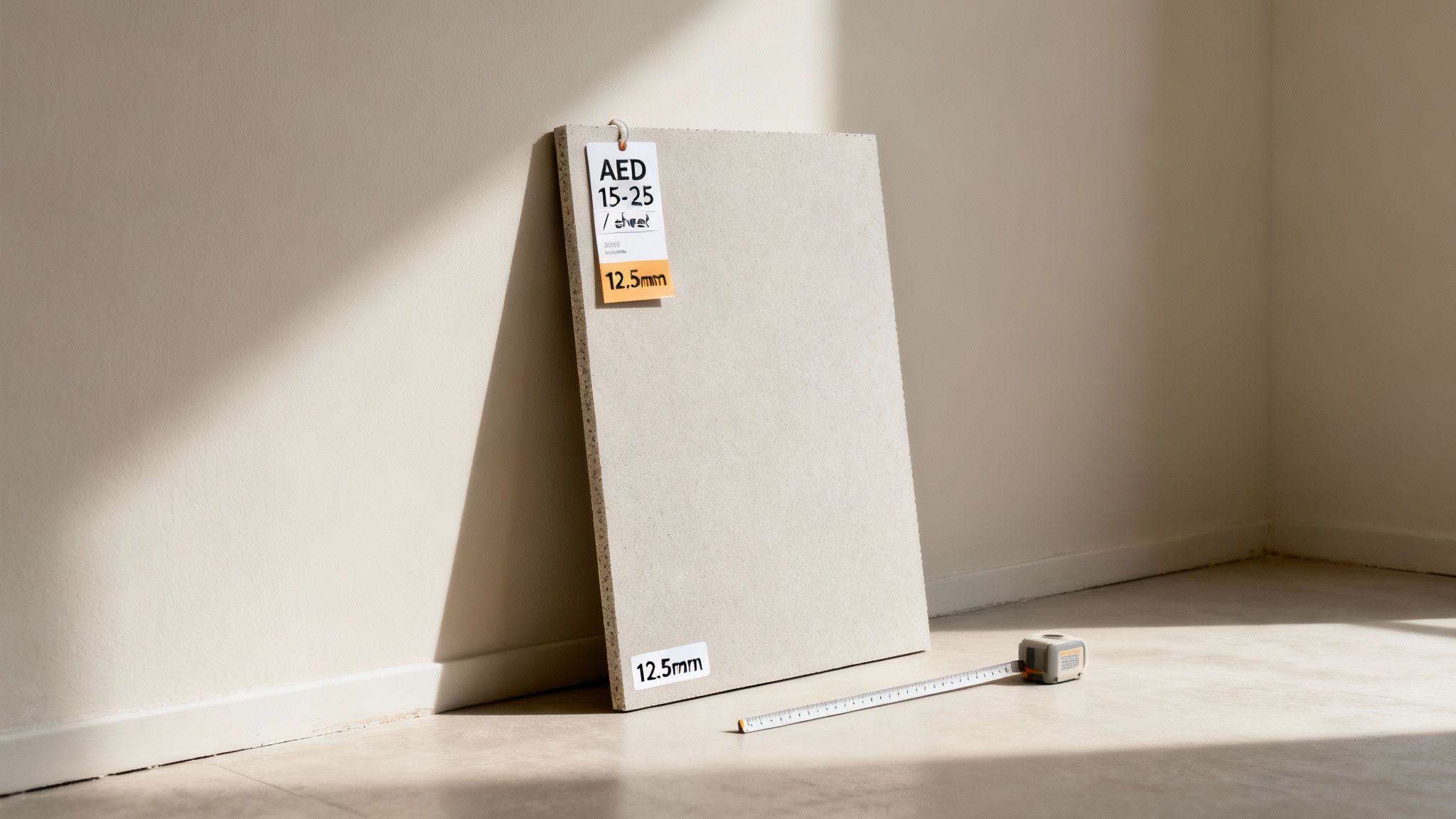
When you're pricing a job in Dubai, one of the first numbers you'll need is the cost of gypsum plasterboard. As a starting point, you can expect a standard 12.5mm gypsum plasterboard sheet to cost somewhere between AED 15 to AED 25.
Of course, that’s just a baseline. The final price you pay will depend on the board's specifications, the brand, and your supplier.
Understanding Gypsum Plasterboard Prices in Dubai
Nailing down your material costs early is crucial for any construction project in the UAE. For interior fit-outs, the price of gypsum plasterboard is a major line item that directly affects your tender and, ultimately, your profit margin. This material is the backbone of modern interiors—used for everything from walls and partitions to ceilings—but it’s important to remember that not all boards are the same.
Think of it like buying tyres for a car. Your standard road tyre is affordable and perfect for everyday driving. But if you're heading off-road or onto a racetrack, you'll need specialised tyres that cost significantly more because of their unique design and materials. It's the exact same principle with plasterboard; the price changes based on what you need it to do.
How does board type affect the price?
The single biggest driver of cost is the type of board, as different specifications are required to meet UAE construction standards. A standard board works perfectly well for most dry interior spaces, but many projects have specific areas that demand boards with enhanced performance.
These specialised options include:
- Moisture-Resistant (MR) Boards: A must-have for wet areas like bathrooms and kitchens. These boards have special additives to fight off mould and prevent water damage.
- Fire-Resistant (FR) Boards: You'll see these specified for fire-rated partitions, corridors, and service shafts. Their core is reinforced with glass fibres to handle high temperatures and slow down the spread of fire.
- Acoustic Boards: Built with a much denser core, these boards are all about soundproofing. They are ideal for reducing noise between rooms in offices, hotels, and residential buildings.
Here's the bottom line for any contractor: the cheapest sheet isn't always the best value. Choosing the right board for the job is essential for compliance, durability, and keeping your client happy. A good building materials distributor can walk you through the options and help you find the most cost-effective solution for every part of your project.
To help with your initial estimates, here’s a quick overview of the typical price ranges you'll find from suppliers in Dubai. Use these figures as a handy benchmark when you start budgeting.
Estimated Gypsum Plasterboard Price Ranges in the UAE
This table provides estimated price ranges for common types of gypsum plasterboard, helping contractors quickly benchmark costs per sheet and per square metre.
| Plasterboard Type | Standard Thickness | Estimated Price Per Sheet (AED) | Estimated Price Per m² (AED) |
|---|---|---|---|
| Standard Gypsum Board | 12.5mm | 15 - 25 | 5 - 9 |
| Moisture-Resistant (MR) | 12.5mm | 25 - 35 | 9 - 12 |
| Fire-Resistant (FR) | 12.5mm | 30 - 45 | 10 - 16 |
| Acoustic Board | 12.5mm | 40 - 60 | 14 - 21 |
As you can see, the price jumps significantly once you move into specialised boards. Factoring these different rates into your bill of quantities from the outset is key to creating an accurate and competitive tender.
What Really Drives the Price of Gypsum Board?
To get your project budget right, you need to understand what actually shapes the final gypsum plasterboard price. It's a mistake to think of plasterboard as a single, generic product. It's more like a car—the final price tag can change dramatically depending on the engine, the features, and what it's built to do.
That final number on a quote from a supplier in Dubai isn't just pulled out of thin air. It’s a direct reflection of the board's performance capabilities, its dimensions, and whether it meets strict local regulations. Once you get a handle on these factors, you can budget smarter and make much better purchasing decisions.
What is the biggest cost driver for plasterboard?
The single biggest factor is the type of board, which is determined by its core ingredients and paper wrapping. A standard gypsum board is the entry-level model, but when you need specialised performance—like resistance to moisture, fire, or sound—the manufacturing gets more complex, special additives are involved, and the price goes up accordingly.
Think about it this way: a standard 12.5mm board is perfectly fine for a bedroom wall. But try using that same board in the washroom of a busy restaurant, and you're asking for trouble. Not only would it violate UAE construction standards, but it would crumble and grow mould in no time. For that job, you need a moisture-resistant (MR) board. It costs more because its core and paper are specially treated to fend off damp and mould.
The same logic applies to fire-rated (FR) boards, which are mandatory for escape routes, corridors, and service shafts. These boards have glass fibres and other additives mixed into their gypsum core. This reinforcement helps the board hold its shape and integrity for much longer during a fire, which is why it comes at a premium. A knowledgeable building materials distributor can guide you on exactly where each type is required, ensuring you stay compliant without overspending.
How does board thickness influence the price?
The thickness of the board has a direct impact on its price because thicker boards use more raw material. This makes them heavier and more costly to produce and ship, which is why a 15mm or 18mm board will always cost more per sheet than the standard 9.5mm or 12.5mm options.
You might be tempted to use a thinner 9.5mm board for ceilings to save a few dirhams, but this can be a false economy. A thinner board might need more framing to stop it from sagging over time, which could eat up any initial savings on the material itself.
On the flip side, paying a bit more for a thicker 15mm board can give you some serious benefits:
- Better Durability: It creates a tougher, more solid wall that can take a few knocks without showing damage.
- Quieter Rooms: The extra mass is great for blocking sound, a huge plus for offices, apartments, and villas.
- Safer Spaces: A thicker board naturally takes longer to burn through in a fire compared to a thinner version of the same type.
It's a classic trade-off: a higher upfront cost for a product that performs better and lasts longer. The key is to match the board's thickness to what the project actually needs in terms of acoustics, fire safety, and overall strength.
Do brand and certification matter?
Yes, brand reputation and official certifications play a big role in the gypsum plasterboard price. Established brands invest heavily in research, development, and strict quality control systems, ensuring their products consistently meet or exceed local and global standards, and this quality assurance is factored into the price.
Here in the UAE, compliance is everything. Materials have to meet the standards laid out by authorities like the Dubai Municipality. When a board comes with certifications from respected bodies like UL (for fire safety) or ASTM (for material quality), it’s a guarantee that it will perform as advertised. That piece of paper is vital for getting your project signed off and handed over.
You could be tempted by a lower price from a lesser-known brand, but that comes with risks. If it doesn't have the right paperwork or fails to perform under pressure, you could face costly delays or even legal issues. Working with a trusted supplier in Dubai ensures every board you buy is fully certified and compliant. Think of the small premium for a recognised brand as an investment in quality, safety, and your own peace of mind.
How the UAE's Booming Market Shapes Your Material Costs
Let's be realistic—your project budget doesn't operate in a bubble. It's directly tied to the pulse of the UAE's construction market. Grasping these larger economic forces is the difference between simply buying materials and becoming a strategic partner who can anticipate price changes and lock in stable costs with a reliable building materials distributor.
The link is simple: when the UAE's construction industry is booming, especially in powerhouse cities like Dubai and Abu Dhabi, the demand for essential materials like gypsum plasterboard goes through the roof. This classic supply-and-demand tug-of-war is one of the biggest factors influencing the gypsum plasterboard price and, ultimately, your project's final cost.
Why does high demand squeeze my gypsum board price?
High demand affects your price because it creates intense competition for a limited supply of materials. When numerous large-scale projects launch simultaneously, manufacturers and suppliers are pushed to their limits to keep up, which can lead to price increases and longer lead times for your orders.
Think of it like a single water tap for an entire neighbourhood. On a normal day, water flows freely for everyone. But during a heatwave, when everyone needs water at the same time, the pressure drops. In the same way, a construction boom puts a huge strain on the entire supply chain, from quarrying the raw gypsum to getting the finished boards delivered to your site.
This is why planning your procurement ahead of time is so critical. By working closely with a trusted supplier in Dubai like Yasu Trading Co. LLC, you can reserve your stock in advance. This move helps shield your project from those nasty surprises, like sudden price hikes or material shortages that can throw your entire schedule off track.
A proactive procurement plan is your best shield against market volatility. By understanding demand cycles, you can secure your prices early and ensure materials arrive exactly when you need them, preventing expensive delays.
What is the growth outlook for the UAE gypsum market?
The UAE gypsum board market is poised for significant expansion, indicating that high demand will continue. This incredible growth is a direct result of the nation's ambitious development vision and its status as a global real estate hub, which directly impacts the gypsum plasterboard price.
The numbers don't lie. In 2023, the UAE's gypsum board market was valued at a hefty USD 443.4 million. But that's just the start. Projections show it’s expected to climb to an incredible USD 1,082.7 million by 2030, growing at a compound annual rate (CAGR) of 13.6%. You can explore more about these market projections to get a deeper sense of the regional construction landscape. For any B2B building materials distributor, this data confirms gypsum board will remain a fundamental building block for projects all across the Emirates.
So, what’s fuelling this fire?
- Mega-Projects: The continuous pipeline of iconic hotels, malls, and residential towers keeps demand consistently high.
- Infrastructure Investment: Government spending on public projects like schools and hospitals requires enormous volumes of high-quality, compliant building materials.
- Renovation and Retrofitting: There's also a growing trend of updating older buildings to meet modern UAE construction standards, which adds another steady stream of demand.
How can I protect my project from price swings?
You can safeguard your project from price volatility by building strong supplier relationships and adopting a smart procurement strategy. In a market this active, you can't just hunt for the lowest price per sheet; you need a reliable partner.
First things first, partner with an established supplier in Dubai who maintains a deep inventory and has solid relationships with manufacturers. This gives you a massive advantage—access to more stable pricing and a reliable supply, even when the rest of the market is feeling the pressure. A great distributor is more than just a seller; they’re your eyes and ears on the ground, offering insights that help you buy at the right time.
Beyond that, you need to give potential suppliers the full picture. Don't hold back information. Provide them with:
- Accurate Timelines: Let them know your project schedule, especially when you plan to start the interior fit-outs.
- Full Bill of Quantities: Give them the total volume of materials needed for the entire project, not just the first phase.
- Specific Requirements: Be crystal clear about the types of boards you need, detailing any special specs like fire-rated or moisture-resistant properties.
When you share the complete scope of your project, you give your supplier the ability to offer better volume pricing and plan their logistics effectively. This helps secure your material pipeline and keeps market surprises from derailing your budget.
What are the hidden costs of a drywall system?
Focusing purely on the per-sheet gypsum plasterboard price is a common mistake that can lead to budget overruns. The board is just one component; a complete drywall system requires a framework, finishing materials, and fasteners, all of which contribute to the total cost.
To build an accurate budget, you must account for every accessory needed to turn individual boards into a finished wall or ceiling. A good building materials distributor will run through this with you, but overlooking these items is a common pitfall that can derail your project's finances.
This is where the bigger picture comes into play. The price you pay is heavily influenced by the wider UAE construction market. When major projects are booming, demand for materials like gypsum shoots up, and that ripple effect eventually hits your invoice.
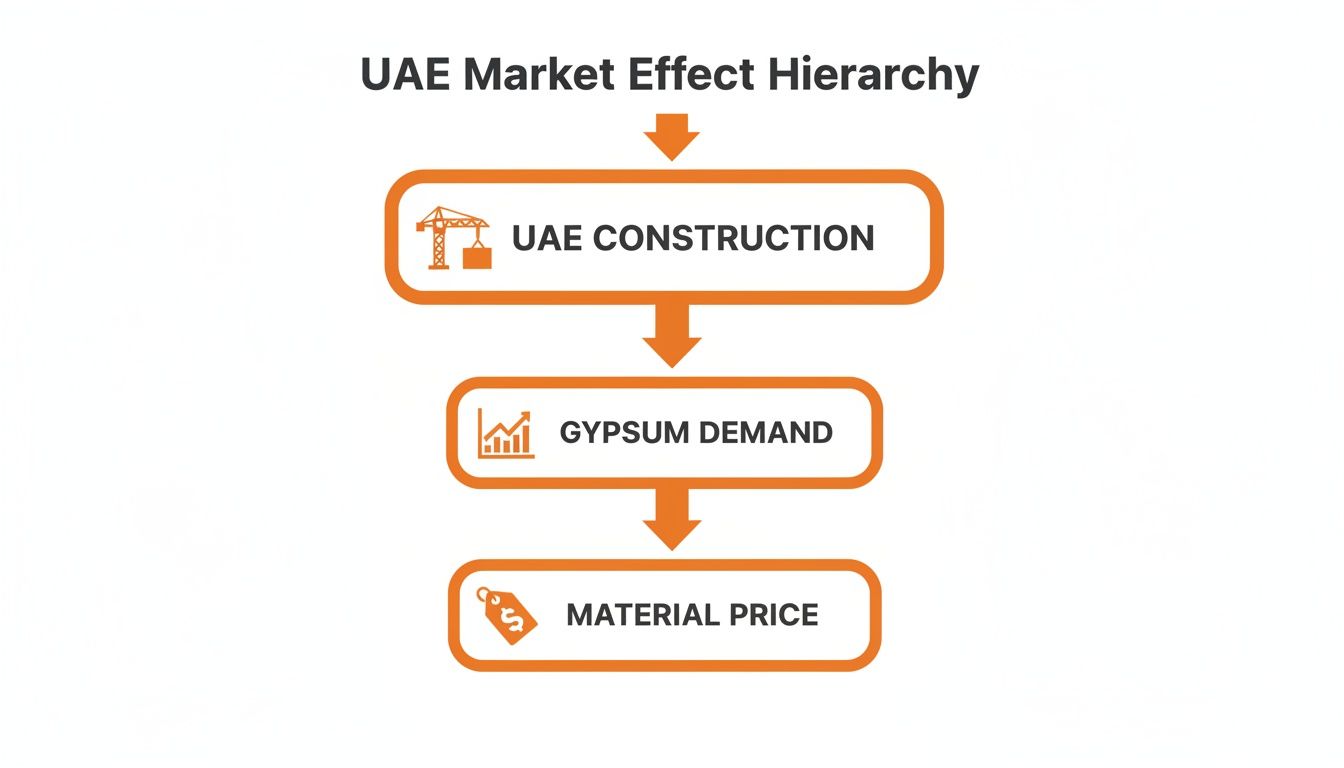
As you can see, strong construction activity at the top directly drives up demand, which then shapes material pricing all the way down the supply chain.
The Structural Framework
First things first: the skeleton. This is the metal framework that holds the gypsum boards, forming the real shape of your partition or ceiling. It's built from metal studs and tracks, and these are absolutely non-negotiable for any installation that needs to meet UAE construction standards.
The cost for the frame isn't fixed; it shifts based on a few key specs:
- Steel Gauge: This is the thickness of the metal. Thicker gauge steel is stronger and more rigid, but it costs more. The right gauge is usually determined by the height of the partition and what it needs to support.
- Stud Spacing: The industry standard is to place studs 400mm or 600mm apart. Closing that gap makes for a tougher wall, but it also means you're buying more studs, which bumps up the material cost.
- Corrosion Resistance: Working in a humid environment or a wet area? You'll likely need galvanised steel with a heavier zinc coating to prevent rust, which adds another layer to the cost.
Finishing Materials
Once the boards are up, the finishing materials are what turn a patchwork of panels into a smooth, seamless surface ready for paint. These items might seem small, but their costs quickly add up, especially on a large job.
Your main finishing kit will include:
- Jointing Compound: Everyone just calls it "mud." It's the paste used to tape and fill the seams between the boards. You can get different types, from all-purpose versions to fast-setting compounds for when you're on a tight schedule.
- Jointing Tape: This is either paper or a fibreglass mesh. It gets bedded into the compound over the joints to strengthen them and stop cracks from appearing later.
- Corner Beads: These are metal or plastic strips that go on the outside corners. They give you a crisp, professional edge that can take a few knocks without crumbling.
Fasteners and Accessories
Don't underestimate the cost of screws. They might look insignificant, but you'll use thousands of them on a decent-sized project. Skimping here is a bad idea; using the wrong type or too few can lead to boards sagging or even failing down the line.
You'll need to budget for specific types, like fine-thread screws for metal studs and coarse-thread for wood frames. Screw length is also critical—it has to be right for the board's thickness to get a solid grip. A knowledgeable supplier in Dubai can help you calculate the exact amount you need based on your project's square meterage. For specialist boards, like those used in bathrooms, you'll need specific corrosion-resistant fasteners. If you're curious about these, our guide on https://yasutrading.com/blog/waterproof-gypsum-board has all the details.
To help you get a handle on these "hidden" costs, here’s a quick checklist of the essential accessories you’ll need to budget for.
Installation Accessories Checklist and Estimated Costs
| Accessory Item | Unit of Measurement | Estimated Cost Range (AED) | Key Consideration |
|---|---|---|---|
| Metal Studs & Tracks | Per linear metre | 3.50 - 9.00 | Thicker gauge (e.g., 0.55mm) costs more but is essential for taller partitions. |
| Drywall Screws | Box of 1,000 | 25 - 50 | Ensure you have the correct thread type (fine for metal, coarse for wood) and length. |
| Jointing Compound | 25kg bag | 40 - 75 | Setting-type compounds dry faster but can be harder to work with for beginners. |
| Jointing Tape | 150m roll | 15 - 30 | Fibreglass mesh tape is often easier for DIYers, while professionals prefer paper tape. |
| Corner Beads | 3m length | 8 - 20 | Metal provides maximum durability; vinyl/plastic options offer flexibility and rust resistance. |
| Acoustic/Thermal Insulation | Per m² | 15 - 45 | Rockwool or fibreglass batts add significant performance but also to the budget. |
This table gives you a ballpark idea, but remember that prices fluctuate based on brand, quality, and supplier. Always get a detailed quote that breaks down every single component.
It's also worth remembering that costs go beyond materials and direct labour. As a contractor, you have to factor in operational overheads. For instance, understanding equipment repair costs helps you price your bids more accurately. Labour is another huge variable; a job with complex curved walls or extra-high ceilings will require more skilled hands and more time, which directly inflates the final installation price.
How to Get an Accurate Quote from a Supplier in Dubai
Getting a fast, accurate quote for your gypsum plasterboard isn't just about asking for a price. It's about giving your supplier the right details right from the start. A clear, thorough request means they can give you a sharp, competitive offer without the back-and-forth, saving you from frustrating delays or budget surprises down the line.
Think of your request as a blueprint for your project's needs. The clearer the picture you paint, the less guesswork for the supplier. This helps them instantly check their stock, figure out the logistics for delivery, and see if any volume discounts apply. The end result? You get their best possible price, faster.
What information must I provide for a quote?
To get a firm quotation, you must provide the board's technical specifications, precise quantities, delivery details, and your project timeline. Without these four key pieces of information, any building materials distributor is just guessing, which can delay your project.
Getting this right from the start is crucial. It sets a professional tone and directly impacts the accuracy of the gypsum plasterboard price you receive. When a supplier sees a well-prepared request, they know they're dealing with someone who is serious and organised.
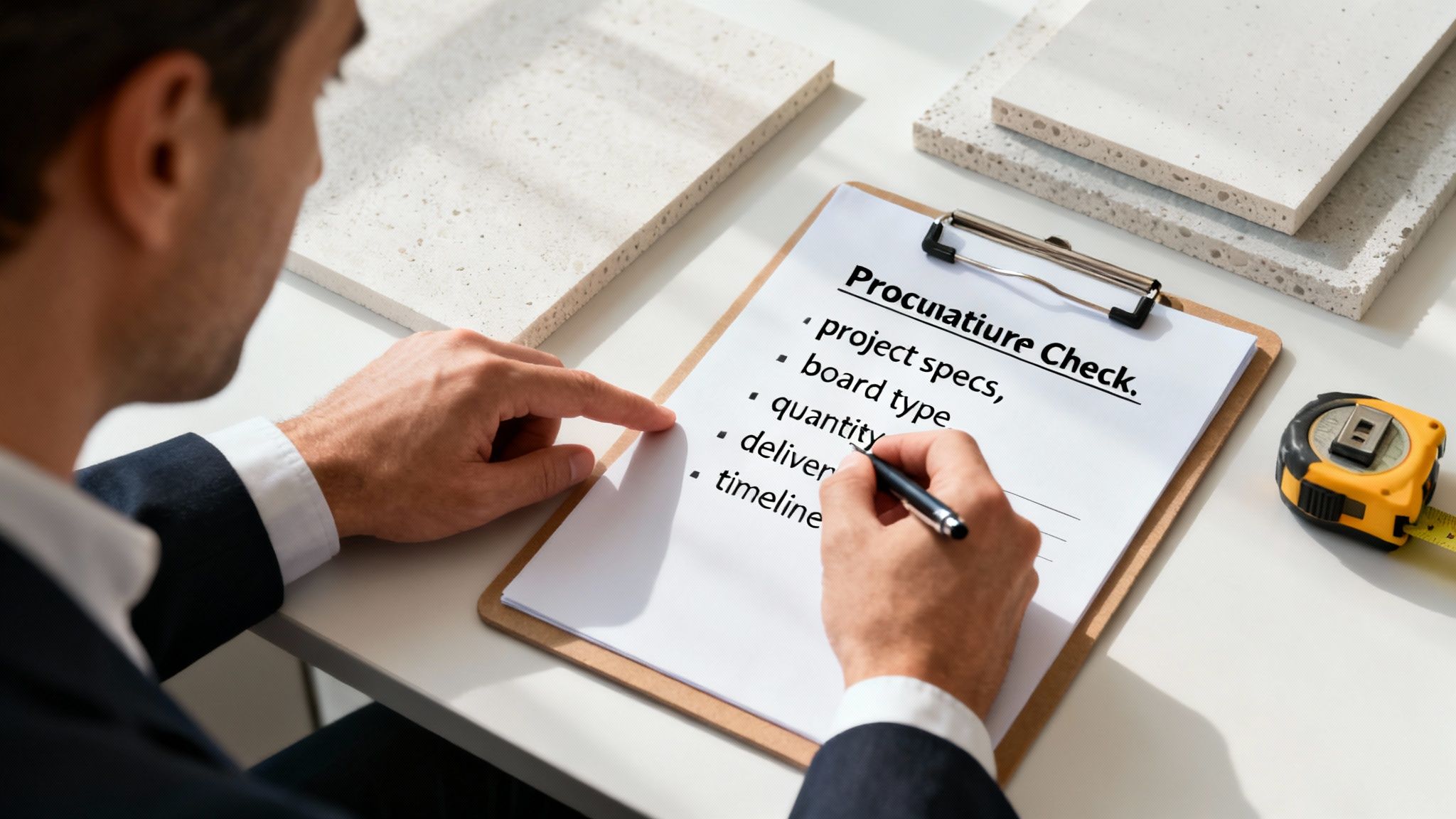
Here’s a simple checklist to have ready before you reach out:
- Board Specifications: Be specific. What type do you need – standard, moisture-resistant (MR), or fire-rated (FR)? What thickness (12.5mm, 15mm)? Are there any specific certifications required to meet UAE construction standards?
- Exact Quantities: Don't just estimate. Provide the total number of sheets or the complete square meterage for the entire job.
- Delivery Location: Give the full site address. Be sure to mention any potential access issues or specific points for drop-off.
- Project Timeline: Let them know your ideal delivery date. If the project is phased, share the schedule so they can plan stock and logistics accordingly.
How do I compare quotes effectively?
Look past the headline price per sheet and evaluate the total value offered by the supplier in Dubai. A cheap quote is worthless if it leads to expensive project delays because the materials didn't show up when promised.
A great supplier isn't just selling a product; they're providing a service that helps your project succeed.
A truly competitive quote reflects a supplier’s ability to deliver the right materials, on time, with the right technical backing. Focusing solely on the lowest price can expose your project to risks like stock shortages and logistical failures, eroding any initial savings.
As you review different offers, ask these critical questions:
- Is Delivery Included? Is the price you're seeing ex-works, or does it include transport to your site in Dubai or another Emirate?
- What is the Stock Situation? Can they guarantee the full quantity right now, or are you looking at partial deliveries and potential waiting times?
- Who is the Manufacturer? Knowing the brand helps you verify the quality and compliance. You can learn more about the leading gypsum board manufacturers in Dubai to get a better feel for the market.
- What Support is Offered? Does the building materials distributor have a team that can offer solid technical advice? This can be invaluable in making sure you've chosen the right spec for the job.
By approaching procurement with this structured mindset, you can secure more than just the best gypsum plasterboard price—you get the best overall value for your project.
Frequently Asked Questions About Gypsum Plasterboard
When you're in the middle of sourcing materials, questions are inevitable. Getting straight answers quickly is key to making the right call, keeping your project on track, and making sure the budget doesn't get out of hand. Here, we'll tackle the most common queries contractors and project managers have about gypsum plasterboard price and its use here in the UAE.
We've already broken down the main cost drivers, but these specific answers should help you handle the day-to-day decisions you're making on-site.
What is the most cost-effective type of gypsum board for residential projects?
For general residential spaces like living rooms and bedrooms, the most cost-effective option is the 12.5mm standard gypsum plasterboard. It offers a great balance of strength, performance, and price for areas without special requirements.
You might be tempted by thinner boards that look cheaper on a per-sheet basis, but be careful. Thinner boards, especially on ceilings, can sometimes demand more framing to stop them from sagging over time. That extra framing can easily eat up any initial savings, so always think in terms of the total system cost, not just the board price.
When it comes to wet areas—think bathrooms, kitchens, and laundry rooms—moisture-resistant (MR) boards aren't just a good idea; they're essential. Using them is a requirement to meet UAE construction standards and, more importantly, to prevent headaches like mould and humidity damage down the road. A good building materials distributor can help you figure out the right mix of standard and MR boards for your job.
How do volume discounts work with building material distributors?
Volume discounts are a standard practice where the price per sheet decreases as the order quantity increases. A dedicated building materials distributor like Yasu Trading Co. LLC can offer tiered pricing because larger orders are more efficient for them to process, handle, and deliver.
To lock in the best rate, give your supplier the full project quantity right at the start, even if you need the materials delivered in phases over weeks or months. This lets them price the job based on the total volume. Not only does this get you maximum savings, but it also helps them reserve your stock, so you know the materials will be there when you need them.
When you share your complete bill of quantities at the quoting stage, you’re giving your supplier the information they need to offer their sharpest price. It turns a simple purchase into a proper partnership where everyone wins.
Why is fire-rated gypsum board more expensive?
Fire-rated (FR) gypsum board is more expensive because its specialized core is reinforced with glass fibres and other non-combustible additives. This advanced composition is engineered to withstand extreme heat for a longer duration, slowing the spread of fire and maintaining structural integrity during an emergency.
The manufacturing process for FR board is more involved and uses pricier raw materials compared to standard board. Here in the UAE, Civil Defence codes are very clear about where FR boards must be used to meet safety regulations. These areas typically include:
- Exit Corridors and Stairwells: To keep escape routes safe for people.
- Elevator Shafts: To stop fire from jumping from one floor to another.
- Service Rooms: To contain risk in areas with electrical panels or machinery.
- Area Separation Walls: Partitions between different apartments or commercial units.
That higher gypsum plasterboard price for FR boards isn't just a cost; it’s a non-negotiable investment in life safety and getting your building approvals signed off.
Does the gypsum plasterboard price vary between Dubai and Abu Dhabi?
No, the base price for gypsum plasterboard from major distributors generally does not vary significantly between Dubai and Abu Dhabi. Any price difference you encounter is typically due to transportation and logistics costs based on your site's distance from the supplier's warehouse.
A supplier in Dubai, for instance, can usually offer very competitive delivery rates for projects inside the city because of the short distances. A delivery to a site in Abu Dhabi, Sharjah, or one of the other Emirates might have a small transportation fee added.
Often, this fee depends on how big the order is—for really large quantities, many suppliers will absorb the delivery cost. The best way to avoid any surprises is to always ask for a quote that is "inclusive of delivery" to your exact site location. That way, the price you see is the price you pay, giving you a clear number for your budget and letting you compare offers from different suppliers fairly.
For a complete range of gypsum plasterboards and all the accessories you'll need, it pays to work with a supplier who knows the UAE market inside and out. At Yasu Trading Co. LLC, we deliver competitive pricing, solid advice, and reliable service to keep your project running smoothly. Get an accurate quote for your project today.