Nuts Bolts Washers Explained for UAE Contractors
A requisition lands on a Thursday afternoon. Two thousand M12 bolts with nuts and washers, needed on site by Saturday, described in one line and priced on unit cost. The buyer gets what the market can deliver fastest, the site team fits it, and nobody checks the assembly against the drawings until something leaks, rattles or rusts. That sequence is behind most of the fastener problems I get asked about.
The fix is rarely a more expensive bolt. It's buying the bolt, nut and washer as one specified set, matched to the zone the joint lives in. Here's how that works from grade selection through to receiving inspection.
Table of Contents
- How Nuts, Bolts and Washers Work as One Joint
- Bolt Grades and Standards at a Glance
- Washer Types and When Each One Is Needed
- Choosing Coatings and Materials for UAE Exposure
- Specifying and Ordering Fasteners as Complete Assemblies
- Verifying Equivalence Before Substitutions Reach Site
How Nuts, Bolts and Washers Work as One Joint
A rooftop plant screen goes up in spring. By late summer the brackets start to rattle: a nut backed off half a turn on four or five fixings, nothing dramatic. The usual cause is boring. The washer never left the bag, the nut ran straight down onto painted or bare steel, and the plate around the hole dished until the clamp went slack.
Tightening a bolt stretches it like a spring. That stored tension, the clamp force or preload, is what holds the plates together. The bolt supplies the stretch, the nut turns applied torque into tension, and the washer spreads bearing pressure so the surface is not dented or pulled through an oversized hole.
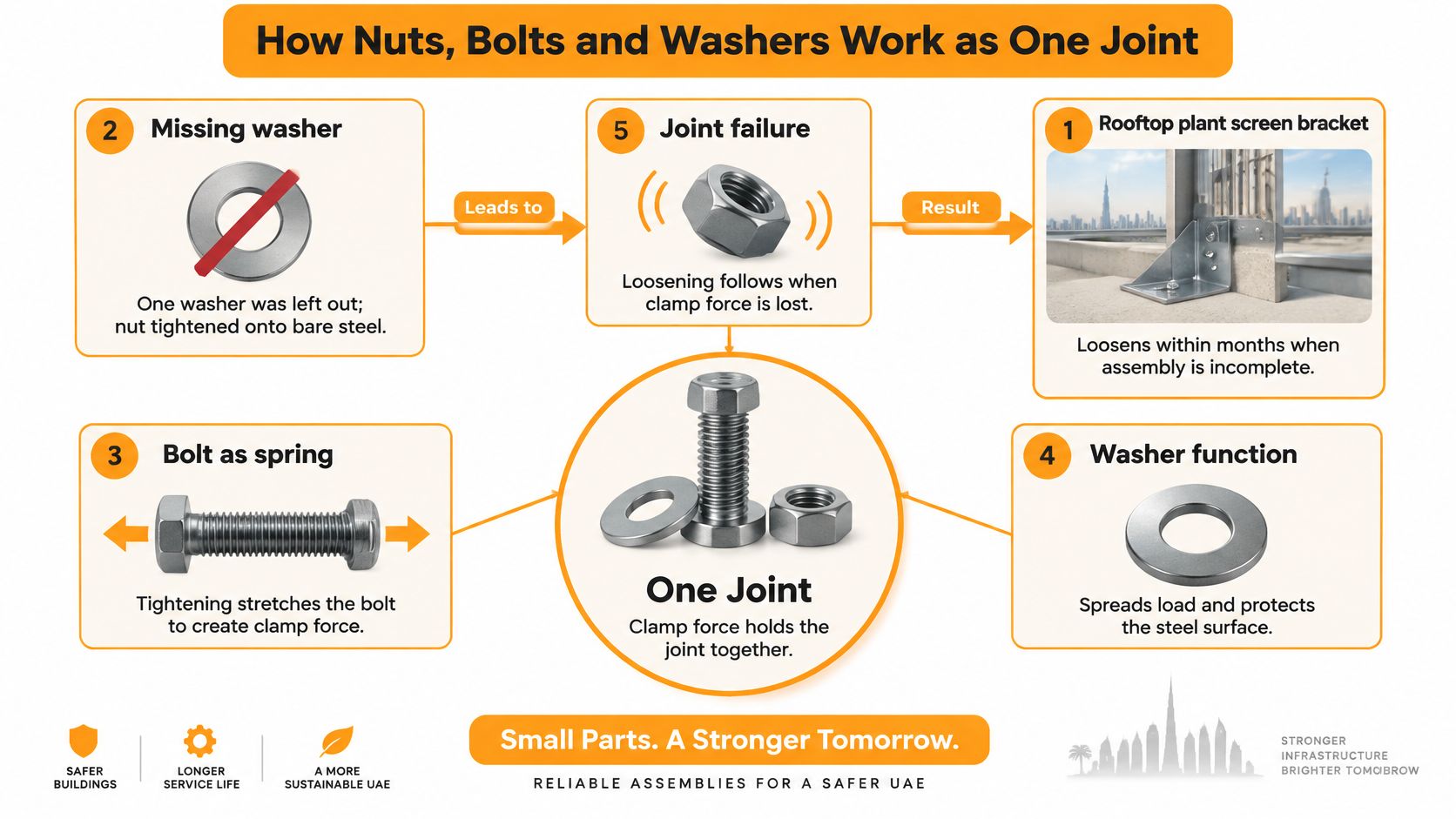
That is the whole mechanism. It also explains why a correct bolt with the wrong washer still loses preload, and why the lowest unit price can turn into rework where humidity, salt air or washdown keep the joint wet. A dry interior support and a coastal edge bracket can share diameter and grade yet belong to different zones.
| Component | Job in the joint | What fails if it is wrong |
|---|---|---|
| Bolt | Stretches under torque to create clamp force | Plates slip or separate under load |
| Nut | Turns applied torque into tension on the bolt | Threads strip or the joint loosens under vibration |
| Washer | Spreads load under the head or nut and protects the surface | Surface dents, the slot pulls through, preload drops |
Fasteners are traded here in serious volume. According to World Bank WITS import data, UAE imports under HS code 7318 reached about US$466.6 million and 158.4 million kilograms in 2023, with China supplying roughly US$179.0 million of that and bolts and screws alone about US$224.7 million. Most of what reaches a Dubai site arrives by ship, so accuracy at order stage is the key quality gate before a joint ever sees a spanner.
Where vibration is expected, threadlocker resists loosening at the threads. The washer still does the bearing work, and preload still has to come from correct tightening. Matching compound strength and cure behaviour to fastener size and service temperature is the part site teams underestimate; MA Hydraulics on threadlocker grades sets out the differences.
Bolt Grades and Standards at a Glance
Diameter tells you what spanner to pick up. Grade tells you what the joint will carry. Two M20 bolts can look identical on the shelf and differ substantially in capacity, and only the head marking or the certificate reveals which one you bought.
Read the marking before you read the drawing. Metric property classes are stamped as 8.8, 10.9 or 12.9. Heavy hex structural bolts usually carry A325 or A490 and three radial lines. An unmarked bolt in a structural pile is a bolt you can't use without paperwork.
| Standard or class | Typical use | Strength reference |
|---|---|---|
| ASTM A307 Grade A | Light, non-pretensioned connections | Low-carbon general purpose grade, no pretension requirement |
| ASTM A325 | Pretensioned structural steel joints | About 120 ksi minimum tensile for common diameters |
| ASTM A490 | Higher-strength pretensioned structural joints | 150 ksi minimum tensile |
| ISO 898-1 class 8.8 | General machinery and MEP supports | 800 MPa tensile |
The table narrows the field. It doesn't settle the choice. Connection type decides whether pretension applies, the drawings set the grade, and the nut and washer have to come from the same system. A 10.9 bolt with a class 8 nut is a joint waiting to strip.
For a wider walk-through of how the grades map onto site applications, this guide to construction fastener grades for contractors is worth keeping on the procurement desk.
Washer Types and When Each One Is Needed
A spring washer does not stop a nut from loosening. Neither does a plain washer. If a joint loses preload, no washer design will hold it together, and treating a split washer as a locking device hides the underlying problem, which is inadequate clamp force.
Correction worth making early: a washer protects the surface and spreads the load. It does not tension the bolt.
Four types earn their place on UAE sites. Plain flat washers distribute load and protect coated surfaces in general work, and they're the sensible default where the drawing is silent. Hardened structural washers belong in pretensioned joints where the specification calls for them, because their hardness maintains the bearing surface under high clamp force and a soft substitute changes preload behaviour. Large-outside-diameter washers cover thin sheet and slotted holes, where a standard washer would dish into the void. Wedge-type locking washers address vibration in specific assemblies where the design calls for them.
The rule is short. If the drawing names a washer, match it exactly, including hardness and outside diameter. If it doesn't, a plain washer of suitable thickness and size is the baseline.
Small outdoor assemblies show why this matters. Fence gate hardware fails within a season when a thin flat washer is asked to do a locking job, and the comparison in this piece on choosing washers for fence gate hinges illustrates the difference between load spreading and vibration resistance in plain terms. Check washer thickness and hardness on receipt with a caliper and the certificate, never from the bag label.
Choosing Coatings and Materials for UAE Exposure
Corrosion in the UAE isn't one environment. A corrosion-mapping study for Abu Dhabi recorded zinc corrosion of about 15 µm per year on the coast against 0.6 µm per year inland, and steel corrosion of about 56 µm per year on the coast against 10 µm inland, according to the published corrosion mapping study. Salt-laden air removes zinc and steel far faster at the water's edge.
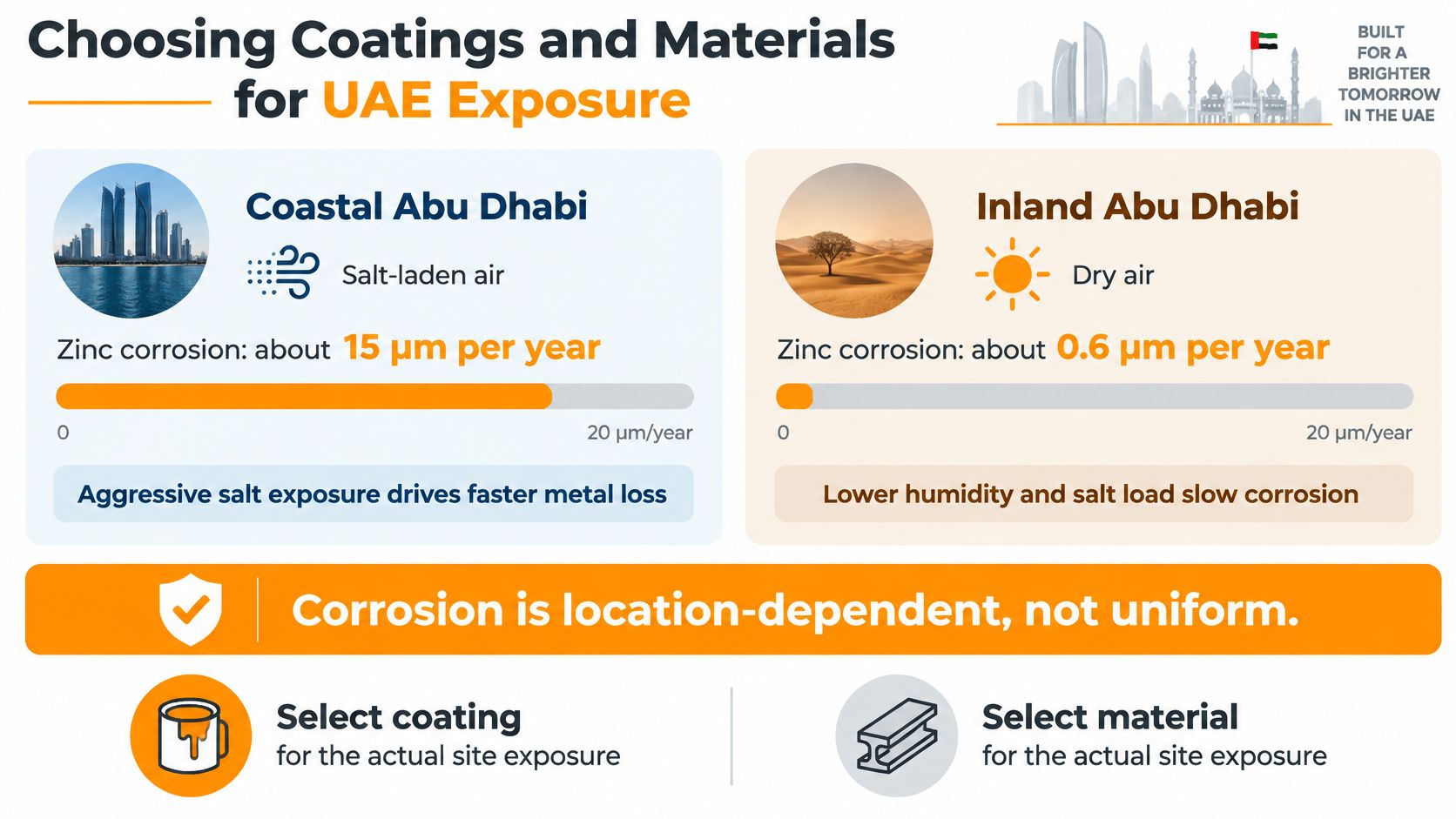
That difference drives the finish choice, zone by zone.
| Finish or material | Coastal Dubai or Abu Dhabi | Indoor dry areas | Pools, wet rooms and washdown |
|---|---|---|---|
| Zinc-electroplated carbon steel | Not recommended for exposed joints | Suitable | Not recommended |
| Hot-dip galvanised to ASTM A153 | Suitable, with coating thickness checked | Suitable | Acceptable with routine inspection |
| 304 stainless (A2) | Marginal, pitting risk in salt spray | Suitable | Marginal, chlorides attack it |
| 316 stainless (A4) | Suitable | Suitable | Suitable |
Stainless isn't automatically the best answer. In a dry, air-conditioned plant room a galvanised or plated part does the job at a fraction of the cost, and pairing stainless fasteners with plated steel brackets invites galvanic corrosion at the contact face. The lowest unit price becomes the highest lifecycle cost when it means rework on a façade or a leak behind a concealed joint.
Pool work is also a compliance question. Ras Al Khaimah building regulations require corrosion-prone metal to be protected with hot-dip galvanising or approved industrial coatings and call for corrosion-resistant pool components. Record the coating or material certificate for every lot; if the pool column of the table is on your project, that certificate is your evidence. For a direct comparison of the two systems, read galvanised versus stainless fasteners.
Specifying and Ordering Fasteners as Complete Assemblies
In Dubai, bolted steel connections must be designed and constructed to the AISC Specification for Structural Joints, and the Dubai Building Code names ASTM A325 and ASTM A490 structural bolts for those connections. A generic "high-tensile" note on a requisition is not a specification.
Run five checks before the order leaves your desk:
- Designation: confirm the ASTM or ISO reference for bolt, nut and washer separately.
- Connection type: pretensioned, bearing or non-pretensioned, because it changes the whole assembly.
- Washer specification: normal, hardened, or a load-indicating type where the engineer requires it.
- Coating: select it from the exposure zone, not from what's in stock.
- Documentation: request mill or conformity certificates showing properties, heat treatment and lot traceability.
Then write each joint out as a complete line item, bolt grade plus nut plus washer plus coating plus certificate requirement. Check that list against the approved drawings and the consultant's approval route, and send it to the supplier before the order is placed, so quotes come back as matched sets. Skimping here shows up months later, which is why fastener checks belong in pre-engineered building erection checks alongside frame alignment not after it. Because we handle municipal compliant construction hardware daily, we quote fasteners and adhesives as assemblies, with the documentation attached.
Verifying Equivalence Before Substitutions Reach Site
A substitute can fit perfectly and still fail. Wrong coating, wrong property class, wrong thread form, or a washer with half the required hardness all pass a visual check at the gate and fail in service. Judge the delivery as one assembly: a compliant bolt paired with a soft washer is still a rejected joint.
Cost pressure raises the stakes. A UAE construction cost review identifies material-cost volatility as a significant challenge, with developers responding through bulk procurement, local-manufacturing exploration and stronger regional supplier relationships. Bulk buying secures supply and can lock a project into the wrong specification just as easily. On coastal and wet UAE sites, the saving on a cheaper coating is spent again cutting out corroded fixings a season later.
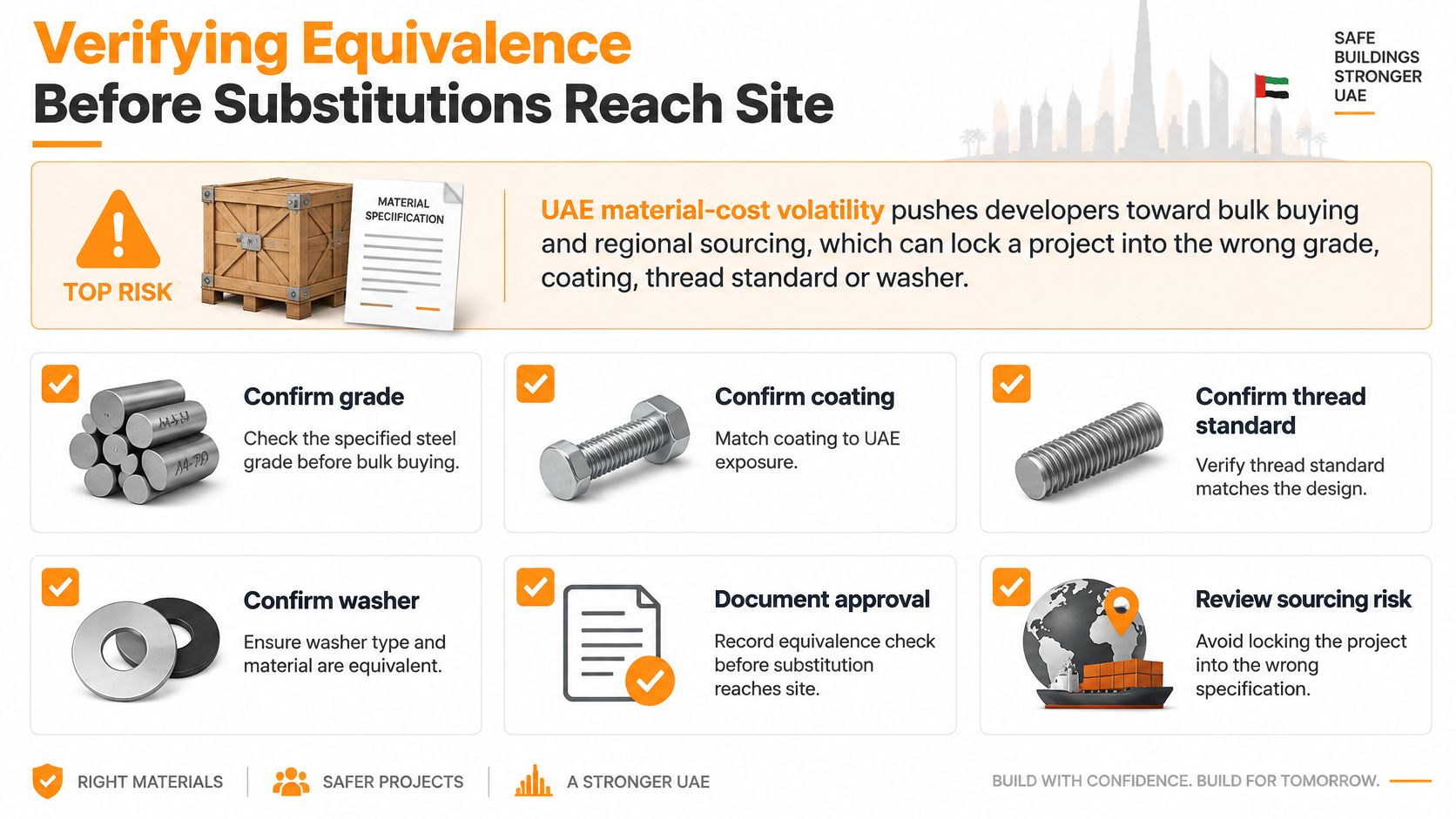
Run this receiving inspection on arrival:
- Grade marking and nut match: the head stamp on the bolt and the class marked on the nut must correspond, and both must match the approved designation.
- Washer dimensions: measure outside diameter and thickness, and confirm hardness against the certificate where a hardened washer is specified.
- Thread form and length: check pitch and length against the approved drawing, since a near-fit thread still strips under load.
- Coating integrity: reject damaged coatings, cut threads and unprotected contact zones before they reach storage.
- Lot traceability: match lot numbers to the certificate pack and the inspection-test plan so every box can be traced back to its heat.
A failed check means the lot is quarantined pending a decision, whatever the pressure on programme. Any change of grade, coating or washer type needs consultant approval before installation. The same documents govern delivery in Dubai, Abu Dhabi, Sharjah and the Northern Emirates, so one checklist covers every site.
Yasu Trading Co. LLC stocks fasteners and adhesives for UAE projects from Naif in Deira, with same-day or next-day delivery across Dubai, Abu Dhabi, Sharjah and the Northern Emirates. Send us your joint schedule with grades, coatings and certificate requirements, and our team can advise on the right specification before you order. Visit Yasu Trading Co. LLC to start the enquiry.