PPR Pipe Meaning: What It Is and Where UAE Plumbers Use It
PPR stands for polypropylene random copolymer, a thermoplastic pipe used mainly to distribute hot and cold water. It's a material family, not a performance guarantee, and the printed PN number on the wall carries far less information than most buyers assume.
The advice I'd push back on hardest is the one repeated in nearly every brochure and forum thread: take the highest pressure class you can afford, and the pipe is safe. That reading treats PN25 as an unconditional 25-bar rating at any temperature. A domestic hot-water riser running at 65°C to 70°C won't honour it, and the label never claimed it would. What decides whether a PPR line performs is duller: the standard the product is certified against, the derated pressure at the operating temperature, the quality of the fusion joints, and the paperwork that goes into the submittal.
Getting the PPR pipe meaning right for a UAE project means reading all of those together, not shopping by name.
Table of Contents
- What PPR Pipe Stands For and Why It Matters
- How PPR Pipe Is Made and Joined
- Pressure and Temperature Ratings Explained
- Where PPR Pipe Is Used in Plumbing
- PPR Compared With PVC and Other Pipe Materials
- Limitations and Common Misconceptions About PPR
- Confirm the PPR Specification Before You Order
What PPR Pipe Stands For and Why It Matters
PPR stands for polypropylene random copolymer, a thermoplastic pipe used mainly to distribute hot and cold water. The term names a material family. It's not a brand, not a pressure rating, and not evidence that a specific product is approved for the line you're running.
The technical identity comes from standards rather than one number, as Dubai Municipality's polypropylene pipe conformity documentation sets out. ISO 15874 covers polypropylene piping systems for hot and cold water, while DIN 8077 and DIN 8078 handle dimensions, tolerances and quality requirements for PP-R and PP-RCT. Dubai Municipality publishes a conformity-certification rule for polypropylene pipes against DIN 8078, which is why UAE consultants ask for it by name.
Think of PPR as a surname. Knowing someone is called Smith tells you the family, not the individual. The standard, nominal diameter, pressure class and conformity evidence are what identify the actual pipe in the crate.
Six details should be readable on any label or quote before you commit:
- Material, stated as PP-R or PP-RCT rather than just "PPR".
- Nominal diameter, with the exact range the certificate covers.
- Pressure class, such as PN16 or PN25.
- Applicable standard, ISO 15874 plus the relevant DIN dimension standard.
- Manufacturer, with a traceable product line.
- Conformity evidence, matched to the authority and emirate.
That last point catches people. Compliance can be product-line specific rather than applying to everything a factory ships, so a certificate for one diameter or one grade doesn't cover the rest of the catalogue. Read those six together and you can judge a pipe. Read only the name and you're buying a promise.
How PPR Pipe Is Made and Joined
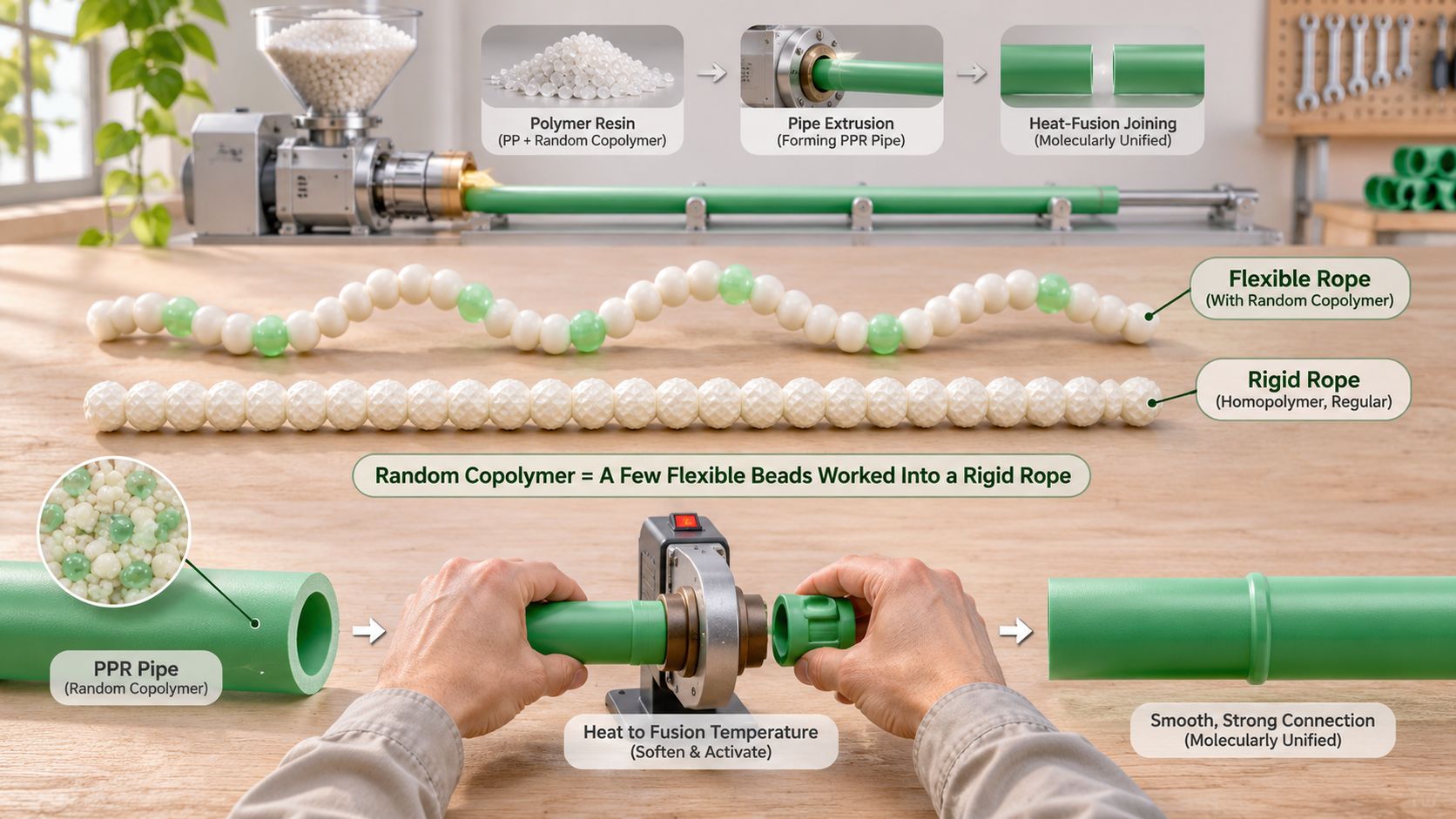
A random copolymer is like working a few flexible beads into a rigid rope. The regular pattern breaks up, so the rope bends instead of snapping. PPR does that chemically, adding ethylene units into the polypropylene chain at irregular intervals, which improves toughness and resistance to temperature-related stress compared with more brittle polypropylene grades, as Aqua Gas Plastics' guide to PPR pipes in the UAE explains.
The same source gives the service envelope UAE suppliers publish: continuous service designs around 0°C to 90°C, short-term exposure up to approximately 100°C, and a design service life of at least 50 years under specified conditions. Those figures are the headline, not the whole story, because the conditions attached to them are what the next section unpacks.
The joint is where the material earns its reputation. A fusion connection produces a continuous wall of polypropylene instead of a threaded or glued seal, and it's done in four moves:
- Heat the pipe end and the fitting together in a fusion tool sized to that diameter, at the tool's set temperature.
- Push the two together to full insertion depth in one steady movement, without twisting.
- Hold them still while the joint cools under light pressure.
- Let the joint cool completely before any pressure test touches the line.
Four things ruin the result: a tool running cold or hot, a partial insertion, a cut that isn't square, and a pipe end with dust, oil or moisture on it. That's why a crew needs trained operators and a set of fusion tools matched to every diameter on the drawing. A faulty fused joint cannot be tightened back into service. It gets cut out and refitted, which is why pipe and fitting compatibility checks belong in the procurement stage rather than on the scaffold.
Pressure and Temperature Ratings Explained
PN is a nominal pressure class: the pressure a pipe can carry at a reference temperature, with wall thickness rising as the class rises. UAE buyers meet the same handful of grades again and again, and the number moulded into the wall tells them less than they assume.
| Grade | Typical service | What to check |
|---|---|---|
| PN10 | Low-pressure cold-water supply | Confirm the duty stays within low pressure |
| PN16 | General water supply | Confirm temperature duty before using for hot water |
| PN20 | Higher-demand and hot-water lines | Check derated pressure at operating temperature |
| PN25 | Higher-pressure service | Do not read the label as full rating when hot |
| PP-RCT | Higher pressure at elevated temperature | Confirm DIN 8078 and fitting system |
The correction that matters is simple. PN is not a fixed working pressure at every temperature. Pressure capability depends on temperature, service life, pipe dimensions, installation quality and the behaviour of the whole system. Prolonged exposure above approximately 60°C accelerates ageing, so a PN25 line on hot-water duty carries well under 25 bar in service, as HomeFix's UAE plumbing installation guidance points out.
Sizing starts with the manufacturer's temperature-pressure derating table. Add surge pressure from pump starts and valve closures, then allow for thermal expansion over the run.
Practical rule: size a line on the derated pressure at its hottest realistic operating temperature, plus surge. Never on the number moulded into the wall.
Take a rooftop tank feeding a recirculating hot-water loop at 65°C with a booster pump downstream. That line gets sized at the derated figure for 65°C with pump surge added. The printed class is a starting point in a table, not the answer.
The contrarian point holds across the whole table: correct sizing and derating matter more than choosing the highest class. An oversized, poorly supported PN25 system still fails through bad fusion, movement or pressure transients. What clears a UAE submittal is the derating calculation and the manufacturing standard behind the pipe. The DIN 8078 reference that separates PP-RCT from standard PP-R carries more weight with a reviewer than any class a supplier can print on the wall.
Where PPR Pipe Is Used in Plumbing
Walk a three-storey villa from the roof down. A rooftop tank feeds the cold riser, which drops through the building and branches into bathrooms and the kitchen. Beside it, a water heater pushes hot water out through its own branches, often clipped to the same wall. Two lines, same material, different duties, and the selection has to respect that difference.
The main uses break down like this:
- Domestic risers and branch lines in villas and apartments, carrying hot and cold supply from tank and heater to fixture.
- Hotel guest bathrooms and laundries, where hot and cold lines run close together and a leak behind a tiled wall costs far more than the pipe.
- Potable water networks in schools, clinics and hospitals, subject to hygiene approval rather than dimensional compliance alone.
- Concealed pipework in walls and ceiling voids, where a fused joint leaves no thread or glue line to weep.
- Exposed plant-room runs, only with UV shielding and proper support spacing.
PPR is a supply pipe. Drainage stays with PVC and similar systems, and mixing the two responsibilities on one drawing is a common source of confusion at submittal stage.
A method that keeps this straight: take the drawing, mark every line as hot, cold, potable or exposed, then match each line to its duty before any product is ordered. The hot riser in that villa follows hot-water duty and gets sized on a derated pressure. The cold riser follows cold supply duty. Same surname, different individual.
PPR Compared With PVC and Other Pipe Materials
For most hot and cold domestic water lines in the UAE, PPR is a sound choice. PVC is not suited to hot water, and no amount of supplier enthusiasm changes that.
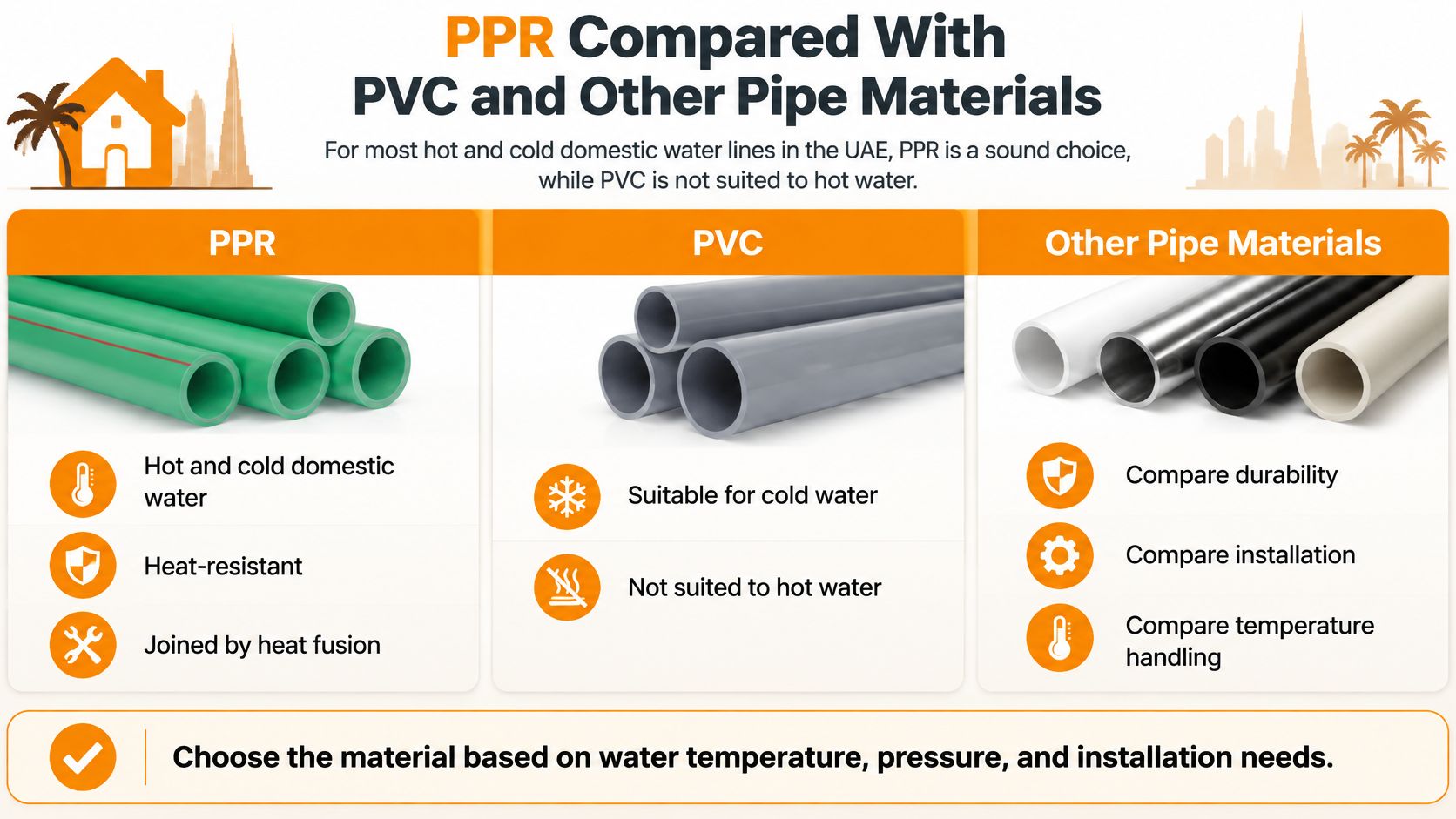
| Material | Hot water | Joining method | Main advantage | Main limitation |
|---|---|---|---|---|
| PPR | Yes, designed for hot and cold | Heat fusion | Continuous joints and tough wall | Needs trained fusion and UV protection |
| PVC / uPVC | No, cold water and drainage | Solvent cement | Low cost and rigid | Not suited to hot water |
| CPVC | Yes, hot and cold | Solvent cement | Hot-water rated plastic | Solvent handling and curing time |
| Copper | Yes | Soldering or press fittings | Long track record in metal | Higher material cost |
| Steel | Yes | Threaded or welded | High strength | Corrosion risk and heavier installation |
| HDPE | Limited indoors | Butt or electrofusion | Flexible in large diameters | Rarely used for indoor hot water |
Where PPR pulls ahead for water services:
- A wall that resists temperature-related stress instead of softening through a hot-water duty cycle.
- Continuous fused joints, with no threads to tape or glue lines to cure.
- A smooth bore that doesn't scale or corrode the way steel does.
Three factors decide the material, not brand loyalty. Does the line carry hot water? Is it exposed or concealed? Can the crew fuse joints correctly? If the answer to the third is no, a solvent-cement system may serve you better on paper and worse in five years.
Copper and steel stay common where metal is specified or where the site is set up for it. CPVC is the other hot-water plastic, joined with solvent cement, and it's a legitimate option where fusion tools aren't on site. If a project is converting an existing metal system, the sequence for copper to PEX repiping steps shows how much of the decision sits in the transition details rather than the pipe itself.
Cost comparisons are only meaningful on the same standard and pressure class. Comparing a PN20 PPR quote with an unrated PVC line is a comparison of two different jobs. Use a proper breakdown of types of plumbing pipes and fittings to keep the lines equivalent.
Limitations and Common Misconceptions About PPR
The most persistent myth is that any PPR pipe is safe for drinking water and already municipality approved. Neither follows from the material name. As MarkNtel Advisors' UAE PPR pipes market report frames it, the term describes the material, not proof of compliance, pressure suitability or drinking-water safety.
Four things need evidence, and they arrive as four separate documents:
- Dimensional compliance with ISO 15874 and the relevant DIN 8077/8078 dimensions.
- Hygiene approval for potable water, issued against the product, not the factory.
- The pressure class the design calls for at its operating temperature.
- Project conformity documentation tied to the authority, emirate, consultant or end use.
A pipe can match every dimension and still fail a hotel submittal because the hygiene certificate or the batch traceability is missing. I'd rather see that gap caught in procurement than in a consultant's comments three weeks before handover.
The limits, briefly:
- UV exposure degrades unprotected pipe, so exposed runs need shielding.
- Linear expansion is significant over long hot runs and needs support and allowance.
- Ratings fall as temperature rises, which the derating table spells out.
- Joint quality depends on the crew and the condition of the fusion tool.
- Drainage isn't PPR work, and never will be.
It also helps to keep perspective on the market. PVC, HDPE, ductile iron and steel remain recognised for infrastructure applications, so PPR is one approved material among several, not the only one. Before accepting any claim about a product, ask which standard the project requires and whether the certificate names that exact product line.
Confirm the PPR Specification Before You Order
Confirm six items before ordering or submitting, in this order:
- Water service type. Identify whether the line carries potable or non-potable water.
- Standard. Confirm ISO 15874 and the DIN 8077/8078 dimensions the project requires.
- Size and class. Set nominal diameter and PN class against design pressure and hot-water temperature, using the manufacturer's derating table.
- Fitting system. Confirm the fittings and the fusion tool match the pipe, diameter for diameter.
- Evidence. Request Dubai Municipality conformity evidence, the hygiene certificate and batch traceability. Our PPR pipes are municipality compliant, and that paperwork travels with the order.
- Installation conditions. Plan support, expansion allowance and UV protection for anything exposed.
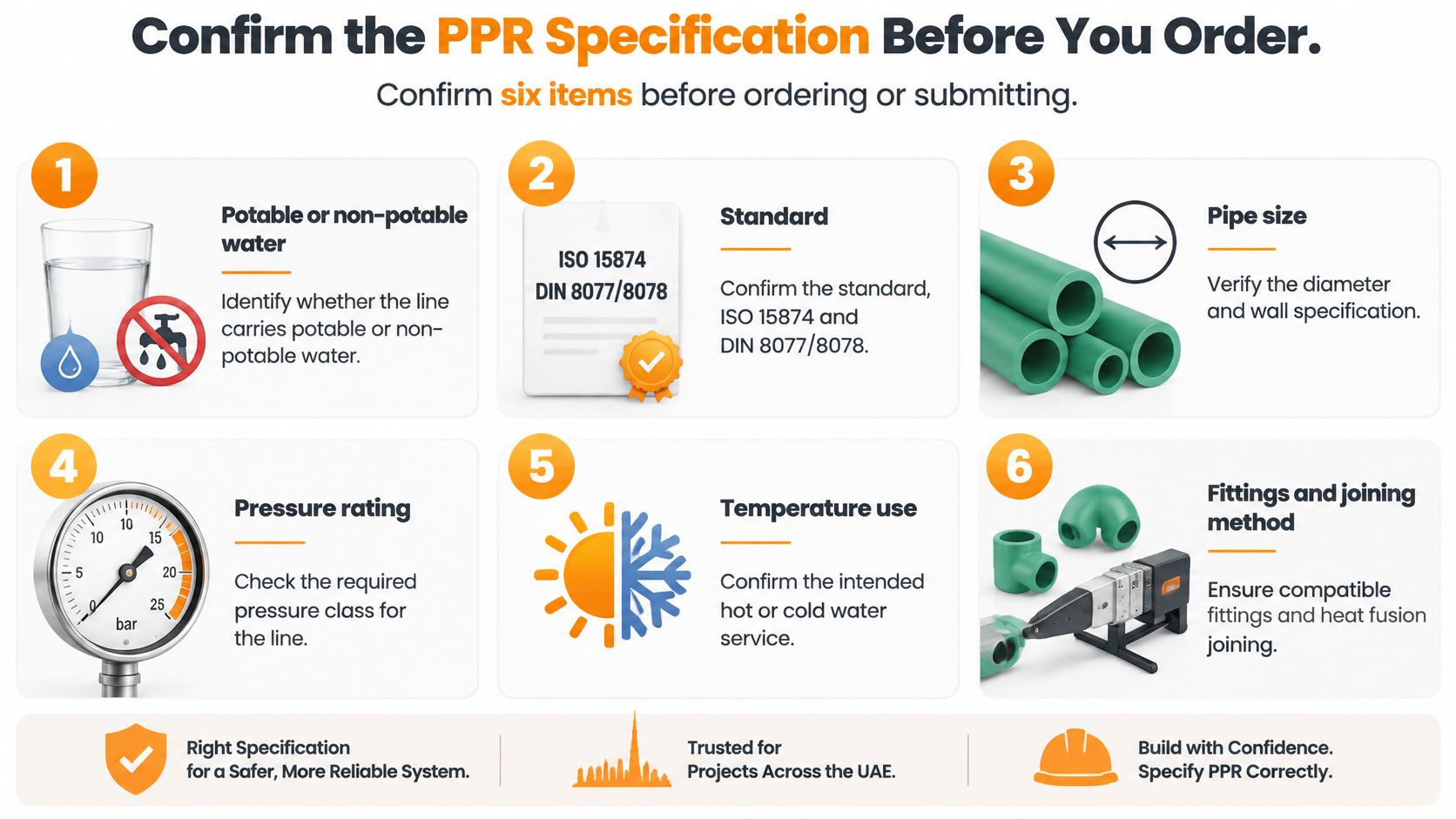
That checklist, not a product name, should decide the order. The pipe we stock is designed for hot and cold water supply and supplied in 4-metre lengths at 40mm diameter, so if your duty sits outside that, say so early rather than discovering it at the counter. Send the drawing, the water service type, and the design pressure and temperature to Yasu Trading Co. LLC's technical team, and we'll confirm which PN class and fitting system suit the line and which documents to request before submittal.
Yasu Trading Co. LLC has supplied municipality-compliant plumbing materials to UAE contractors since 2002, with PPR pipes and fittings held in stock at our Naif, Deira warehouse and dispatched same-day or next-day to sites in Dubai, Abu Dhabi, Sharjah and the Northern Emirates. Send us your drawing with the water service type and the design pressure and temperature, and our technical team will confirm the right PN class, diameter and fitting system for the duty before you submit. Visit Yasu Trading Co. LLC to browse the plumbing range or speak to the counter team about your next order.