Types of Plumbing Pipes and Fittings: UAE Guide 2026
The pipe quotation lands on your desk with a price per metre and a delivery date, and not much else. Three suppliers, three materials, three jointing methods, and a consultant who wants the plumbing submittal approved before the first riser goes in. Somewhere in that pile is a datasheet for a pipe that's pressure-rated for cold water and nothing more.
Most conversations about types of plumbing pipes and fittings start with material names. They should start with the service, the temperature, the joint and the approval evidence. A pipe, its fittings and its jointing method work as one assembly, and that assembly passes or fails inspection as a unit.
Here's how that assembly gets chosen on a UAE project, from the material shortlist through to the certificates you hand over before the first order.
Table of Contents
- Why Pipe Choice Starts With the Job It Does
- Pipe and Fitting Materials at a Glance
- Plastic Pipes for Water and Drainage
- Metal Pipes and Iron Fittings for Pressure and Heat
- Fitting Shapes and Joining Methods Explained
- Matching Pipe Types to UAE Applications
- Compliance Checks Before You Order
Why Pipe Choice Starts With the Job It Does
A hot-water riser goes into a Dubai tower with the correct diameter, the specified insulation and a pressure class copied straight across from the cold-water line. Nothing on the drawing looks wrong. Then the tower runs through its first summer, water sits hot in the riser between draw-offs, the polymer softens, and the supports spaced for cold duty end up carrying a line that sags between floors.
The pipe wasn't undersized. It was misapplied. The job decides the material, not the other way round.
A pipe and its fittings form one system, and the service it carries sets the shortlist: potable cold water, domestic hot water, chilled water, drainage and sewerage, pressure mains, or fire lines. Choosing by diameter alone is like picking a car tyre by width without checking the load rating. The size fits the rim and the performance still fails.
Plumbing splits into three working families: potable supply, drainage and sewerage, and specialist services such as pumping stations and fire protection. UAE projects add two more pressures. Sustained high ambient temperature derates materials that perform fine in cooler climates, and municipality approval has to be evidenced before installation rather than argued about afterwards.
The supply chain shows how much of this market is plastic: in 2024, UAE imports of plastic pipe and hose fittings included USD 35.60 million from the European Union, USD 24.48 million from China and USD 19.95 million from Germany, according to World Bank WITS using UN Comtrade data. Volume at that scale means availability is rarely the constraint. Specification is.
Pipe and Fitting Materials at a Glance
| Material | Typical maximum service temperature | Corrosion behaviour | Relative cost |
|---|---|---|---|
| PPR (polypropylene random) | About 70°C continuous, 95°C short term | Excellent in potable water | Low to moderate |
| uPVC (PVC-U) | About 60°C, cold water and drainage only | Excellent | Low |
| CPVC | About 82°C | Excellent | Moderate |
| HDPE and MDPE | Around 60°C at reduced pressure | Excellent | Low to moderate |
| Copper | Above 100°C, limited by joint rating | Sensitive to aggressive water | Moderate to high |
| Galvanised steel | Moderate, varies by rating | Corrodes; legacy only | Low |
| Stainless steel | High | Excellent | High |
| Ductile iron | Not used for hot water | Good with protective coating | Moderate |
| GRP (glass-reinforced plastic) | Set by the resin system, commonly 60°C to 80°C | Excellent | Moderate to high |
The temperature column is where UAE projects get caught. A nominal rating is not a working rating. A pipe rated for 70°C continuous is being asked to hold that at full pressure in a service shaft where the air around it raises the wall temperature further, and a line exposed on a roof is hotter again.
The corrosion column explains the drift away from metal in buried and concealed work. Plastics and GRP don't corrode in aggressive ground or chlorinated water, while galvanised steel does, from the inside out, and the products end up at the tap. The cost column runs in the opposite direction to the temperature column almost everywhere: copper and stainless steel cost more than PPR and uPVC, and what you're buying is headroom.
Derating rule: ask for the rating at your working temperature and pressure, not the catalogue maximum, and put both figures in the submittal.
The values above are typical. Two products in the same material family can carry different pressure classes, so confirm each against the actual datasheet before you write it into a specification.
Plastic Pipes for Water and Drainage
Plastic wins on corrosion and cost, and loses on heat. In practice the joint tells you which plastic you're holding.
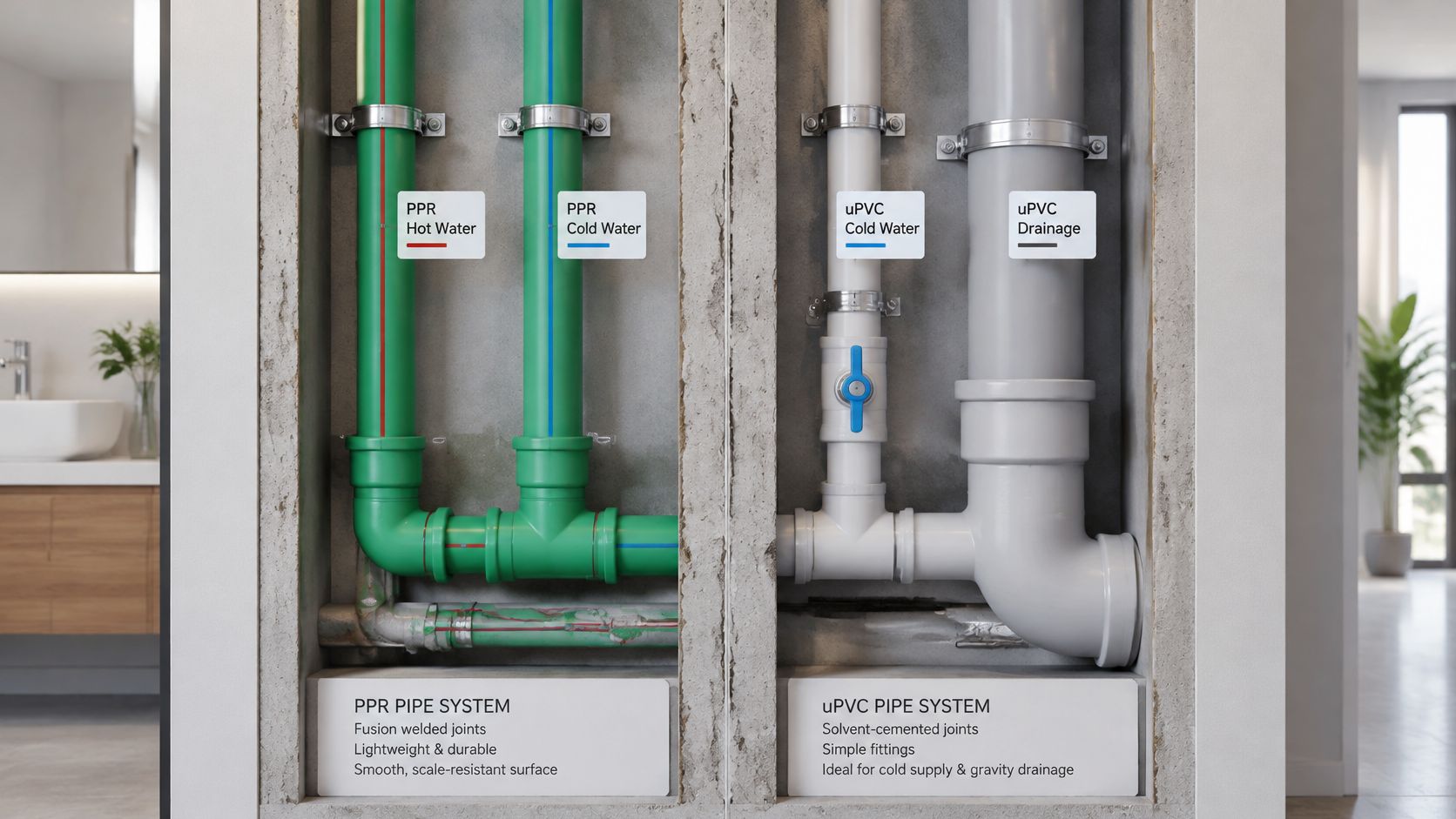
PPR is the workhorse for in-building hot and cold supply. It's fusion-welded with a heating tool, so the joint becomes a continuous piece of polymer rather than a glued overlap, and it resists scale in hard water. uPVC covers cold supply and gravity drainage, joined by solvent cement, and it's the material most often mistaken for a hot-water option because it looks identical to CPVC on a rack. CPVC takes hot water and carries its own cement and fitting range; mixing the two cements produces a joint that looks set and isn't.
HDPE and MDPE belong in the ground. Fused butt or socket joints, flexibility that tolerates settlement, and no corrosion in aggressive soil.
Dubai's sewerage guidance sets materials out by application rather than preference. For house sewer connections up to 200 mm outside diameter, the municipality recommends uPVC, MDPE or HDPE, with a minimum sewer diameter of DN 150 mm, a design gradient between 1% and 10%, and a self-cleansing velocity of 0.75 m/s on gravity lines, as published in the Dubai Municipality sewerage guidelines. The same document names ductile iron for pumping station pipework, stainless steel for small stations, and ductile iron, GRP or HDPE for pressure mains.
Think of a plastic pipe as a flexible hose next to a rigid steel bar. It follows ground movement instead of fighting it, and in exchange it gives up strength quickly as temperature climbs.
Practical rule: any plastic line exposed on a roof or in an unshaded riser needs UV protection and support spacing sized for the hot condition, not the ambient one on the drawing.
Metal Pipes and Iron Fittings for Pressure and Heat
Metal earns its price where heat, pressure or fire performance takes plastic off the table. Copper remains the default for hot and cold supply in hotels and hospitals, joined by brazing, soldering or press fittings. The press tool is faster and avoids open flame in an occupied building, but the O-ring becomes the weak point if the water is aggressive.
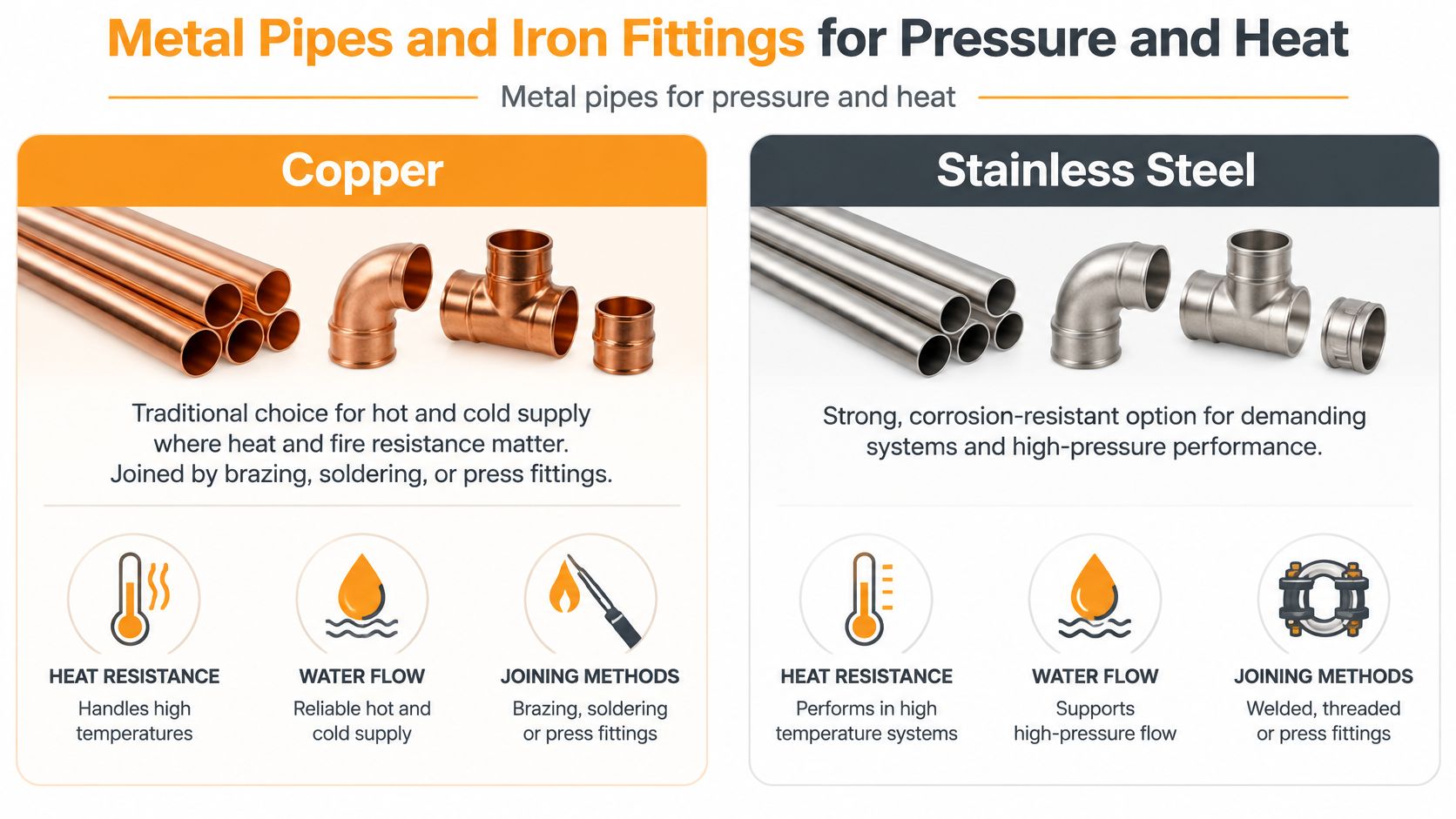
Stainless steel sits above copper on corrosion resistance and on cost. I'd specify it for specialist and pumping pipework where chlorinated or slightly brackish water will sit in the line for long periods. Galvanised steel is the material to recognise rather than specify: threaded, corroding from the inside, and with no place on new potable work.
Three iron families, three jobs
Cast iron takes compression well and tension badly. It suits gravity drainage and soil stacks, where the load runs downward, and it cracks if it takes a knock during handling, so the protection you give it on site is part of the specification.
Malleable iron is cast iron that has been annealed, which converts the flaky carbon structure into nodules and gives the metal enough ductility to be threaded. It's the standard fitting for threaded water and gas lines, and the joint depends on correct sealant and torque as much as on the fitting.
Ductile iron goes further and bends before it breaks. It's what you reach for where pressure and impact arrive together, and where a cast fitting would fail under a hammer blow.
Choice rule: ductile iron for pressure and impact, malleable iron for threaded service, cast iron only for gravity drainage.
Any ductile iron line needs a protective coating and thrust restraint at bends, or the pressure will find the joint.
Fitting Shapes and Joining Methods Explained
Every fitting answers one of five questions: does the line change direction, branch, change size, join, or stop? Grouping an order that way makes a fittings schedule readable at a glance.
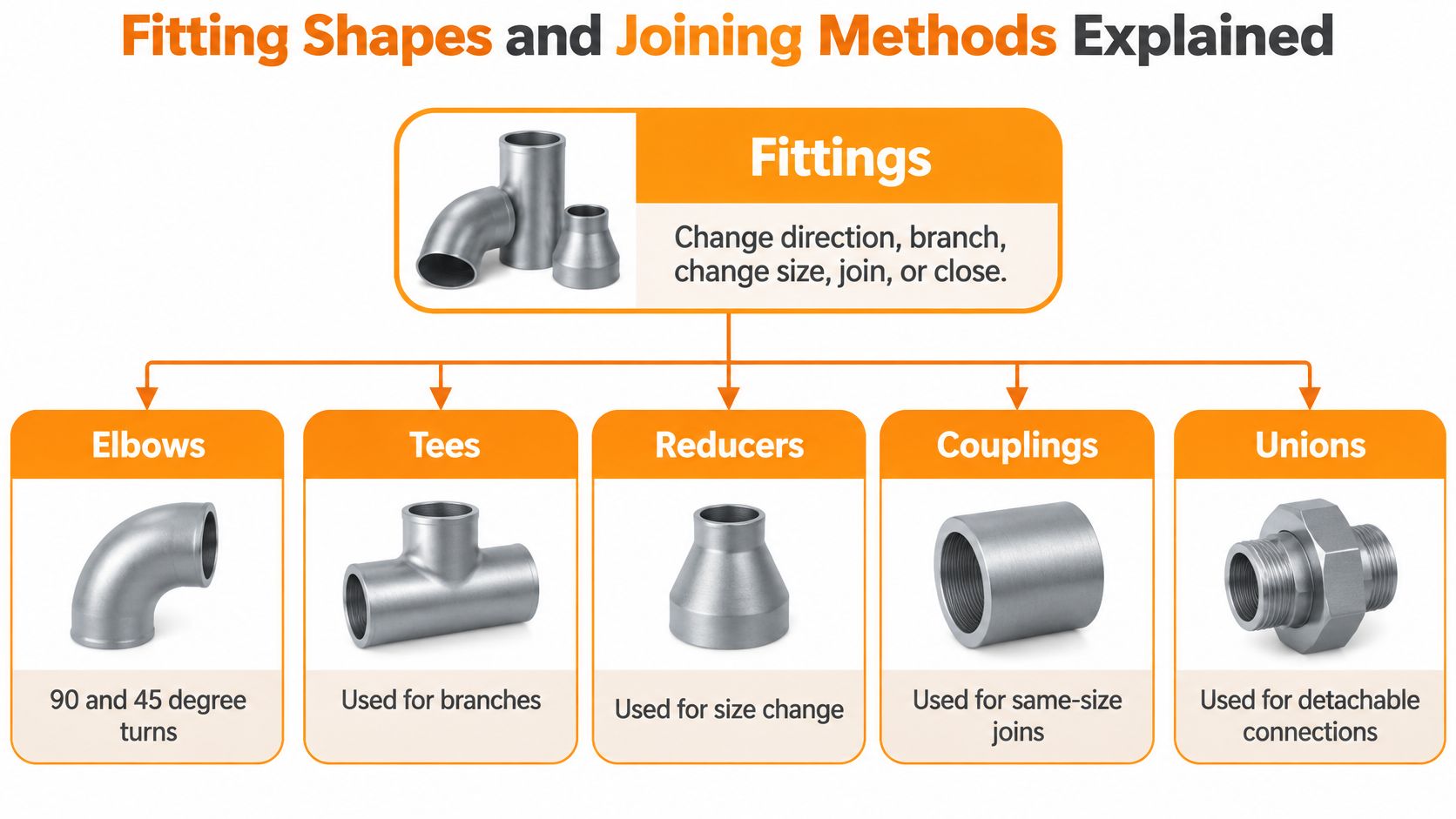
Elbows turn the line at 90 or 45 degrees, and the drainage version is the sweep, a long-radius bend that keeps solids moving instead of packing them into a tight corner. Tees branch, and a 20 to 32 mm tee combining two lines into one main at 90 degrees is the most common small-bore example on a fit-out. Reducers change diameter, couplings join two same-size pipes, unions let a section come apart without cutting, adaptors move between plastic and threaded metal, and end caps close a line for testing or later extension.
| Fitting | Job | Typical joint |
|---|---|---|
| Tee | Joins or branches a line at 90 degrees | Same joint as the pipe |
| Reducer | Changes pipe diameter | Same joint as the pipe |
| Coupling | Joins two same-size pipes | Solvent, fusion or press |
| Union | Allows disassembly | Threaded or flanged |
| Adaptor | Transitions plastic to threaded metal | Threaded transition |
| End cap | Closes a line | Solvent, fusion or threaded |
| Sweep bend | Drainage direction change with lower blockage risk | Solvent weld for uPVC |
Solvent welding softens and fuses uPVC and CPVC surfaces; the failure mode is a joint made in the heat without enough cement or without holding it long enough. Fusion welding does the same job thermally for PPR and PE. Threaded joints on malleable iron depend on sealant and torque, press and compression fittings suit copper, and flanged or grooved mechanical joints handle the large diameters and pump connections where nothing else assembles fast enough.
Dubai Municipality's certification requirements show why the pair has to be specified together. For uPVC systems to BS EN 1401-1, both pipes and fittings are pressure-tested under EN ISO 1167-1, while pipes also take impact testing to EN 744 and fittings take mechanical strength or flexibility assessment under EN 12256 and impact strength under EN 12061, per the Dubai Municipality certification requirements. A compliant pipe with a non-compliant bend still fails the assembly.
Threads are their own discipline, and tapered versus parallel threads seal by different mechanisms, so getting that wrong on a metal adaptor leaks whether or not the parts carry certificates.
Matching Pipe Types to UAE Applications
| Application | Recommended pipe | Key constraint |
|---|---|---|
| Potable cold water | PPR, or uPVC for cold water only | Pressure class and potable approval |
| Domestic hot water | PPR or CPVC | Derated temperature rating; insulation at fittings |
| Chilled water | PPR or copper, with continuous insulation | Insulation continuity and condensation control |
| House drainage and sewer connection | uPVC, MDPE or HDPE up to 200 mm outside diameter | Sewer minimum DN 150 mm and 1% to 10% gradient |
| Pumping stations and pressure mains | Ductile iron, GRP or HDPE | Stainless steel for small pumping stations |
| Irrigation | HDPE or MDPE | Pressure class; UV protection above ground |
| Fire protection | Steel or ductile iron with approved fittings | Fittings approved for the fire system |
Three rows carry most of the risk. Domestic hot water needs PPR or CPVC at a derated rating, and the insulation schedule has to list valves and bends as separate line items rather than covering only straight runs. Chilled water is the same problem in reverse: a gap in the covering lets moisture condense on the pipe and drip onto the ceiling below, so continuity matters more than thickness. The DEWA green building guidance treats plumbing as a complete system of pipes, pumps, valves, tanks, taps, controls and drainage, and requires insulation on hot, chilled and refrigerant water pipes to cut heat loss and condensation.
For domestic hot and cold water supply, PPR deserves a close look because it is designed for both duties. Yasu Trading Co. LLC sells PPR pipes under Plumbing / PPR Pipes & Fittings, with a 4 metre length and 40 mm diameter, and the PPR pipes are municipality compliant. On a job where hot water, pressure and approval paperwork sit in the same submittal, that combination is more useful than choosing by material name alone. The technical team can recommend the right PPR pipe variant for the customer's needs, which helps when the line serves mixed fixtures, short branches and hotter ambient plant rooms.
Pumping stations and pressure mains are where restraint and coating get skipped. A ductile iron main with bare bends and no thrust restraint will move under pressure long before it leaks. The same discipline applies to irrigation lines: MDPE and HDPE handle the pressure duty well, but exposed pipe needs UV protection, and buried lines need the pressure class checked against the pump duty and operating temperature. For fire protection, steel or ductile iron only works as part of an approved assembly. The pipe, fittings and system approval have to line up, because a compliant length with the wrong fitting still leaves the installation open at inspection.
A potable-rated pipe does not stop stagnation. Oversized mains and low-use outlets leave water sitting warm, and Abu Dhabi's 2025 Water Quality Regulations, in force since 1 January 2025, require water used for drinking, washing, cooking or food production to meet prescribed quality parameters. Short branches, correctly sized pipe and accessible valves do as much for that as the material does. Contractors planning maintenance access should also account for how plumbing crews will be reached when a leak is reported outside normal hours, which is why 24/7 answering for plumbing crews has become part of the service offer rather than an afterthought.
Compliance Checks Before You Order
A material can meet every requirement on the drawing and still stop at inspection because the folder behind it is thin. On UAE projects, approval is judged on the whole assembly: pipe, fitting, joint, insulation, support and evidence. A compliant pipe with the wrong fitting certificate is still a failed submittal.
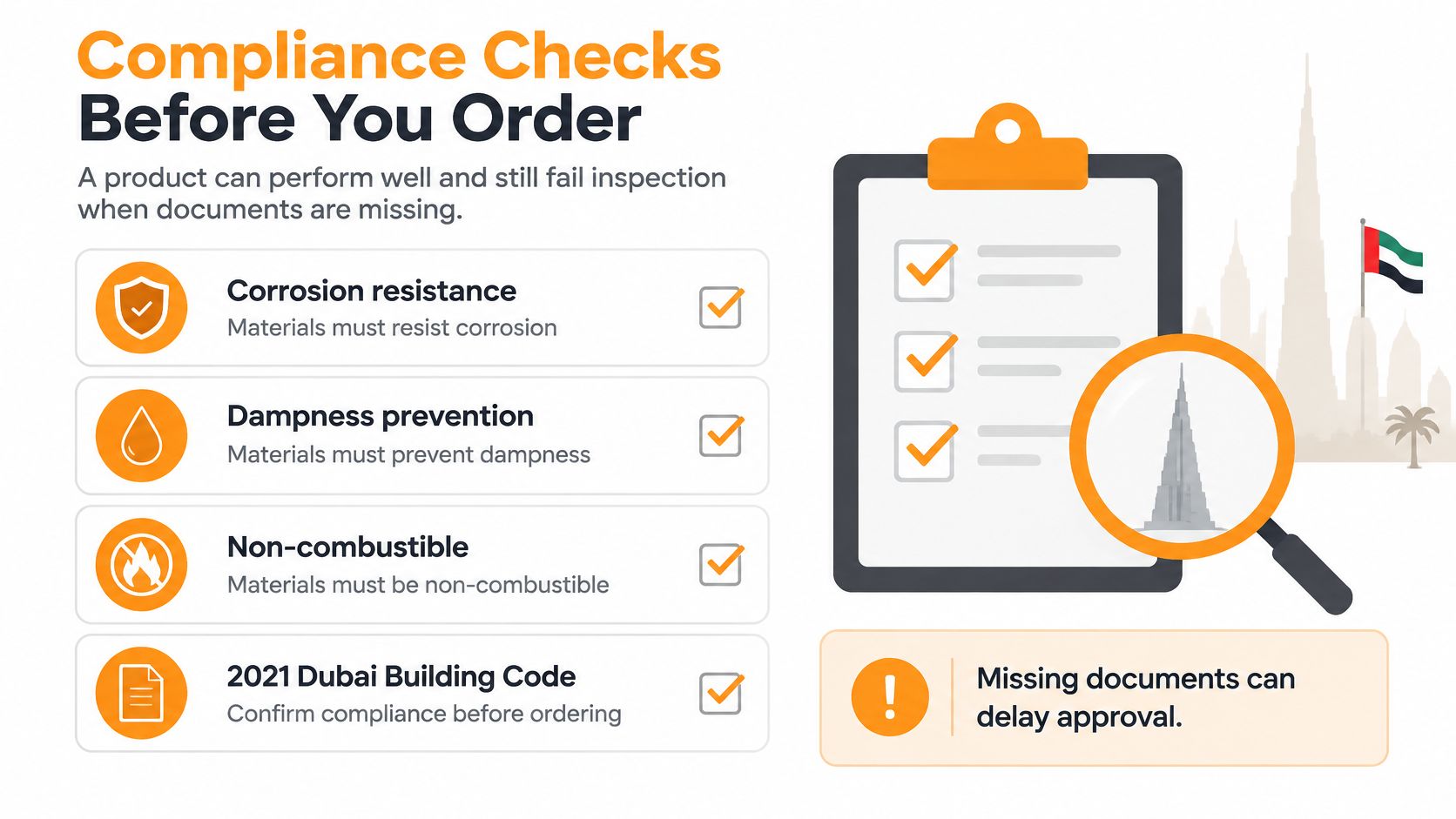
Dubai's 2021 Building Code sets performance requirements across pipes, joints and sanitary fittings. Materials must resist corrosion, prevent dampness, be non-combustible and have a smooth inner surface, and asbestos-containing materials are prohibited outright, as the Dubai Building Code 2021 edition states. Its sanitary provisions also require water tanks to have sun protection so stored water stays closer to room temperature. None of that gets checked at the delivery gate unless the paperwork is ready.
Seven checks, in order
- Write the service down first. Potable cold, domestic hot, chilled, drainage, pressure main or fire. Every later decision hangs off this one line.
- Confirm the material is listed for that service. Read the pressure class and the temperature rating after derating, not the headline number on the datasheet. If the submittal is being challenged on wall thickness, this explanation of high-pressure PVC pipe class and wall thickness sets out how the two relate.
- Match the joining method and fitting family to the pipe. Don't bridge plastic to threaded metal without an approved adaptor, and don't assume a same-size fitting made to another standard will do.
- Request certificates for the complete assembly. Bends, tees, reducers and couplings included, under one approved standard, with traceability.
- Check the insulation schedule covers fittings. The line item is usually missing, and it's the item that shows up on a commissioning walk.
- Confirm support spacing, expansion allowance and inspection access for strainers and valves. An isolation valve behind a closed ceiling is a future problem with a fixed price attached.
- Get municipality approval for any alternative material before the first order. Dubai's sewerage guidance requires justification and approval for alternatives, which turns compliance into a specification issue rather than a purchasing one. Our PPR pipes are municipality compliant, and our technical team can recommend the right PPR pipe variant for your service conditions.
Where the paperwork breaks
Most delays trace back to a submittal assembled from three suppliers' certificates under three different standards, with a fittings schedule that nobody cross-checked against the pipe standard. Buy the pipe, bends and tees as one package with one standard behind it and the review moves. If the specification doesn't match anything in the catalogue, that's a sourcing problem before it's a compliance problem. Ask for the certificate, the approval route and the delivery date in the same reply, because concealed pipework is expensive to disturb after ceilings and finishes are closed.
Ordering rule: if the certificate doesn't name the fitting you're installing, it isn't evidence. Confirm the assembly, the approval path and the delivery date before the order goes out, because replacing concealed pipework costs far more than the rework quote once ceilings, finishes and re-inspection are back in the programme.
Yasu Trading Co. LLC supplies PPR pipes and a plumbing range of PVC, copper and steel fittings from our Naif, Deira warehouse, with same-day or next-day delivery to sites in Dubai, Abu Dhabi, Sharjah and the Northern Emirates. Our technical team will match the PPR pipe variant to your service conditions before dispatch, and we can source custom materials and solutions for unique project requirements. Send your pipe and fittings schedule to Yasu Trading Co. LLC and we'll come back with the compliant assembly, the compliance evidence and the price in one reply.