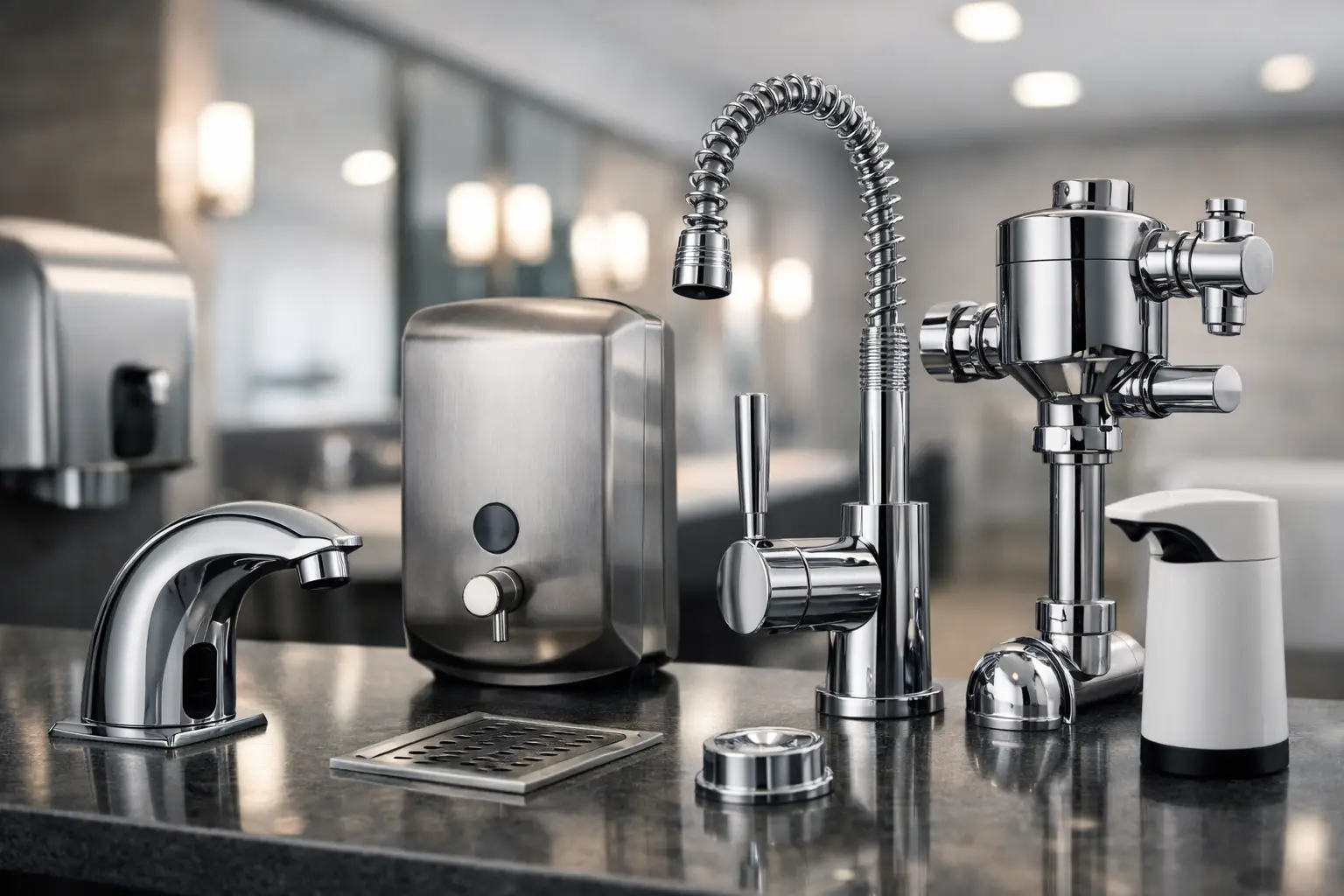
Review Commercial Sanitary Fittings Brands
A washroom fitting can look acceptable at handover and still become a maintenance problem within months. A dripping basin mixer, a flush valve with unavailable spare parts, or inconsistent sensor performance creates repeat callouts that quickly outweigh the purchase saving. When procurement teams review commercial sanitary fittings brands, the right question is not simply which brand costs less. It is which product line will perform reliably under the building’s traffic level, water conditions, maintenance plan, and approval requirements.
For contractors, MEP subcontractors, fit-out teams, and facility managers, brand selection should protect the handover date and reduce post-completion liability. That calls for a comparison based on operating conditions, technical support, parts continuity, and documented product suitability - not showroom appearance alone.
What Commercial Sanitary Fittings Must Deliver
Commercial sanitary fittings include basin mixers, sensor faucets, flush valves, cistern mechanisms, angle valves, shower mixers, bottle traps, health faucets, and related control components. They work alongside sanitary ware, drainage accessories, plumbing pipes and fittings, and water supply valves as one operating system.
A branded fitting is not automatically the right commercial fitting. A premium residential mixer may suit an executive washroom with low daily use, while a public facility needs a product designed for repeated cycles, quick servicing, and controlled water use. Schools, labor accommodations, mosques, restaurants, retail centers, offices, clinics, and high-rise common areas all impose different demands.
Procurement should therefore start with the duty profile. Consider expected users per day, cleaning methods, available water pressure, hot-water requirements, vandalism exposure, and the maintenance team’s ability to stock replacement cartridges, sensors, diaphragms, and seals. This early review prevents a common site issue: choosing fittings by finish and price, then discovering that the internal components are unsuitable for actual use.
Review Commercial Sanitary Fittings Brands by Category
A useful brand review compares manufacturers within the fitting category being specified. No single brand leads every category or budget level.
Grohe: Strong for Specified Commercial and Premium Fit-Outs
Grohe is commonly considered for commercial washrooms, hospitality projects, office developments, and higher-end fit-outs where finish quality, water-management features, and coordinated design matter. Its portfolio can be a good match when the consultant specification calls for a recognized international brand and the project requires a consistent appearance across multiple washrooms.
The trade-off is cost. Grohe products may not be the most economical choice for every high-volume utility area, especially where a simple, serviceable mechanical fitting will meet the requirement. Before approving an item, verify that the selected series has local spare-part availability and that the finish suits the cleaning chemicals used by the facility.
Geberit: A Practical Choice for Concealed and Flush Systems
Geberit is a strong consideration where concealed cisterns, wall-hung WC systems, flush plates, and service access are central to the design. Its commercial value is often in the system approach: frames, cisterns, flush mechanisms, and actuation components are engineered to work together.
This can reduce coordination risk during installation, but concealed systems demand disciplined execution. The frame setting, pipe connections, tile finish, access opening, and testing must be completed correctly before closure. A lower-cost concealed system can become expensive if repair requires breaking finished walls. For projects using Geberit-type systems, procure original service parts with the initial supply where possible, particularly for facilities that cannot tolerate washroom downtime.
RAK Ceramics: Useful for Coordinated Sanitary Ware Packages
RAK Ceramics is often relevant when a project requires coordinated sanitary ware and compatible fittings across apartments, hotels, offices, and mixed-use developments. Its broad market presence makes it a practical brand to assess for projects needing visual consistency and scalable supply quantities.
The key is to review the exact range rather than relying on the brand name alone. A residential-focused mixer, for example, should not be assumed suitable for a heavily used public restroom. Match the cartridge type, operating pressure, installation method, and warranty terms to the intended environment. For bulk procurement, ask for a clear schedule separating sanitary ware from fittings, traps, valves, and installation accessories so scope gaps do not appear at site level.
Ideal Standard: Suitable for Balanced Commercial Specifications
Ideal Standard is frequently specified in commercial and institutional washrooms because its product range can balance recognizable design, practical performance, and a variety of price points. It can fit office, education, healthcare support, and hospitality applications where the project needs a dependable branded option without moving every area into a luxury specification.
Its suitability still depends on the selected product family. For public washrooms, prioritize fittings with accessible service components and suitable flow control. For staff washrooms or private suites, conventional mixers may be more economical and easier to maintain than sensor-operated units. The right specification can vary within the same building.
Kohler: Best Evaluated for Design-Led Applications
Kohler can be a good fit for premium hospitality, executive areas, villas, and design-led commercial spaces where the fixture itself contributes to the interior standard. The brand offers strong visual options and coordinated collections, which can help architects maintain a consistent washroom concept.
For high-traffic applications, look beyond the finish. Confirm cartridge durability, sensor servicing requirements where applicable, water consumption, and replacement lead times. A project may use Kohler in guest-facing areas while standardizing a simpler commercial fitting range in back-of-house or high-abuse locations. That is not a downgrade. It is specification control.
Compare the Details That Affect Site Performance
Brand reputation is only the first filter. The technical submittal should answer the questions that affect installation, inspection, and maintenance.
First, confirm water pressure compatibility. Low pressure can affect certain mixers and sensor faucets, while excessive pressure can shorten the life of internal components if pressure regulation is missing. Verify connection sizes, center distances, mounting requirements, and whether isolation valves, filters, or pressure-reducing valves are needed.
Second, assess water efficiency without sacrificing usability. Flow restrictors and timed or sensor controls can reduce consumption in public washrooms, but poorly selected settings cause user complaints or repeated sensor adjustments. The goal is controlled water delivery that works consistently, not the lowest possible flow rate on paper.
Third, check the service pathway. Commercial facilities need cartridges, aerators, solenoids, diaphragms, flush seals, batteries, and electronic parts after handover. A lower initial price is rarely a saving if the maintenance team must replace the complete fitting for a minor internal failure.
Finally, verify documentation and approval alignment. UAE projects may require products that meet consultant, client, utility, or municipality requirements. Keep approved data sheets, warranty information, and item codes aligned with the bill of quantities. Substituting a visually similar fitting late in procurement can delay approvals and create inconsistency in the maintenance schedule.
Sensor Faucets vs. Manual Mixers
Sensor faucets are often specified for hygiene, water control, and reduced touchpoints. They can perform well in airports, malls, restaurants, clinics, and public washrooms with steady footfall. However, they require correct power planning, sensor calibration, and a maintenance team familiar with their components.
Manual mixers remain the practical choice for many staff facilities, residential common areas, and lower-traffic washrooms. They are generally simpler to service and do not depend on batteries or electrical connections. In some projects, a mixed approach delivers the best value: sensor fittings for public-facing washrooms and quality manual mixers for restricted-access areas.
Do not treat sensor technology as an automatic upgrade. It should be selected where the operating benefit justifies the additional system requirements.
Build a Procurement Package, Not a Product List
A commercial fitting package should arrive at site ready for installation. That means matching fittings with the correct angle valves, flexible connectors where approved, traps, waste fittings, sealants, mounting hardware, and compatible plumbing accessories. Missing low-value items can stop a washroom installation just as effectively as a missing mixer.
For multi-floor projects, standardize approved item codes by washroom type. Keep a schedule for public toilets, accessible toilets, staff washrooms, executive areas, and pantry or janitor sinks. This simplifies ordering, reduces incorrect substitutions, and gives the facility team a clear spare-parts list at handover.
Yasu Trading Co. LLC supports contractors with consolidated procurement across sanitary ware, plumbing materials, valves, tools, sealants, and site essentials, helping teams avoid fragmented purchasing when deadlines are tight. For project quantities, request a quote based on the approved specification, required delivery sequence, and required warranty documentation.
The best sanitary fittings brand is the one that fits the project’s real operating conditions and remains serviceable after the contractor leaves site. Specify for the user, procure with installation accessories included, and protect the project with dependable availability of approved components.