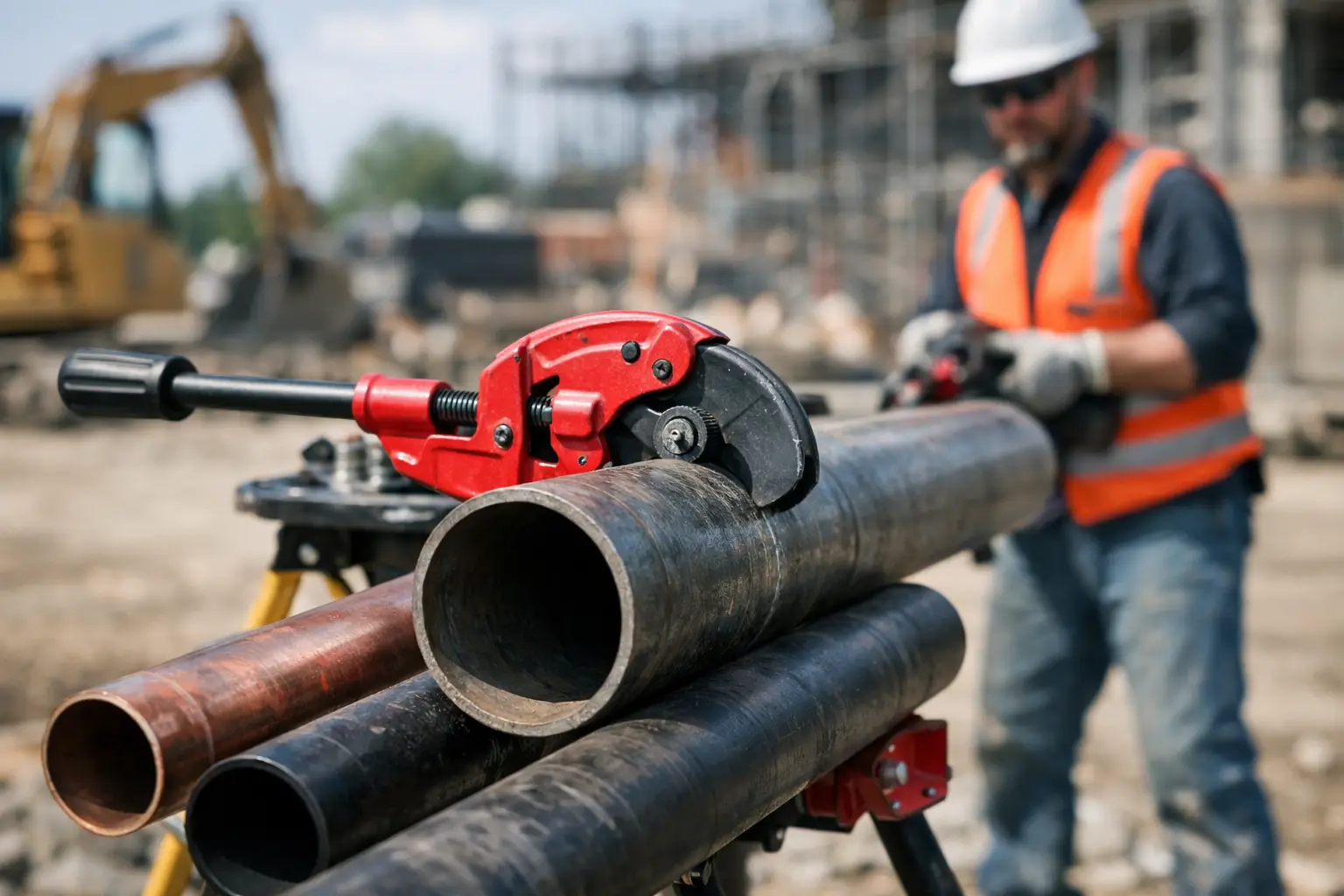
Review Heavy Duty Pipe Cutters for Site Work
A pipe cutter that works well on a small repair can lose time quickly on a multi-floor plumbing package. For contractors, a proper review heavy duty pipe cutters process is not about finding the lowest unit price. It is about confirming that the tool can make clean, repeatable cuts across the pipe sizes and materials specified for the project, without slowing the crew or compromising joint quality.
Heavy-duty pipe cutters are a practical part of plumbing tools, MEP tool kits, and facilities maintenance stock. The right model reduces deburring work, protects fittings from poor pipe preparation, and keeps installation crews moving when urgent modifications are required on site. The wrong model can leave crushed pipe ends, premature blade wear, and a tool room full of equipment that cannot support the actual job.
What Heavy-Duty Means on a Construction Site
The term heavy-duty is used broadly, so procurement teams should look beyond the label. A heavy-duty cutter should have a rigid frame, a stable feed mechanism, a cutting wheel designed for the intended pipe material, and a capacity suited to the project’s normal pipe range. It must also tolerate repeated use by different technicians, not just occasional workshop cutting.
For plumbing and MEP work, cutting pressure needs to remain controlled throughout the rotation. A weak frame can flex under load, causing an uneven cut. A poorly designed feed screw can bind, especially when dirt, moisture, or metal filings are present. These issues may seem minor until a crew is preparing dozens of pipe sections for fittings, valves, couplings, or threading operations.
A professional cutter should also be serviceable. Replaceable cutting wheels, rollers, handles, and reamers extend useful life and protect the initial purchase. For a contractor managing several active sites, a tool that accepts readily available spare parts is usually the better operational choice than a cheaper disposable option.
Review Heavy Duty Pipe Cutters by Pipe Material
The first question is not which cutter is strongest. It is what pipe the team needs to cut. Using a single cutter across incompatible materials can damage both the cutting wheel and the pipe.
Steel, Galvanized Steel, and Iron Pipe
For steel and galvanized pipe, select a cutter with a reinforced body, hardened cutting wheel, and broad roller support. These cutters apply progressive pressure as the operator rotates the tool around the pipe. The result should be a square cut with minimal distortion.
The trade-off is speed. On larger wall thicknesses, a manual wheel cutter takes more time than a powered cutting method. However, it avoids sparks and can be a better choice in occupied buildings, maintenance rooms, or controlled work areas where hot-work restrictions apply. A clean cut also improves the next operation, whether the pipe is threaded, grooved, or fitted with a mechanical coupling.
Inspect the wheel regularly. A dull wheel increases force requirements and can score the pipe rather than cut it cleanly. For galvanized pipe, excessive surface damage can also affect corrosion protection at the cut end, so finishing and coating procedures should follow the project specification.
Copper, Aluminum, and Thin-Wall Tubing
Copper and thin-wall tubing need a different approach. The priority is avoiding ovality and deformation. A compact tubing cutter with smooth rollers and a precise feed screw is generally more suitable than an aggressive large-pipe cutter.
For HVAC, refrigeration, and plumbing connections, the cut must be square enough to support proper flaring, brazing, or fitting engagement. Technicians should tighten gradually, rotate several times, then add pressure in small increments. Over-tightening is one of the most common causes of crushed copper tube ends.
A built-in reamer is helpful for field work, but it should not replace a proper inspection. Burrs left inside the pipe can restrict flow, interfere with joint preparation, and circulate through sensitive systems.
PVC, CPVC, PPR, and Other Plastic Pipe
Plastic pipe cutters use a different cutting action. Ratchet-style cutters and purpose-designed shears are common for PVC, CPVC, PPR, PE, and similar systems. Their blades should be sharp, correctly aligned, and matched to the material and diameter.
A heavy-duty ratchet cutter can be efficient for repetitive installation work, particularly on smaller and medium pipe sizes. But capacity ratings matter. Near the maximum stated diameter, a cutter may require more force and can leave an angled or cracked edge if the blade is worn. For larger plastic pipe, a specialized cutter or saw system may provide better control.
Do not assume one plastic cutter is suitable for every polymer. Some materials are more prone to cracking in cold conditions, while others require specific preparation before heat fusion or solvent welding. Confirm the pipe manufacturer’s installation requirements before selecting the cutting method.
Capacity Is More Than Maximum Diameter
Catalog capacity is useful, but it should not be the only buying criterion. A cutter rated for a large diameter may technically close around the pipe while still being awkward to operate in a ceiling void, riser shaft, pump room, or service corridor.
Review the working clearance around the tool. Wheel cutters require room for full rotation. Ratchet cutters need handle travel. Long-handle models offer leverage but can be impractical in tight locations. For fit-out and maintenance teams, carrying a combination of compact cutters and larger heavy-duty models is often more efficient than expecting one tool to cover every condition.
Also consider the pipe schedule and wall thickness. A cutter that handles standard light-wall tube may struggle on heavier steel pipe. Procurement should compare the cutter’s actual material specification, not only its nominal size range. This is particularly important when projects include fire protection lines, industrial piping, or service upgrades where wall thickness varies.
Build Quality That Protects Productivity
On site, the cutter is handled by multiple users, transported in toolboxes, and exposed to dust and moisture. Frame material, handle grip, screw quality, and roller alignment all affect reliability.
Look for a rigid forged or heavy-cast body where the application demands high force. Check that the feed screw turns smoothly without excessive play and that the cutting wheel is securely retained. Rollers should support the pipe consistently rather than allowing it to wander during rotation. A cutter with an enclosed or protected mechanism is easier to keep functional in dusty working conditions.
Ergonomics also matter. A comfortable handle and positive adjustment mechanism reduce fatigue during repetitive cutting. This is not simply a user preference. Fatigue encourages operators to apply excessive force or rush the cut, which raises the likelihood of damaged pipe ends and rework.
For tool room control, standardizing on compatible models can simplify spare wheel inventory and technician familiarity. It also makes it easier to set a practical inspection routine: check wheel sharpness, roller movement, screw lubrication, handle condition, and frame alignment before tools are issued to site.
Choose the Cutter Around the Installation Method
A clean cut is only the first step. The selected cutter must support the connection method that follows. Threaded steel pipe needs a square, properly prepared end before threading. Grooved pipe requires accurate cut geometry for dependable coupling performance. Copper joints need deburring and clean surfaces before brazing or press fitting. Plastic piping may need chamfering, cleaning, and controlled insertion depth before joining.
This is why purchasing pipe cutters separately from pipes, fittings, adhesives, sealants, and installation accessories can create avoidable coordination gaps. A consolidated supplier can help align the cutter type with the pipe system, fitting method, and jobsite stock requirement. That is especially useful when a project needs both bulk material supply and urgent replacement tools without delaying installation teams.
A Practical Procurement Check Before Ordering
Before placing a project order, confirm the primary pipe materials, usual diameter range, maximum wall thickness, access conditions, expected frequency of use, and spare-part availability. Then assess whether the crew needs manual cutters only or whether a powered solution is justified for volume work.
For low-volume maintenance, a quality manual cutter may provide the best balance of control, cost, and portability. For repetitive production work, higher-capacity cutters and ready spare wheels can reduce downtime. For mixed MEP packages, it is usually sensible to specify separate tools for steel, copper tubing, and plastic pipe rather than forcing one tool into every application.
Yasu Trading Co. LLC supports contractor procurement with jobsite-ready hand tools, power tools, plumbing materials, fittings, and related construction hardware, helping buyers coordinate supply against actual installation requirements. When timing is tight, the better purchase is the cutter that arrives ready for the specified work, with the correct capacity and consumables available from the start.
The final decision should be made at the point where tool capability meets site reality: the pipe material, the connection method, the clearance available, and the number of cuts the crew must complete before handover. That is where a heavy-duty pipe cutter earns its place in the project tool plan.