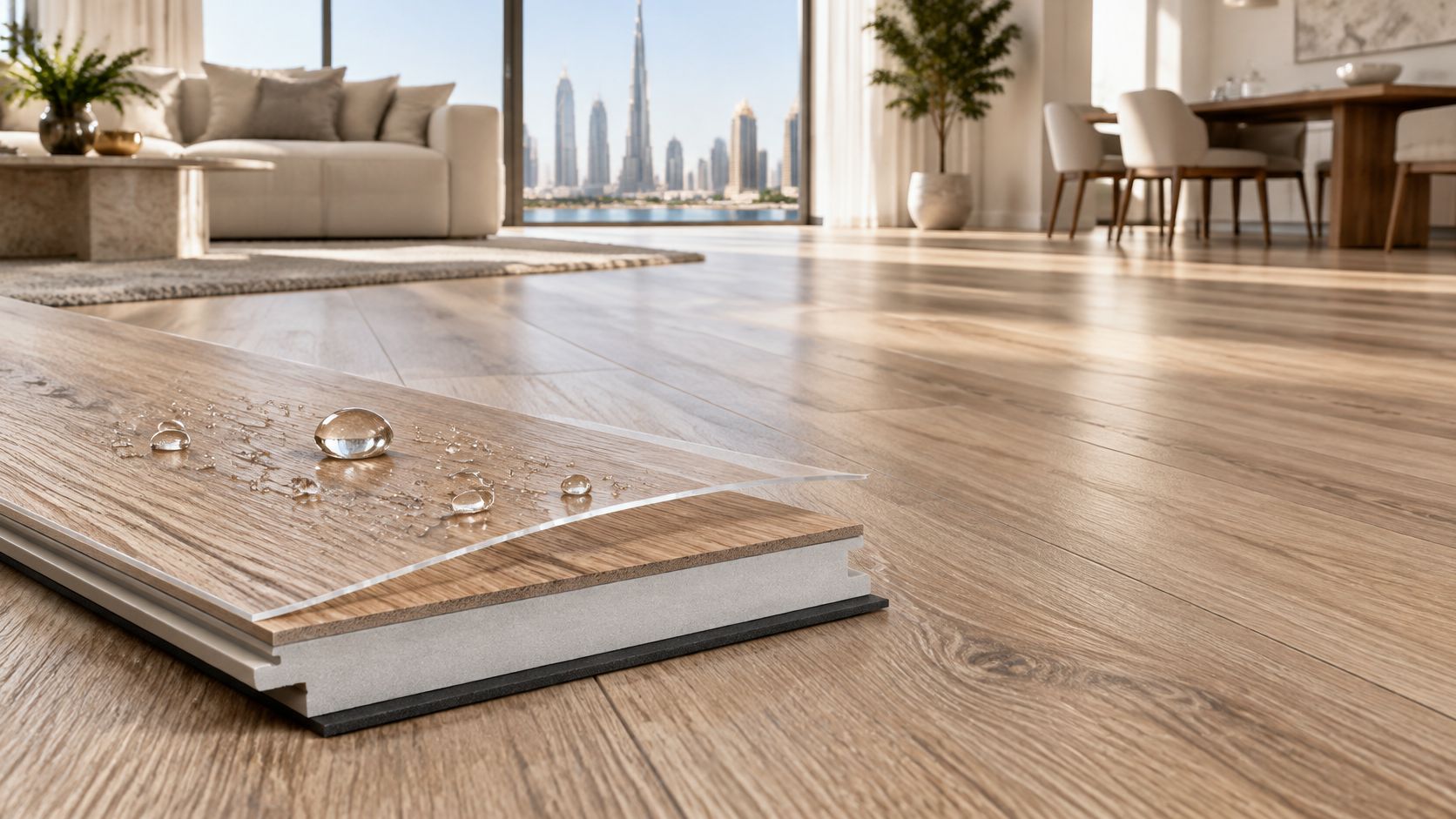
SPC Flooring Meaning: What It Is and Why It Matters
SPC stands for stone-plastic composite, a rigid resilient floor whose core is mineral filler, usually limestone, bound with PVC and stabilisers. That construction is being specified inside a UAE floor-covering market valued at USD 2.42 billion in 2025. Mordor Intelligence estimates that 2025 market at USD 2.42 billion, with Dubai representing 36.37% of revenue.
If the label already says waterproof, why do locked planks still fail over a screed that only looks dry?
The name describes how the board is made. It doesn't describe the slab under it, the open joints at the edges, or the batch of wear layer on the pallet. A rigid core can hide a high spot until the locks crack. A waterproof face says nothing about moisture trapped below. On a UAE fit-out, approval rests on test reports for that batch, not on the acronym printed on the box.
What SPC Stands For and Why the Name Matters
Say a consultant marks a hotel guest-room drawing "SPC, waterproof, wood look" and sends it for pricing. Three suppliers quote. All three use the same letters. Only one is a mineral-filled rigid core. The other two are flexible vinyl with a water-resistant face. The acronym didn't sort them. The build-up will.
SPC means stone-plastic composite, also written stone polymer composite. Take the name apart. Stone is the mineral filler, usually limestone or calcium carbonate, and that powder is what gives the board its weight and stiffness. Plastic is the PVC resin that binds the powder and resists water. Composite means those two materials act as one board, not as a coating stuck on something else. Think of a plank the way you think of concrete. Cement holds the gravel, and together they carry the load. Here the stone carries the load and the plastic holds the mass together.
SPC names a construction, not a brand and not a finish. Not every waterproof vinyl floor is SPC. What separates it from WPC (wood-plastic composite) is the core. WPC puts wood-based material in that core. SPC replaces the wood with mineral content, so the board is denser and holds its shape more steadily. Air-conditioned rooms, fast fit-outs, and wet zones in kitchens, bathrooms, and hospitality spaces make that stability attractive across the UAE. You still have to prove the construction.
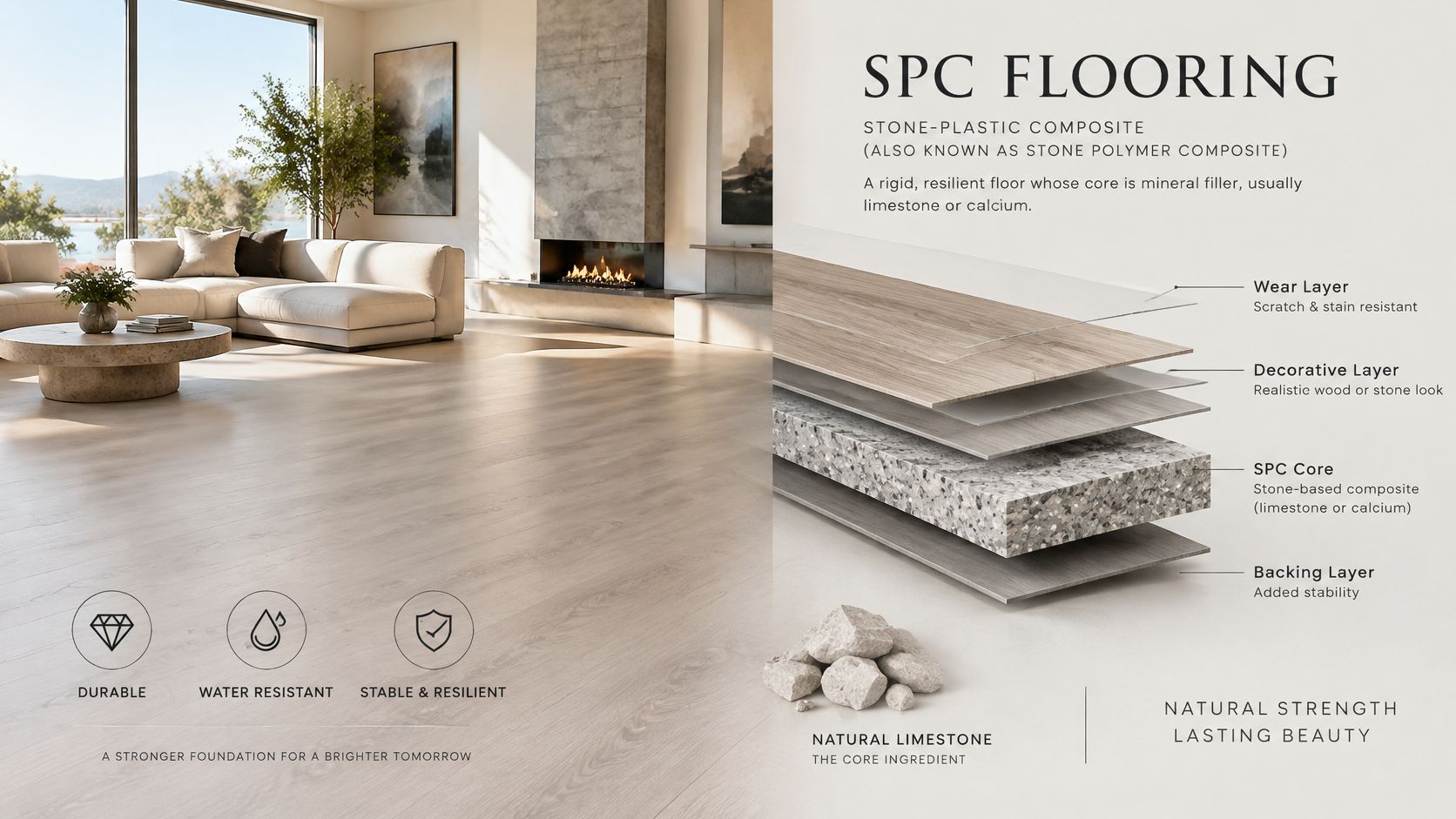
Practical rule: When a supplier says SPC, ask for the core recipe and the layer build-up, not only the acronym.
Deep Market Insights estimated the UAE SPC flooring market at USD 217.20 million in 2025, including USD 127.45 million for SPC and USD 89.75 million for other rigid-core flooring. The next section is the check you run on that build-up.
How an SPC Plank Is Built, Layer by Layer
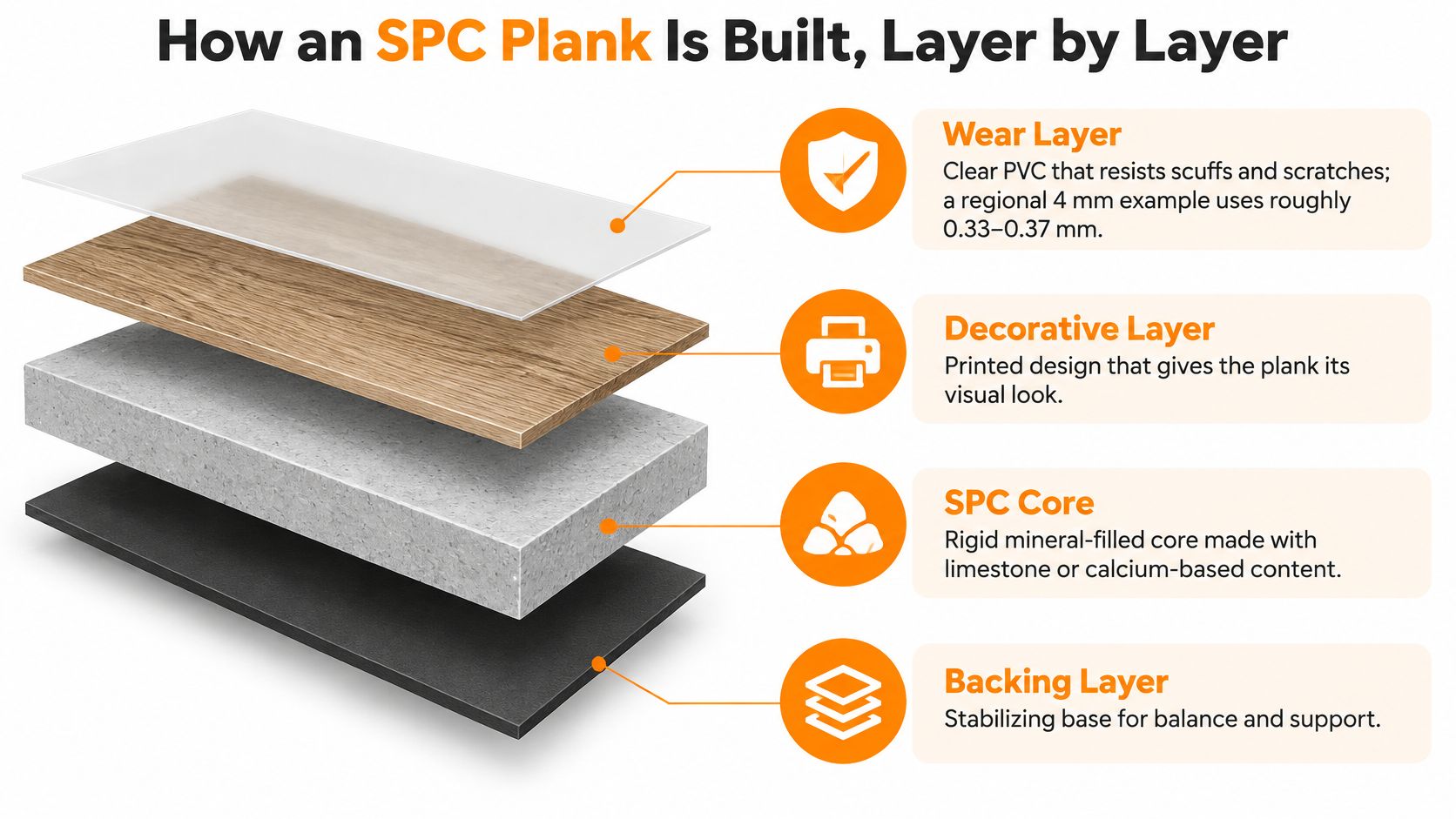
A finished plank is a stack, and each layer has one job. Read it from the room downward.
The top is a wear layer of clear PVC. It takes scuffs, grit, and chair legs so the print underneath stays intact. In a regional 4 mm example, that clear film is about 0.33–0.37 mm. Thicker isn't automatically better for every room, but a thinner film wears through sooner under rolling loads.
Under it sits the decorative film, a printed sheet that carries the wood grain or stone image. The print is only a picture. It doesn't add strength, and two planks with the same oak image can have completely different cores.
The SPC core is the working part of the SPC flooring meaning. Limestone powder, PVC, and stabilisers are pressed into a rigid board. Eco Flors lists core densities around 1.95–2.05 g/cm³ and dimensional change of no more than 0.10% under EN ISO 23999. That low movement is why click joints stay tight when a cool, air-conditioned room meets a hotter slab. Flexible luxury vinyl gives under a point load. This core resists indentation and keeps its shape, so the locks don't work loose as easily. It still isn't magic. An uneven slab pushes the rigid board up at high spots and loads the joints until they fail.
Some planks add an attached underlay, foam or a composite pad. It cuts footfall noise and, on some products, includes a vapour barrier. If the pad isn't attached, you specify it separately. Layer count and thickness change by manufacturer. The datasheet governs, not a showroom sample.
| Layer | Material | Job | Typical value |
|---|---|---|---|
| Wear layer | Clear PVC | Resists scuffs and scratches | 0.33–0.37 mm in a regional 4 mm example |
| Decorative film | Printed film | Carries the wood or stone pattern | High-definition print, thickness stated on the datasheet |
| Rigid core | Limestone powder, PVC and stabilisers | Load, stability and joint strength | 1.95–2.05 g/cm³ density; dimensional change up to 0.10% (EN ISO 23999) |
| Underlay (optional) | Foam or composite, may include vapour barrier | Sound reduction and moisture control | Attached or loose pad; vapour barrier only if the product states it |
Before you compare two prices, ask for the thickness of each layer and the core density. If those numbers aren't on the sheet, you aren't comparing the same product.
How SPC Compares with LVT, WPC and Tile
| Floor type | Core | Water performance | Underfoot feel | Best fit |
|---|---|---|---|---|
| SPC | Mineral-filled PVC rigid core | Waterproof board; joints and edges must be sealed | Firm, low flex | High traffic, hospitality and wet areas on a sound subfloor |
| LVT | Flexible PVC core | Waterproof surface; can curl if moisture gets underneath | Softer, more give | Bedrooms, offices and quieter fit-outs |
| WPC | Wood-plastic composite, often foamed | Water resistant at surface; edges can swell if water sits | Medium firm, warmer | Dry residential rooms |
| Ceramic or porcelain tile | Fired clay body | Impervious when glazed; grout absorbs unless sealed | Hard and cool | Wet areas and entrances where a hard, cool surface is wanted |
Read the core column first. The other columns follow from it.
SPC and LVT both sit in the vinyl family, and a wider look at vinyl flooring in Dubai shows how often the two get bundled in one specification. LVT's core is flexible PVC. It feels softer and quiets footsteps, and a heavy cabinet leg can leave a dent. SPC is firmer because the mineral core doesn't compress the same way. You trade a little give for joints that stay locked under rolling luggage.
WPC uses a wood-plastic core, often foamed, so the plank feels warmer and a bit softer than SPC. The face resists water. If water sits at a cut edge, the wood content can swell. That makes it a poor pick for a shower threshold or a kitchen that gets mopped hard every night.
Ceramic or porcelain tile is harder still. A glazed body doesn't absorb water. The grout does, unless you seal it and keep sealing it. Tile is cold under bare feet, heavy to carry up a tower, and slow to replace when one piece cracks.
A hotel corridor with trolleys and wheeled cases points to a rigid core on a flat slab. A bedroom above a neighbour who complains about footsteps can favour LVT on a quieter underlay, because the flexible board and the pad do more for sound than a dense mineral core. Choose by traffic, moisture, and how flat the subfloor is. The acronym doesn't make that choice for you.
How SPC Performs Under UAE Heat, Traffic and Water
| Space | Class | Wear layer guidance | Checks to confirm |
|---|---|---|---|
| Private bedroom | 23 residential | Standard layer, for example 0.33 mm | Batch slip and fire certificates |
| Hotel corridor or retail | 32 commercial | Thicker than residential example; confirm value | R10 slip and Bfl-s1 fire reaction for the batch |
| Bathroom or wet area | 23 if private, 32 if public | Confirm with manufacturer | Joint sealing and substrate moisture test |
| Community facility | 32 commercial | Heavy-use layer; confirm value | Impact and acoustic data |
Class follows the feet, not the pattern
A private bedroom and a hotel corridor can share a limestone-PVC core and still need different tops. Class 23 is the residential grade for light household traffic. Class 32 is the commercial grade for corridors, retail, and community rooms where people, trolleys, and cleaning machines pass all day. Creative Vision Global cites a regional 4 mm specification with about a 0.33–0.37 mm wear layer, class 23 and class 32, R10 slip resistance, and Bfl-s1 fire reaction. Those figures belong to that example. They aren't a promise for every carton labelled SPC. Match them to the batch and to the authority reviewing the project.
The wear layer is what abrasion consumes. A lobby needs a thicker, commercially rated film than a bedroom even when the core recipe is identical. Ask for the millimetre value in writing. "Commercial grade" on a brochure isn't a thickness.
Water, heat, slip, and fire
The PVC in the core shrugs off spills, so kitchens, bathrooms, and back-of-house pantries are fair uses. Water that reaches a joint, a perimeter gap, or the adhesive under a glued installation is a different problem. It can sit there, smell, and work along the edge. The board being waterproof doesn't seal the floor.
The mineral core moves very little, so a floor that spends its life in air-conditioning, then meets a hotter daytime slab near glazing, is less likely to peak or gap, provided the installer leaves the expansion gap the datasheet requires. Close that gap with a skirting pinned tight to the plank and the board has nowhere to go.
R10 and Bfl-s1 show up often in UAE hospitality submittals. Treat them as batch documents. A slip test on last year's range doesn't cover this production run, and a fire class from a sister product doesn't transfer.
A waterproof face with an open joint over a damp slab is not a waterproof floor.
Before you accept a durability claim, ask three things. Which class is printed for this batch? What wear-layer thickness is on the datasheet? Which slip and fire certificates name this product code?
Installing SPC on UAE Slabs Without Trapping Moisture
Picture a ground-floor apartment in Dubai. The screed looks pale and hard, and it was poured only weeks ago. Click the planks down and the room looks finished by lunch. That finished look is the trap. The rigid core bridges small defects instead of showing them, so a damp or uneven slab stays hidden until the joints open.
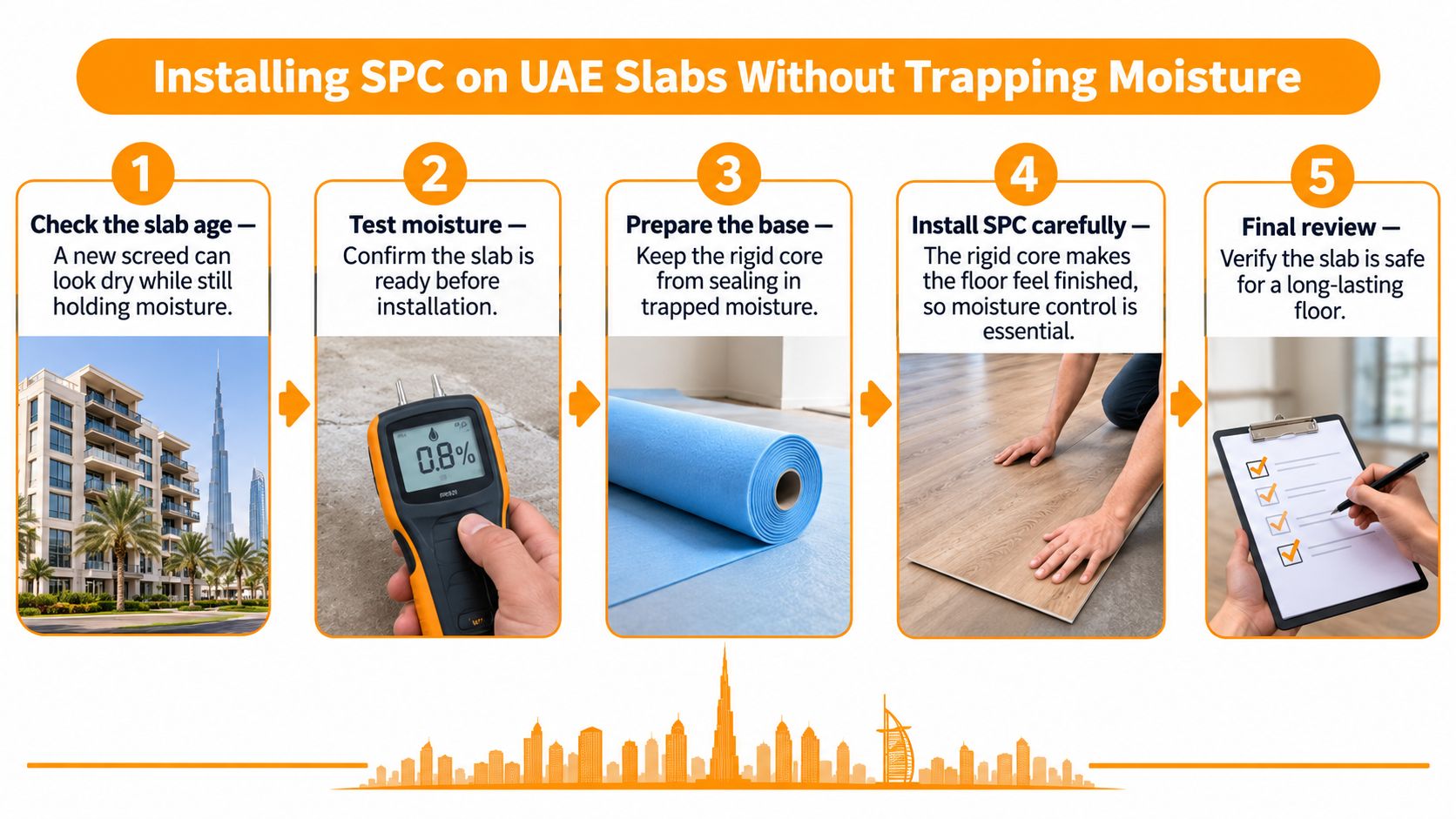
Dubai's Building Code treats movement joints as a common path for water and expects the design to limit ingress. Concrete can also hold construction moisture or rising damp long after the surface looks ready. A waterproof board is not the same thing as a moisture-safe assembly.
- Test the slab and write the number down. Use the moisture method the manufacturer names, and record relative humidity before any plank arrives. Guidance reviewed for Dubai installs cites about 75–80% relative humidity when a vapour-barrier underlay is used. The manufacturer's limit and the project spec still control. A screed over that limit is not ready, however good the click system is.
- Level, then grind the high spots. Rigid planks telegraph bumps and dump load onto the locks. A self-levelling coat is often the practical fix. Our note on self-levelling screed walks through how a thin cementitious layer knocks down those ridges before the floor goes down. Clicking planks together doesn't replace that work.
- Confirm the underlay. If the specification calls for a vapour barrier, the pad has to include one, or you add a separate membrane. A comfort foam with no barrier doesn't count.
- Set movement and perimeter joints before the first row. Leave the expansion gap, and put transition profiles at doors, columns, and wet-area thresholds. A joint that is buried under skirting can't move, and it also becomes a path for water.
- Acclimatise the boxes in the room. Keep them inside the temperature range on the sheet so the locks aren't forced while the plastic is still cold from a container or a hot truck.
- Start along the longest straight wall and check every lock. A half-engaged click feels closed and isn't. Tap it home, then look along the joint for a step.
A short install walk-through makes the lock and the gap easier to picture before you brief a crew.
After the floor is down
Sweep grit before it sands the wear layer. Skip harsh solvents and wax, which can haze the clear PVC. Where the manufacturer calls for joint sealant at wet thresholds, leave it in place during later cleaning. The installer signs the moisture readings and the gap photos. The contractor signs that those readings met the datasheet before the bulk order was laid. Nobody should sign a damp screed off because the planks clicked.
Compliance Papers to Request Before Approval
"Stone-plastic composite" describes what is in the board. It doesn't prove low emissions, recycled content, or a credit in a green-building submission. Dubai's Building Code expects materials to be chosen with sustainability provisions in mind, and UAE projects increasingly tie that paperwork to Al Sa'fat, Estidama, and net-zero targets. The scheme sets the evidence. The acronym doesn't.
| Document | What to check | Why it matters |
|---|---|---|
| Technical datasheet | Layer thicknesses, core density and dimensional change | Confirms the build-up matches the specification |
| Slip and fire certificates | R10 slip and Bfl-s1 fire reaction for the batch | Commonly required by consultants and authorities |
| VOC or formaldehyde test | Emissions result for the product and adhesive | Supports indoor air-quality credits |
| EPD or HPD | Environmental and health declaration | Needed for many green-building submittals |
| Recycled-content declaration | Share of recycled material | Supports sustainability claims |
| Installation and moisture method | Test method and limit for the substrate | Protects the adhesive system and the warranty |
| Warranty terms | Exclusions for moisture, joints and installation | Shows what the manufacturer will cover |
What an approver actually reads
A consultant or municipality reviewer wants the report that names this product code and this batch, not a general catalogue. The datasheet proves the stack. Slip and fire certificates are the two pages most hospitality and community submissions get sent back for. A VOC or formaldehyde result has to cover the plank and, where you glue it, the adhesive. An EPD (environmental product declaration) or HPD (health product declaration) is what many Estidama and Al Sa'fat packs ask for when someone claims a healthier interior. A recycled-content line needs a declaration with a percentage, not a sentence that says the core is "mineral-based."
Warranty length is the claim people remember and the exclusion is the part that matters. Read the clauses on substrate moisture, unsealed joints, and installation outside the temperature range. A 20-year residential warranty that voids on a damp slab doesn't cover the ground-floor case you just priced.
Put one question to the supplier: which document shows this claim for this batch?
If the answer is a brochure, you don't have a submittal yet.
Confirm the Specification Before You Order
Don't release a purchase order from a pattern name and a price.
- Name each space and the class it needs, residential 23 or commercial 32.
- Request the datasheet and the batch slip, fire, and emissions reports, tied to the product code.
- Confirm the substrate moisture result, and specify an underlay with a vapour barrier where the wet or ground-floor areas need one.
- Agree expansion gaps and transition profiles with the installer, including wet-area thresholds.
- Get the warranty exclusions for moisture, joints, and installation in writing.
- Order a sample and check thickness, colour, and lock fit against the sheet before the bulk leaves the warehouse.
Yasu Trading Co. LLC supplies municipality-compliant building materials for UAE projects. Joseph Stalin, our Technical Specialist, matches materials and specs to the job, and you can request a free quote for the construction materials on the package. Ask us to confirm in writing that the exact batch matches the datasheet and the test reports. A general brochure isn't a substitute for that batch evidence. Send the specification, the space list, and the drawings before you order, so the class, the wear layer, and the moisture limit are settled while a change is still cheap.
Yasu Trading Co. LLC helps UAE contractors and developers check SPC batch documents, wear-layer specs, and moisture limits before a floor is approved. We supply municipality-compliant building materials and can walk the datasheet against your spaces. Visit Yasu Trading Co. LLC and send your specification for a free quote.