Vinyl Flooring Dubai: Your Complete Guide (vinyl flooring dubai)
In Dubai's hyper-competitive construction market, flooring choices aren't just about aesthetics—they're about performance, speed, and budget. Vinyl flooring has quickly become the go-to for savvy developers and contractors, offering a powerful mix of durability, style, and installation efficiency that’s hard to beat.
It delivers exceptional water resistance, a huge range of designs, and a rapid installation process perfectly suited to the UAE's demanding climate and unforgiving project timelines. For specifiers, this translates to a reliable, high-performance surface that ticks every box.
Why Is Vinyl Flooring The Smart Choice For Dubai Projects?
In the real world of Dubai construction, vinyl flooring consistently comes out on top against traditional materials. Vinyl flooring is often the smartest choice because it offers superior water resistance, fast installation, and excellent durability compared to materials like hardwood, which can warp in Dubai's humidity, or ceramic tile, which is slow and costly to install. Its engineered layers create a stable and completely waterproof surface that shrugs off the unique challenges of the local climate.
This adaptability makes it a perfect specification for almost any commercial or residential space, from a bustling hotel lobby in Downtown to a sleek apartment tower in the Marina. For any serious building materials distributor, stocking a quality vinyl flooring range isn't just a good idea; it's essential to stay relevant.
What Makes Vinyl Superior For Fast-Track Construction?
Modern vinyl flooring, especially Luxury Vinyl Tile (LVT) and Stone Plastic Composite (SPC), is engineered for speed. The click-lock installation systems are a game-changer, capable of slashing project timelines by as much as 30% compared to old-school glue-down or mortar-set floors. In a city where project deadlines are everything, that’s a massive advantage.
For contractors and developers, faster installation means immediate cost savings on labour. It also leads to quicker project handovers, which gets you to your return on investment that much faster.
How Does Vinyl Compare To Other Flooring Options?
When you put vinyl head-to-head with other common materials, its practical benefits really shine. Vinyl offers a superior balance of performance, looks, and cost, especially in Dubai's demanding environment. It is 100% waterproof, installs quickly, and provides excellent durability and design versatility, outperforming materials like hardwood in moisture resistance and ceramic tile in installation speed and comfort.
Let’s break it down with a direct comparison of the key metrics that matter on a Dubai project.
Vinyl Flooring Vs. Traditional Materials: A Dubai Project Snapshot
| Feature | Vinyl Flooring (LVT/SPC) | Ceramic Tile | Hardwood Flooring |
|---|---|---|---|
| Water Resistance | 100% Waterproof – Core and wear layer are impervious to moisture. Ideal for kitchens, bathrooms, and basements. | Highly Resistant – Glazed tiles are non-porous, but grout lines can absorb water and stain if not sealed. | Poor – Highly susceptible to humidity, spills, and water damage, leading to warping and buckling. |
| Installation Speed & Cost | Fast & Low-Cost – Click-lock systems allow for quick, floating installation with minimal subfloor prep. Reduced labour costs. | Slow & High-Cost – Requires mortar, grout, and specialised labour. Messy and time-consuming process. | Slow & High-Cost – Needs professional installation, acclimatisation period, and often involves nailing or gluing. |
| Durability & Maintenance | Very High – Commercial-grade wear layers resist scratches, scuffs, and stains. Easy to clean with simple mopping. | Extremely High – Very hard and resistant to scratches, but grout can be difficult to clean. Can chip or crack on impact. | Moderate – Prone to scratching and denting. Requires regular refinishing and specific cleaning products. |
| Comfort Underfoot | Good – More resilient and warmer underfoot than tile. Some products include built-in underlayment for added comfort. | Poor – Hard, cold, and unforgiving underfoot. Grout lines can feel uneven. | Excellent – Naturally warm and comfortable, offering a classic, high-end feel. |
| Design Versatility | Excellent – High-definition printing can realistically mimic any wood, stone, or abstract pattern. Huge range of styles. | Good – Wide variety of colours, patterns, and sizes available. | Limited – Limited to natural wood species and stain colours. |
This table makes it clear: while certain materials excel in one area (like the sheer hardness of ceramic), vinyl offers the best all-around profile for the demands of a modern Dubai project.
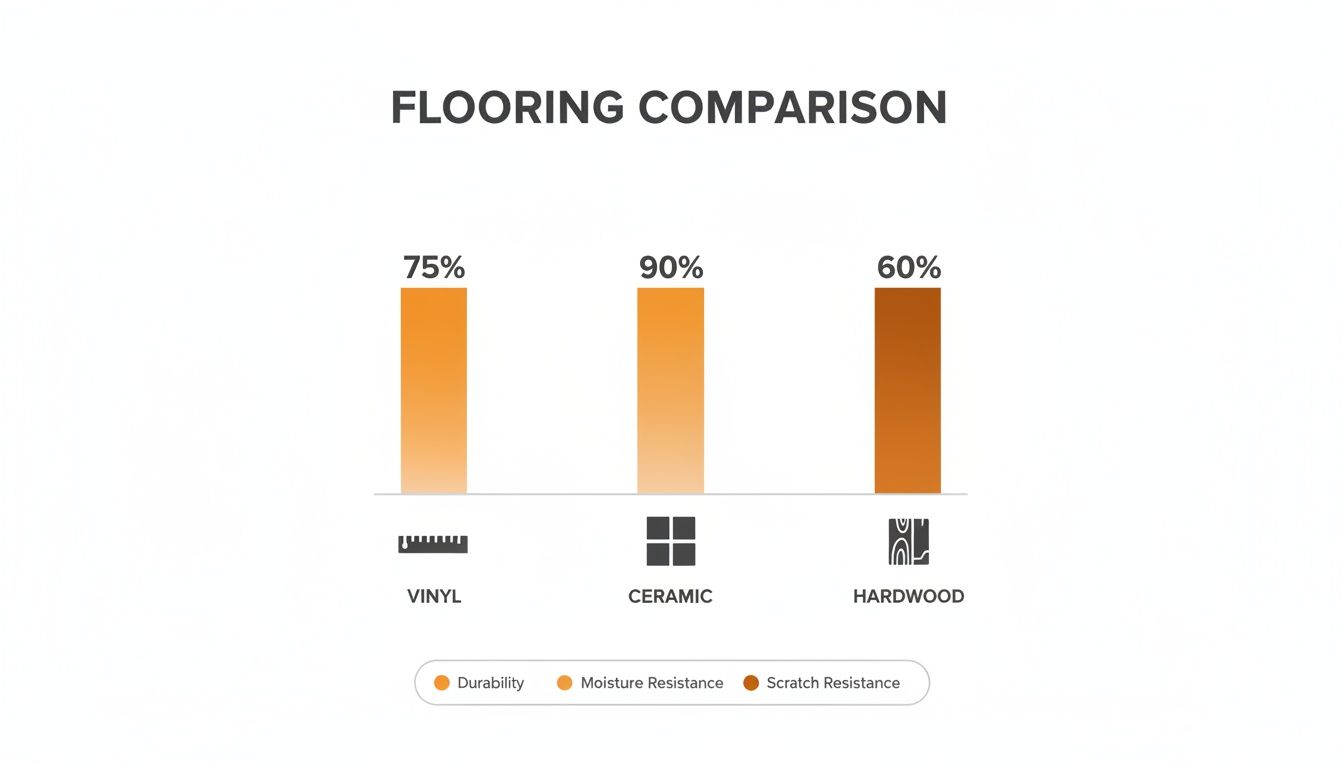
The data confirms that for a balanced solution, vinyl is the clear winner. This is precisely why any leading supplier in Dubai is seeing a surge in specifications for vinyl that meets demanding UAE construction standards.
If you want to dig deeper into how it performs in different scenarios, this vinyl flooring for renovation: a comprehensive guide is a great resource. It offers practical insights into why it's become such a popular choice for both new builds and refits.
What Are the Main Types of Vinyl Flooring?
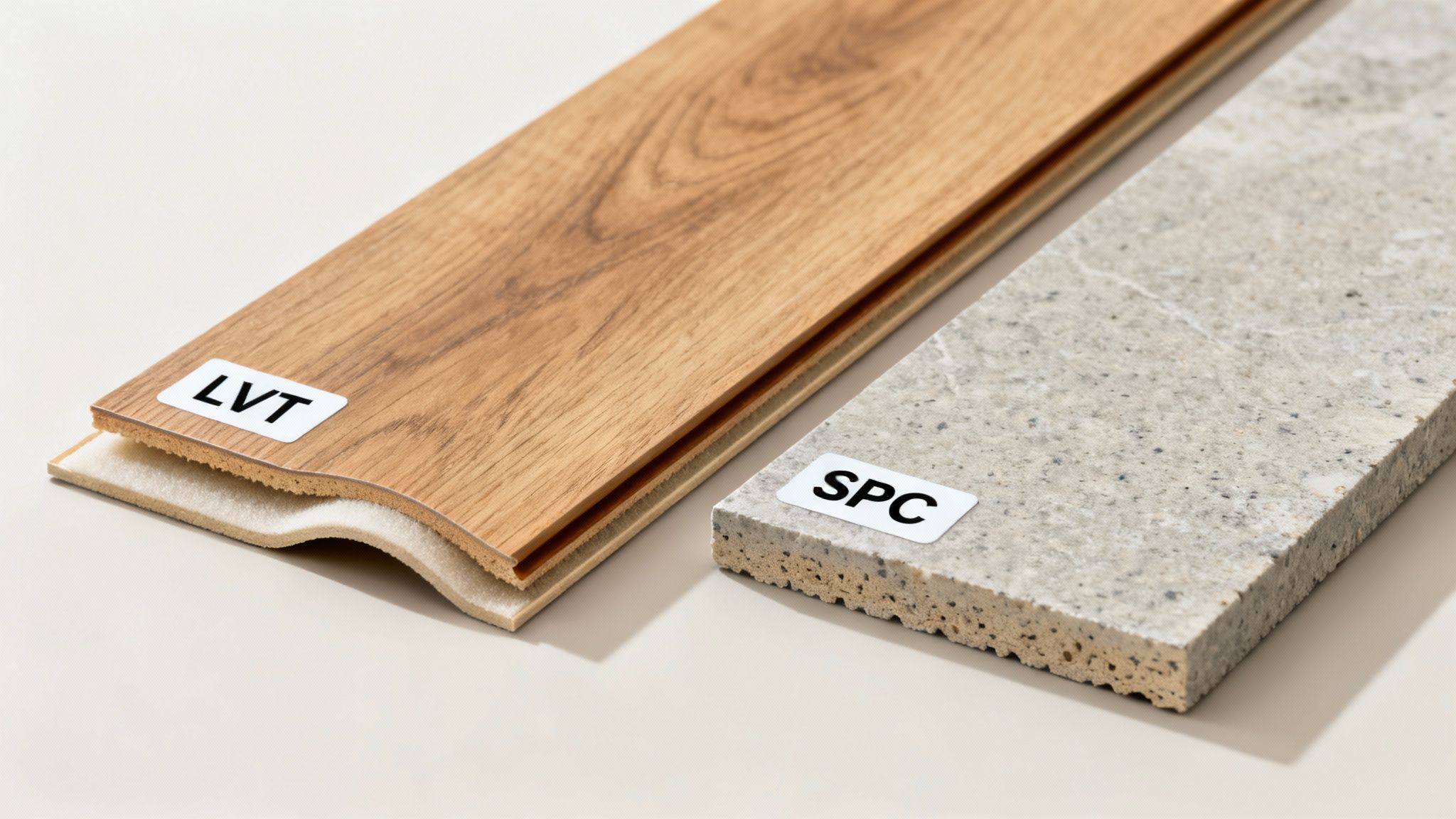
When you’re specifying vinyl flooring in Dubai, you need to know what you’re working with. The two main types of vinyl flooring for professional projects are Luxury Vinyl Tile (LVT) and Stone Plastic Composite (SPC). LVT is flexible and comfortable, ideal for residential and light commercial use, while SPC has a rigid, ultra-dense core, making it exceptionally durable for high-traffic commercial spaces.
Here’s a simple way to think about it. LVT is like the cushioned sole of a high-end running shoe—it’s flexible, comfortable underfoot, and focuses on combining style with a softer feel. SPC, on the other hand, is the carbon fibre frame of a performance race bike—it's incredibly rigid, tough as nails, and engineered for pure, unadulterated durability.
Any good supplier in Dubai will walk you through these differences, but understanding them yourself is the key to making a specification that won't just look good on day one, but will perform for years to come.
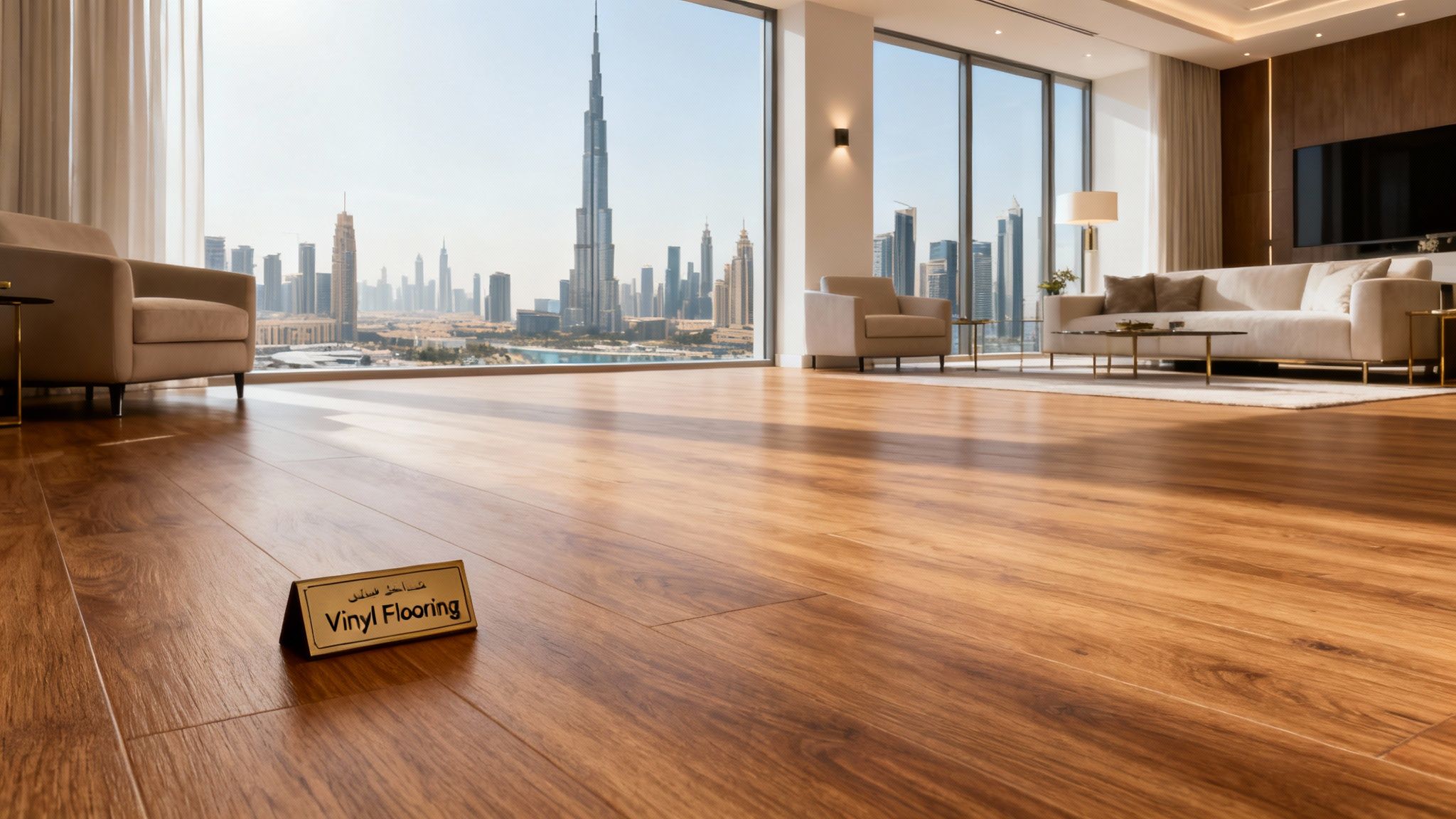
Let's break down what makes them tick, where they shine, and how you can confidently choose the right one for your project. Getting this right from the start is fundamental to meeting the stringent UAE construction standards and delivering a finished space that lasts.
What Is Luxury Vinyl Tile (LVT)?
Luxury Vinyl Tile (LVT) is a type of vinyl flooring known for its comfortable, flexible feel and realistic designs. Made primarily from PVC, its multi-layered construction provides a softer, warmer surface underfoot, making it a popular choice for residential and light commercial spaces like hotel rooms and boutique retail.
Its secret is in its multi-layered construction, which is made primarily of PVC vinyl. LVT truly excels at mimicking natural materials like wood and stone with stunning realism, thanks to a high-definition printed layer that’s protected by a tough transparent wear layer. Its flexibility also means it's a bit more forgiving over minor subfloor imperfections.
What Is Stone Plastic Composite (SPC) Flooring?
Stone Plastic Composite (SPC) flooring is a highly durable type of vinyl built around a rigid, ultra-dense core. This core, made from limestone powder and stabilisers, makes SPC exceptionally stable, impact-resistant, and 100% waterproof, ideal for demanding commercial environments like lobbies, restaurants, and high-traffic areas.
That rigid core is its defining characteristic. Unlike LVT, which can flex, SPC planks are incredibly tough. They resist dents and impacts from heavy foot traffic or dropped objects far better. Its rock-solid nature ensures it can handle the daily grind without showing the strain.
If you want to get into the nitty-gritty of the materials, you can learn more about polyvinyl chloride flooring in our detailed article.
"In a demanding market like Dubai, material specification is everything. SPC's rigid core provides unmatched dent resistance and waterproof performance, making it a fail-safe option for high-traffic commercial projects where long-term durability is non-negotiable."
Which Type of Vinyl Is Better For Commercial Projects?
For the vast majority of commercial projects in Dubai, SPC flooring is the better and more reliable option. Its rigid core provides superior resistance to the dents, impacts, and heavy loads common in busy retail stores, offices, and hospitality venues.
While LVT has its place in lighter commercial settings, SPC’s bulletproof durability and completely waterproof construction offer greater peace of mind and a much longer service life in high-stress environments. A reputable building materials distributor will almost always point you towards SPC for any large-scale commercial job because its performance is proven time and time again.
How Do LVT and SPC Compare Head-to-Head?
To really nail down the right choice, it helps to see them side-by-side. Both are fantastic products, but their strengths are geared for very different applications.
| Feature | Luxury Vinyl Tile (LVT) | Stone Plastic Composite (SPC) |
|---|---|---|
| Core Composition | Flexible PVC (Polyvinyl Chloride) | Rigid core of limestone, PVC, and stabilisers |
| Durability | Good; suitable for residential and light commercial use | Excellent; highly resistant to dents and impacts |
| Water Resistance | Highly water-resistant | 100% Waterproof from top to bottom |
| Comfort | Softer and warmer underfoot | Harder and more rigid underfoot |
| Installation | Can be glued down or clicked together; forgiving over minor subfloor imperfections | Click-lock installation; requires a very flat subfloor due to its rigidity |
| Best For | Bedrooms, living rooms, hotel rooms, small offices | Kitchens, bathrooms, lobbies, retail, high-traffic commercial spaces |
How Does Vinyl Flooring Handle Dubai’s Climate?
Choosing a flooring material in Dubai is less about aesthetics and more about winning a battle against relentless heat and humidity. Vinyl flooring handles Dubai's climate exceptionally well due to its excellent dimensional stability and waterproof nature. Unlike natural wood, it does not swell, shrink, or warp with changes in temperature and humidity, ensuring a durable and long-lasting finish.
Its biggest advantage is its phenomenal dimensional stability. That means no ugly gaps appearing between your planks in the cooler months, and no buckling or warping when the summer heat is at its peak.
Is Vinyl Flooring Waterproof Enough For Humid Conditions?
Absolutely. Modern vinyl flooring is 100% waterproof, making it the go-to choice for Dubai’s humid environment. The core of SPC and LVT products is completely impervious to water, providing total protection against spills, moisture, and high ambient humidity.
This is a game-changer compared to materials like laminate, which often hide a wood-fibre core that’s a ticking time bomb when exposed to moisture. With vinyl, you have a fail-safe solution for kitchens, bathrooms, and any ground-floor installation where damp is a potential headache. To properly secure the entire building envelope, it's also worth brushing up on your knowledge of advanced sealants and waterproofing for the UAE climate.
How Does Vinyl Meet Local Building Standards?
For any reputable supplier in Dubai, compliance is non-negotiable. Top-tier vinyl flooring meets strict UAE construction standards for health and safety, particularly regarding Volatile Organic Compound (VOC) emissions. Leading brands offer low-VOC or zero-VOC products certified by standards like FloorScore®, ensuring excellent indoor air quality.
This is crucial for maintaining excellent indoor air quality—a must-have for residential, hospitality, and healthcare projects aiming to align with Dubai's forward-thinking green building initiatives.
By specifying low-VOC certified vinyl, contractors and developers aren't just ticking a regulatory box. You're delivering a healthier, more sustainable environment for everyone who uses the building. This commitment to quality is what separates a good building materials distributor from a great one.
Why Is Vinyl Gaining Popularity In UAE Mega-Projects?
Vinyl is gaining popularity in UAE mega-projects because its fast click-lock installation systems can reduce project timelines by up to 30%. This speed, combined with its climate resilience and high performance, makes it a strategic solution for the demanding schedules of large-scale residential and hospitality builds.
While traditional ceramics still hold a 37.32% market share in 2025, vinyl flooring is catching up fast, with a projected 9.76% CAGR from 2026 to 2031. You can dig deeper into these market trends on Mordor Intelligence. Ultimately, this trend shows that vinyl is more than just a product; it’s a strategic solution.
What Should You Look for in Commercial Vinyl Flooring?
Choosing flooring for a hotel lobby, a busy office, or a high-end retail space in Dubai is a completely different ball game than picking something for a home. Commercial spaces are a relentless stress test—think constant foot traffic, rolling carts, and aggressive cleaning schedules. This is where the technical specs on a data sheet become the most important predictors of long-term performance and safety.
It’s a bit like choosing tyres. You wouldn’t put standard passenger car tyres on a heavy-duty truck that’s hauling materials across the country, would you? The vinyl flooring in a quiet back office has vastly different demands than the floor greeting thousands of guests in a bustling hotel lobby. Getting this specification right from the start is the key to ensuring your floor doesn't just look good on day one, but holds up for years.
What’s the Single Most Important Spec for Commercial Vinyl?
Without a doubt, it’s the wear layer thickness. The wear layer is the transparent top coat protecting the design from scratches and stains. For true commercial-grade durability, the industry benchmark is a wear layer of at least 0.5mm (also called 20 mil).
Anything less simply isn’t designed to handle the daily abuse of a commercial environment. This tough outer skin is what keeps the floor looking sharp under the constant shuffle of feet, protecting your client's investment and saving them from a premature replacement. When you’re talking to any supplier in Dubai, your first question should always be about the wear layer thickness.
Which Safety Ratings Really Matter in the UAE?
In any public or commercial space, two safety ratings are absolutely non-negotiable: slip resistance and fire classification. These are critical for public safety and compliance with local regulations.
- Slip Resistance: Always check for an "R" rating, usually R9 or R10 for most commercial interiors. This rating comes from a ramp test and tells you how well the surface prevents slips—a vital feature for entrances, corridors, and washrooms.
- Fire Safety Classification: All flooring has to meet the fire safety codes set by the UAE Civil Defence. Look for classifications like Bfl-s1, which means the product contributes very little to a fire and produces low smoke. This is essential for safe evacuation routes.
When you specify materials, your choices directly affect public safety and regulatory compliance. A professional building materials distributor will always provide the documentation to prove their products meet the stringent UAE construction standards.
How Do Acoustics Affect a Commercial Space?
Sound is one of those things you don't notice until it's a problem. The constant clatter of heels, rolling carts, and echoing conversations can make an office, hotel, or clinic feel chaotic and stressful.
This is where high-quality commercial vinyl flooring, especially SPC with a built-in acoustic underlay, can be a game-changer. Check the technical data sheet for an Impact Insulation Class (IIC) rating. A higher IIC number means the floor is better at deadening impact noise between levels, creating a quieter and more pleasant atmosphere for everyone. It's a small detail that makes a massive difference to the end-user experience.
The demand for high-performance vinyl is climbing fast across the region. In the GCC, the vinyl flooring market is projected to grow steadily through 2030, with the commercial sector leading the way thanks to Dubai's tourism boom and major public projects. This is part of a bigger trend where resilient flooring is set to grow by 18.4% in the Middle East and Africa, with vinyl’s waterproof and easy-to-install nature making it a go-to choice. You can learn more about the regional growth of vinyl flooring on Mordor Intelligence.
How Can You Get Installation and Maintenance Right?
You can specify the best vinyl flooring on the market, but if the installation is rushed or the maintenance is sloppy, you've lost all that value. A floor's lifespan really comes down to getting the fundamentals right from day one, followed by a simple, consistent care routine. This is non-negotiable in the demanding UAE climate, where installation shortcuts can quickly turn into expensive failures.
Proper installation is so much more than just clicking planks together. It's a careful process that guarantees stability for years to come. Likewise, maintenance isn’t about heavy-duty scrubbing; it’s about using the right techniques to protect that all-important finish, especially in high-traffic commercial spaces. Let's make sure your vinyl flooring in Dubai lives up to its promise.
What’s the Golden Rule for a Flawless Vinyl Installation?
Without a doubt, it’s subfloor preparation. Your beautiful new vinyl floor is only as strong as the foundation it’s sitting on. The subfloor must be clean, flat, and dry, as any debris, unevenness, or moisture will cause the flooring system to fail over time.
For any professional supplier in Dubai, making sure the project team gets this is a top priority.
- Clean: Get the brooms and vacuums out. The entire area needs to be totally free of dust and particles.
- Flat: Grab a straightedge and check for high or low spots. The industry standard is clear: the subfloor shouldn't vary by more than 3mm over a 2-metre span. Use a self-levelling compound to sort out any imperfections.
- Dry: Always, always run a moisture test, especially on concrete subfloors. Trapped moisture is the enemy of any flooring, so it must be within the manufacturer's specified limits before a single plank is laid.
Why Do We Insist on Letting Vinyl Flooring Acclimatise?
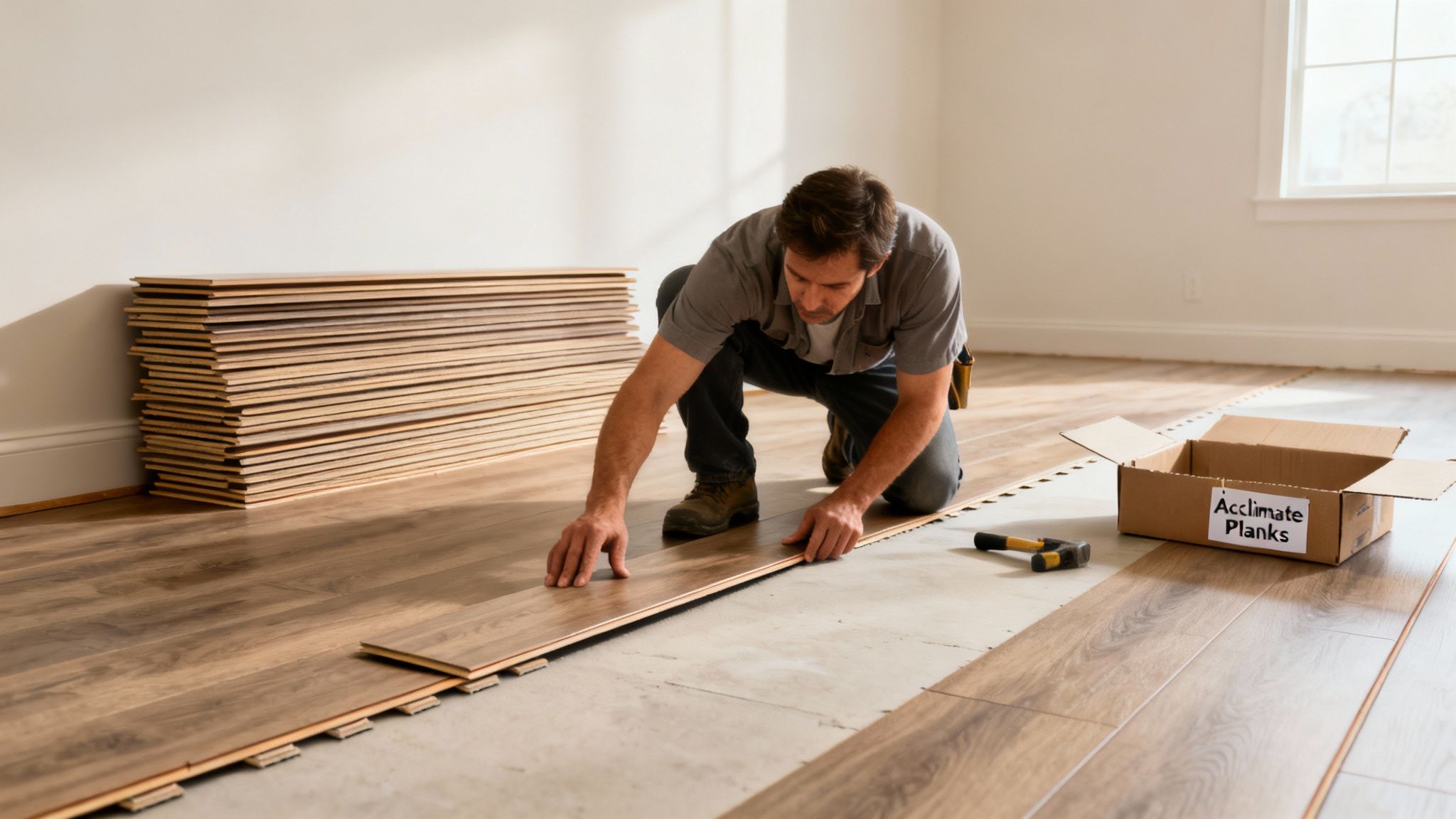
Acclimatisation is the crucial step of letting vinyl planks adjust to the site’s temperature and humidity for at least 48 hours before installation. This prevents the planks from buckling or developing gaps after they are laid, as it allows them to expand or contract to match their new environment.
What happens if you skip it? You're asking for trouble. The planks might start to buckle or pull apart, leaving ugly gaps as they adjust after installation. This simple act of patience is one of the easiest ways to prevent future headaches and is a core requirement under UAE construction standards for quality flooring.
How Should You Clean Vinyl Floors to Keep Them Looking New?
The secret to a long-lasting finish is a simple, consistent cleaning routine with the right tools. The best way to clean vinyl floors is to sweep daily with a microfiber mop and damp-mop weekly with a neutral pH cleaner. Avoid harsh chemicals, abrasive pads, and excessive water to protect the floor's finish.
For hotels, offices, and retail spaces, the best practice is a daily sweep or dust mop, followed by a weekly damp mop using a neutral pH cleaner. This simple system stops abrasive dirt from building up and acting like sandpaper under every footstep.
Here’s an effective maintenance schedule you can put into practice immediately:
- Daily Care: A quick sweep or pass with a microfiber dust mop is all it takes to remove the loose dirt and grit that cause fine scratches. This is the single most important thing you can do.
- Weekly Cleaning: Damp-mop the floor. The key word here is damp, not soaking wet. Use a solution of water and a neutral pH cleaner, and be sure to wring the mop out well.
- Spill Response: Wipe up spills right away with a soft cloth. Even though vinyl is waterproof, you don’t want acidic liquids like coffee or juice sitting on the surface for long.
When you work with a knowledgeable building materials distributor, you're not just buying a product. You're getting the technical expertise you need to install and maintain it correctly, ensuring the entire project is a success from start to finish.
How Can You Find a Reliable Vinyl Flooring Supplier in Dubai?
Picking out the perfect vinyl flooring is just the first step. The real key to a successful project? Partnering with the right supplier. A reliable supplier in Dubai is far more than just a company that moves boxes from A to B. Think of them as a critical extension of your own project team—the people who provide the technical backup, logistical precision, and quality assurance you need.
In a market as fast-moving as Dubai's, your supplier’s ability to get the right materials to your site, on time, can literally make or break your project schedule. That’s why digging into their inventory, logistics, and technical know-how is every bit as important as scrutinising the flooring itself.
What Separates a Great Supplier From an Average One?
A great supplier delivers a complete service package, including deep product knowledge, robust stock levels, and a proven track record. They act as a procurement partner, offering technical support, full manufacturer warranties, and documented proof of compliance with UAE construction standards.
You'll also find that a top-tier building materials distributor has solid relationships with the world’s leading flooring brands. This connection is your gateway to the latest product innovations.
How Can You Verify a Supplier’s Expertise?
Don't be afraid to ask tough questions. A truly knowledgeable partner won't hesitate when you ask about subfloor preparation for our specific climate, or which wear layer is best for a high-traffic hotel lobby. They should be able to pull up fire and slip resistance ratings for you instantly.
Better yet, ask for case studies or references from projects similar to yours. A supplier with genuine local experience will have a portfolio brimming with successful installations in hotels, offices, and residential towers, proving they get the unique challenges of building in Dubai.
What Should You Look for in Their Inventory and Logistics?
The best suppliers in the business keep a massive local inventory specifically to prevent project delays. Before you sign anything, ask them directly about their stock levels for the exact vinyl you need. A supplier who relies too heavily on special orders is introducing a massive risk to your timeline.
Here’s a quick checklist to run through:
- Extensive On-Hand Stock: Can they actually fulfil a large order today, or will it involve a long lead time?
- Site-Direct Delivery: Do they run their own logistics team to guarantee on-time deliveries directly to your site, whether in Dubai or another Emirate?
- Consolidated Procurement: Can they simplify your life by bundling other essentials like adhesives, underlayment, and finishing profiles?
A truly reliable partner understands that in construction, time is money. Their entire operation, from the warehouse to the delivery truck, should be geared towards keeping your project moving forward without any costly hold-ups.
This kind of dependability is non-negotiable in such a booming market. The UAE's vinyl flooring sector hit USD 1324.82 million in 2024 and is forecast to climb to USD 2110.31 million by 2033, all thanks to Dubai’s relentless urban growth. This expansion makes a rock-solid supply chain more critical than ever. You can dig deeper into these market insights on DeepMarketInsights.com.
What Are Your Top Questions About Vinyl Flooring in Dubai?
When you're specifying materials for a major project, you're bound to have questions. Let's get straight to the point with clear answers to the most common queries we hear from contractors, designers, and project managers about using vinyl flooring in Dubai.
What’s the Average Cost of Vinyl Flooring in Dubai?
The average installed cost for quality LVT or SPC vinyl flooring in Dubai typically ranges from AED 70 to AED 150 per square metre. This price can vary depending on brand, wear layer thickness, and the amount of subfloor preparation required.
This price point makes it an extremely smart alternative to materials like ceramic tile or hardwood, especially when you consider the money you'll save on labour thanks to its quicker, simpler installation.
Is Vinyl Flooring Tough Enough for High-Traffic Areas Like Malls?
Absolutely. Commercial-grade SPC and LVT are engineered for high-traffic environments like malls. The key is to specify a product with a robust wear layer of 0.5mm (20 mil) or thicker to resist scratches, scuffs, and dents from heavy footfall.
The dense core stands up to dents from heavy footfall and rolling loads, while that crucial top layer shrugs off the scuffs and scratches you'd expect in busy retail stores, hotel lobbies, and office corridors. Any reliable supplier in Dubai will help you pinpoint the right specification for these high-traffic zones.
Can We Install Vinyl Flooring Directly Over Existing Tiles?
Yes, in many cases you can install vinyl flooring directly over existing tiles, especially rigid core products like SPC. This saves significant time and cost by avoiding demolition. The existing tile floor must be clean, level, and structurally sound, with no loose or cracked tiles.
If the grout lines are too deep or the surface is uneven, you'll need to apply a self-levelling compound first to create a perfectly smooth base for a flawless finish.
Does Vinyl Flooring Meet Dubai’s Green Building Codes?
Yes, many top vinyl flooring brands are fully compliant with Dubai's green building regulations. Look for products with low-VOC (Volatile Organic Compounds) certifications, such as FloorScore®, which guarantee better indoor air quality and help projects meet sustainability targets.
For any project aiming to hit modern environmental benchmarks, specifying vinyl with these certifications is non-negotiable. It shows a commitment to health and sustainability that lines up perfectly with UAE construction standards.
On top of that, many modern vinyl floors contain recycled materials and are 100% recyclable themselves when they reach the end of their life. A good building materials distributor can provide all the technical data sheets and certifications you need to prove compliance.
For over 20 years, Yasu Trading Co. has been the go-to partner for contractors and developers across the UAE. We don't just supply high-quality, compliant building materials; we provide the logistical support and technical expertise your project demands to stay on schedule and on budget.
Explore our comprehensive range of construction solutions and see how we can simplify your procurement process. Visit us at https://yasutrading.com.