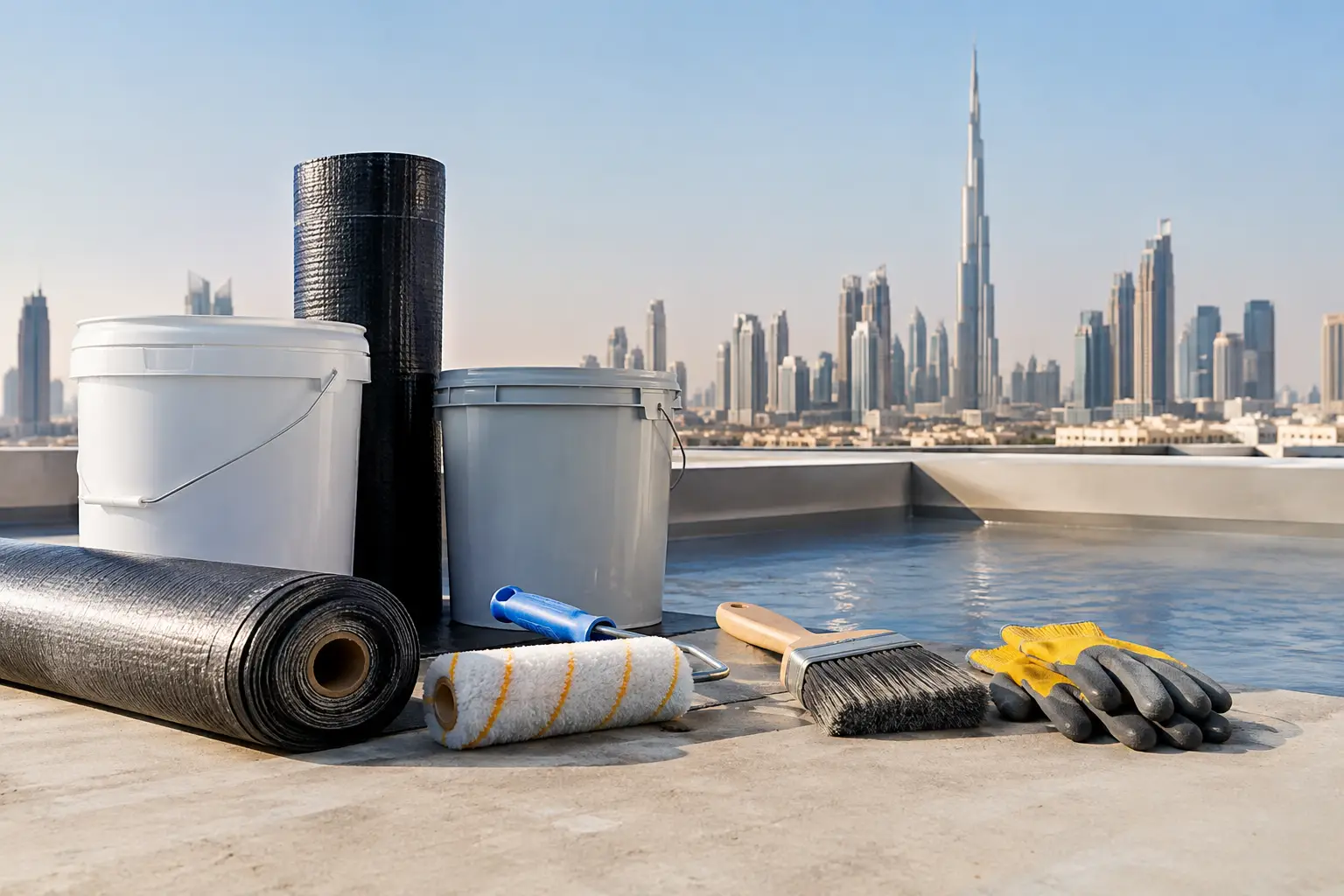
Best Waterproofing Repair Materials for UAE Sites
A leaking roof slab, failed bathroom membrane, or cracked podium joint can turn a small defect into concrete damage, mold, tenant complaints, and delayed handover. The best waterproofing repair materials are not simply the products with the strongest marketing claims. They are the materials that match the substrate, moisture condition, movement level, exposure, and required service life of the repair.
For contractors and maintenance teams, material selection also affects procurement risk. A repair system must be available when the site is ready, compatible with the specified primer and topcoat, and suitable for municipality-compliant project requirements. Selecting one product in isolation often leads to adhesion failures, recurring leaks, or unnecessary rework.
Start With the Failure, Not the Product
Waterproofing repairs fail when teams treat every leak as a crack-sealing problem. Water can enter through a structural crack, a cold joint, a failed membrane lap, an unsealed pipe penetration, deteriorated grout, or a drainage defect. The visible damp area may be several meters away from the actual entry point.
Before ordering material, inspect the surface condition and identify whether the leak is active or intermittent. Check for standing water, hollow screed, movement at joints, UV exposure, contaminated concrete, and previous coatings. On roofs and terraces, confirm that the falls and drains are working. Applying a premium membrane over blocked outlets or ponding water will not correct the underlying problem.
The repair specification should answer four practical questions: Is the substrate concrete, masonry, metal, or tile? Will the repaired area move? Is there positive-side water pressure or negative-side pressure? Will the product remain exposed to sunlight, traffic, or chemicals?
Best Waterproofing Repair Materials by Application
Cementitious waterproofing for concrete and masonry
Cementitious waterproof coatings are widely used for internal wet areas, water tanks, basements, lift pits, retaining walls, and masonry surfaces. They are supplied as one-component or two-component systems and create a bonded barrier over prepared concrete or blockwork.
For rigid, stable substrates, a standard cementitious coating can be a cost-effective solution. Flexible polymer-modified cementitious systems are better where minor movement, temperature changes, or hairline cracking are expected. They are particularly useful in bathrooms, balconies, planter boxes, and below-grade concrete repairs before tiling or protective screed.
The trade-off is surface preparation. Cementitious materials need a sound, clean, dampened substrate and proper curing. They should not be relied on to bridge wide active cracks or movement joints. Where the concrete is weak, dusty, or contaminated by oil, mechanical preparation and a compatible bonding system are necessary before application.
Polyurethane sealants for moving joints and cracks
For expansion joints, control joints, window perimeters, facade interfaces, and pipe penetrations, polyurethane sealant remains a dependable repair material. It adheres well to many construction substrates and accommodates movement that would crack a rigid mortar repair.
Joint design matters as much as the sealant itself. Use the correct joint width-to-depth ratio, insert compatible backer rod where required, and apply primer if the manufacturer specifies it for concrete, metal, or porous surfaces. Filling a deep joint completely with sealant wastes material and can restrict movement.
Polyurethane is suitable for many external applications, but the selected grade must match UV exposure and chemical conditions. For high-movement facade joints or areas exposed to severe heat, consult the project specification rather than substituting a general-purpose cartridge product.
Bituminous coatings and membrane patches for below-grade work
Bituminous materials are commonly selected for foundations, retaining walls, substructures, and buried pipe protection. Cold-applied bituminous coatings can provide a practical moisture barrier on properly prepared concrete, while self-adhesive or torch-applied membrane patches are often used to repair damaged sections of compatible bituminous systems.
These materials are effective where they will be protected from direct sunlight and mechanical damage. On below-grade work, the repair should include protection boards or drainage layers where specified. Backfilling directly against an unprotected membrane can puncture the repaired area before the structure is returned to service.
Do not use a random bitumen product over an existing polyurethane, acrylic, or cementitious coating without confirming compatibility. Incompatible systems can soften, delaminate, or prevent proper bonding at the repair edges.
Liquid-applied polyurethane membranes for roofs and terraces
Liquid-applied polyurethane waterproofing is often the right choice for complex roof details, balconies, terraces, and areas with multiple penetrations. It forms a continuous membrane around drain outlets, upstands, corners, and irregular geometry where sheet materials may require numerous laps and terminations.
Its main advantage is detail coverage. When applied at the required dry film thickness with reinforcing fabric at cracks, corners, and transitions, it can create a durable elastic barrier. Some systems also accept a UV-resistant topcoat for exposed roofs.
The condition of the existing substrate is critical. Moisture trapped below a polyurethane membrane can cause blistering, while poor cleaning can lead to adhesion loss. Contractors should verify substrate moisture limits, primer requirements, and recoat windows. A membrane that looks uniform on installation day may fail early if these controls are missed.
Acrylic coatings for reflective roof maintenance
Acrylic waterproof coatings are frequently used as reflective maintenance coatings on suitable roof surfaces. Their light color can help reduce surface heat gain, and they are relatively easy to apply over large accessible areas.
They work best on roofs with positive drainage and stable existing substrates. Acrylic coatings are generally less suitable for permanent ponding-water zones, heavily trafficked areas, or badly cracked surfaces without reinforcement and localized repair. If the roof has regular standing water after cleaning the drains, resolve the drainage issue before specifying acrylic coating as the main repair.
Epoxy injection and repair mortars for structural cracks
Where cracks are dry, dormant, and structurally significant, low-viscosity epoxy injection may restore continuity in concrete. It is not a waterproofing substitute for a moving crack, but it can be part of a repair sequence before a waterproofing layer is reinstated.
For spalled concrete, honeycombing, damaged coves, and localized substrate repairs, polymer-modified repair mortars provide a sound base for the waterproofing system. The repaired profile should be smooth and properly cured. Sharp internal corners should be formed into coves because membranes are vulnerable at abrupt 90-degree transitions.
Do Not Overlook Primers, Tapes, and Protection Layers
The highest-performing membrane can still fail at its weakest detail. Waterproofing systems are built from compatible components: surface primer, membrane or coating, reinforcing fabric, joint tape, sealant, drainage accessory, and protection layer.
A common site error is using a quality membrane with an unapproved primer or sealing a penetration with ordinary silicone. Neutral-cure silicone has useful applications, but it is not automatically compatible with every membrane, paint, or adhesive. For critical joints, select a sealant and tape that are approved within the same system or confirmed by the manufacturer.
Protection is equally important. On tiled wet areas, use a compatible tile adhesive after waterproofing has cured. On roofs receiving foot traffic, plant equipment, or pavers, specify a protection course designed for the expected load. A waterproof layer should not be expected to withstand site traffic, dropped tools, or sharp aggregate without protection.
Procurement Checks That Prevent Rework
For project buyers, the best material is one that arrives as a complete and traceable repair system. Before issuing a purchase order, confirm the product data sheet, batch availability, coverage rate, primer requirement, curing time, packaging size, shelf life, and storage conditions.
For larger repairs, request a system-based quotation rather than pricing only the main coating by pail or drum. Include sealants, backer rods, repair mortar, tapes, fabric, primers, cleaning materials, and protective accessories. This reduces the risk of a crew stopping work because a small but essential component was not ordered.
It is also wise to confirm whether the repair needs a mock-up, flood test, adhesion test, or consultant approval before full application. These controls are usually faster and less expensive than opening finished tiles or removing a completed roof system after a leak reappears.
Match the Repair System to the Site Schedule
Fast-curing products can help on urgent maintenance work, but speed should not override substrate readiness. A rapid-set mortar may return an area to service quickly, while a membrane with a longer cure period may still be the better choice for a continuously wet or high-movement location. The right decision depends on the required performance after handover, not only on today’s access window.
Yasu Trading supports contractors with jobsite-ready waterproofing-related materials, sealants, adhesives, hand tools, and repair accessories that help consolidate procurement for planned and urgent works. For active projects, provide the substrate type, affected area, exposure condition, and required completion date when requesting a quote so the material recommendation can be aligned with the repair sequence.
A waterproofing repair earns its value when it remains dry after the scaffolding is removed, the tiles are fixed, or the excavation is backfilled. Specify the complete system, prepare the substrate correctly, and protect the repaired area as carefully as the membrane itself.