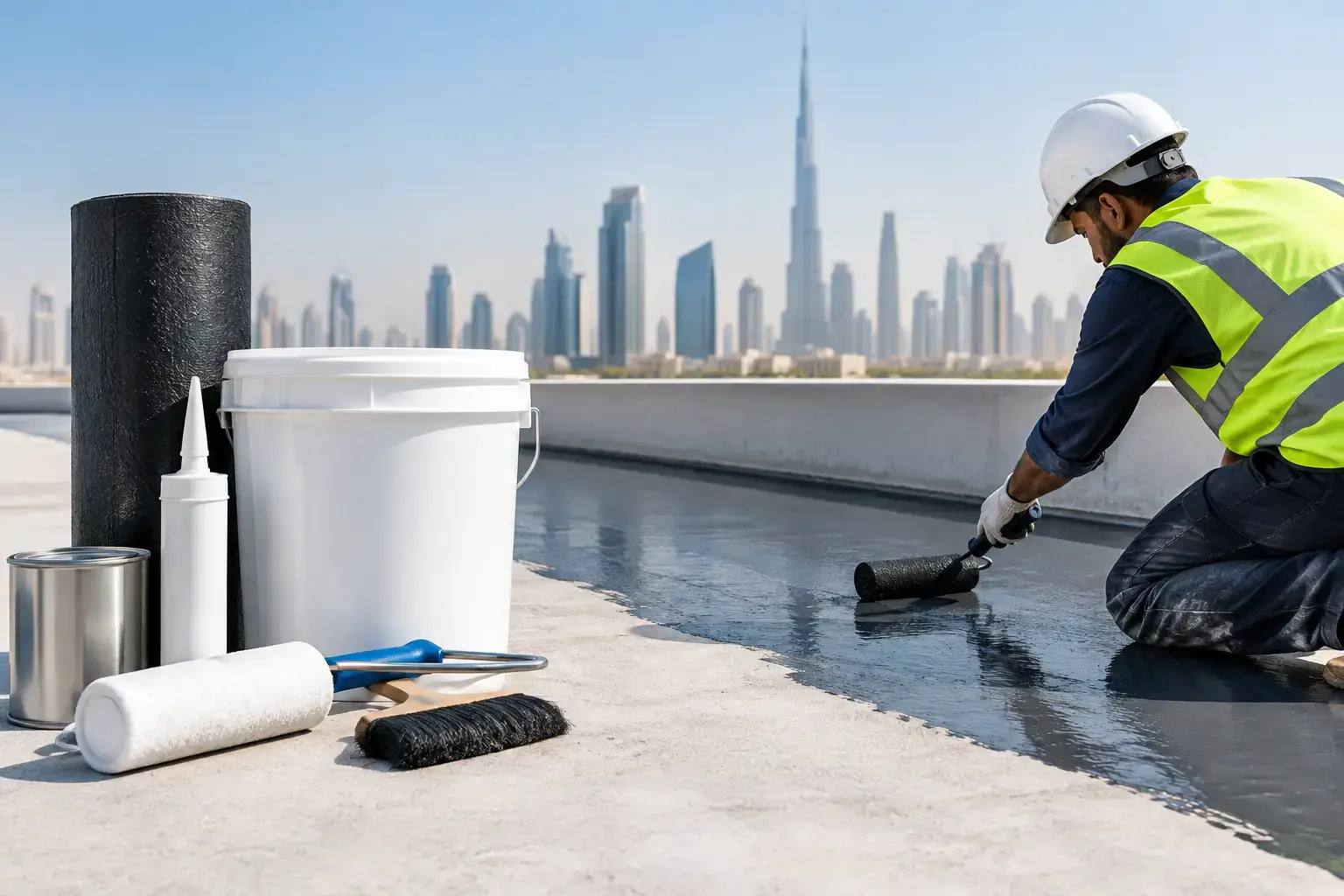
Best Waterproofing Repair Products for UAE Sites
A failed waterproofing layer rarely stays a small maintenance issue. On an active project, a leak can stop ceiling works, damage electrical containment, delay finishes, and trigger repeat inspections. Selecting the best waterproofing repair products starts with identifying where water is entering, what substrate is involved, and whether the repair must withstand movement, pressure, UV exposure, or permanent immersion.
For contractors, MEP teams, and facilities managers, the correct material is not simply the strongest product on the shelf. It is the product that bonds to the existing surface, meets the system specification, can be applied under actual site conditions, and is available when the workfront is ready. A fast repair that fails after the next rain or pressure test creates more cost than a properly specified solution from the start.
Best Waterproofing Repair Products by Repair Type
Different failures demand different chemistry. Using a roof coating to seal an active pipe penetration, or applying a rigid cementitious coating across a moving joint, often leads to premature failure. Procurement teams should match the product category to the source and behavior of the leak.
Polyurethane sealants for moving joints and penetrations
Polyurethane sealants are a practical choice for expansion joints, control joints, window perimeters, pipe sleeves, flashing edges, and penetrations through walls or slabs. Their main advantage is elasticity. A good-grade polyurethane sealant can accommodate normal movement caused by thermal changes, vibration, and building settlement while maintaining a watertight bond.
Surface preparation controls the result. Remove old loose sealant, dust, oils, laitance, and standing water before application. For deep joints, use the correct backing rod to control sealant depth and avoid three-sided adhesion. Where specified, use a compatible primer, especially on porous concrete or difficult substrates.
For exposed roof joints, confirm the sealant’s UV resistance and movement capability. For wet-area applications, verify that it is compatible with the membrane and final finish system. A sealant may stop water temporarily, but it should not replace a full waterproofing membrane where one is required.
Cementitious waterproofing for concrete repairs
Cementitious waterproofing coatings are widely used on concrete water tanks, lift pits, basements, retaining walls, wet areas, and masonry surfaces. They are particularly useful where the substrate is damp but structurally sound, or where the repaired area will receive tile adhesive, screed, or protective plaster.
Rigid cementitious systems suit stable substrates with minimal movement. Flexible polymer-modified cementitious coatings are better for bathrooms, balconies, planter boxes, and other areas where minor cracking or thermal movement is expected. The product must be applied at the manufacturer’s required thickness, usually in multiple coats, with reinforcement tape or mesh at corners, coves, drains, and changes in plane.
Do not treat cementitious coating as a cure for ongoing structural cracking. If the crack is active, the repair may require crack injection, a flexible membrane detail, or a movement-joint solution before coating begins.
Bituminous membranes and cold-applied coatings for below-grade work
For foundations, retaining walls, underground structures, and protected roof systems, bituminous waterproofing remains a dependable option when specified and installed correctly. Torch-applied membranes offer durable protection for large areas, while cold-applied bituminous coatings can be effective for detailed repairs, uneven surfaces, and locations where open flame is not permitted.
The trade-off is protection. Bituminous materials can be punctured during backfilling or subsequent trades, so they often need protection boards, drainage boards, or screed layers. Lap details, terminations, corners, and pipe penetrations require the same attention as the main field area. Most below-grade failures occur at transitions, not in the middle of a properly installed membrane.
When repairing an existing bituminous system, check compatibility before applying a new coating or patch. Some solvent-based products can affect older membranes, while contaminated surfaces may prevent reliable adhesion.
Liquid-applied membranes for complex roof and wet-area details
Liquid-applied polyurethane, acrylic, and hybrid membranes are useful where a sheet membrane would require excessive cutting and detailing. They can form a continuous layer around drains, upstands, parapets, AC bases, pipe clusters, and irregular roof penetrations.
Polyurethane liquid membranes generally provide stronger elasticity and durability for demanding roofs, but they require close control of moisture content, primer selection, curing time, and application thickness. Acrylic coatings are often easier to apply and can offer reflective roof protection, but they may not be suitable for ponding water or high-movement details unless the system is specifically rated for those conditions.
For roof repairs, verify whether the area has positive drainage. No coating compensates for persistent ponding if the product is not designed for water immersion. Correcting falls, clearing blocked outlets, and repairing drain collars may be part of the actual waterproofing scope.
Epoxy and polyurethane injection resins for active cracks
Crack injection products address a different problem from surface coatings. Low-viscosity epoxy resins are used to bond dormant structural cracks, while flexible polyurethane injection resins are commonly used where water is actively entering through cracks, joints, or construction defects.
Polyurethane injection can react with water and expand to stop active seepage, making it valuable for basements, lift pits, tunnels, and concrete structures under hydrostatic pressure. Epoxy is selected when restoring structural continuity is the priority and the crack is dry and stable.
This is specialist work. Injection port spacing, crack assessment, resin selection, pressure control, and cure behavior affect the outcome. Site teams should not specify injection resin solely by price or assume one resin solves both structural and water-sealing requirements.
How to Specify the Best Waterproofing Repair Products
A reliable purchase request should include more than the product name. Start with the substrate: concrete, blockwork, metal, tile, asphalt, existing membrane, or rendered wall. Then identify whether the repair is internal or external, exposed or protected, above or below grade, and subject to UV, chemical exposure, foot traffic, or water pressure.
The next question is movement. Static hairline cracks, construction joints, expansion joints, and pipe penetrations behave differently. A rigid coating can bridge a minor stable surface defect, but it will not reliably survive a joint that opens and closes. Similarly, a flexible sealant is not a structural concrete repair material.
For wet areas, specify the complete build-up. This includes surface preparation, primer, membrane, reinforcement accessories, compatible sealant, tile adhesive, grout, and protection period before handover. Mixing unverified products from different systems can create warranty gaps and make fault diagnosis difficult.
Municipality compliance and project approval requirements should be checked before bulk ordering. Request technical data, application guidance, coverage rates, and compatible accessories early, particularly for projects with consultant submittals or inspection hold points. This reduces the common problem of receiving material on site only to discover it does not match the approved method statement.
Procurement Checks That Prevent Repeat Repairs
The best product can still fail because of poor storage, rushed application, or incomplete accessories. Waterproofing materials should be stored within the manufacturer’s temperature limits and checked for shelf life before dispatch to site. Primer, reinforcement fabric, backing rod, protection boards, and approved cleaning materials should arrive with the main product, not after the installation crew has started.
Coverage calculations also deserve attention. Waterproofing quantity is based on specified dry film thickness or membrane layer count, not only on the floor area. Add allowances for upstands, parapets, drains, overlaps, corners, waste, and test patches. Under-ordering a membrane system can lead to inconsistent batches, delayed application, and pressure to apply below the required thickness.
For urgent repairs, availability matters as much as technical performance. A consolidated supplier can help contractors source waterproofing materials alongside sealants, plumbing fittings, hand tools, safety equipment, and protection materials, reducing supplier coordination when a leak threatens a scheduled handover. Yasu Trading supports project-based material requirements with jobsite-ready supply and technical product guidance for contractors managing time-sensitive repairs.
Apply, Protect, and Test Before Closing the Work
A repair is not complete when the coating looks dry. Observe the required curing time, protect the finished membrane from follow-on trades, and carry out the appropriate flood test, water test, or pressure test before tiles, screeds, ceilings, insulation, or backfill conceal the work. Record the product batch, application date, weather conditions where relevant, and test results for project documentation.
When the repair is exposed to other trades, assign responsibility for protection. A waterproofed balcony can be damaged by scaffold movement, tile cutting, stored materials, or sharp equipment within hours of application. Protection is part of the waterproofing scope, not an optional extra.
The right repair product keeps water out, but disciplined preparation, compatible system components, and timely delivery keep the repair from returning to the snag list. Specify the conditions clearly, secure approved materials before the workfront opens, and give the installation team the time and accessories needed to finish the detail correctly.