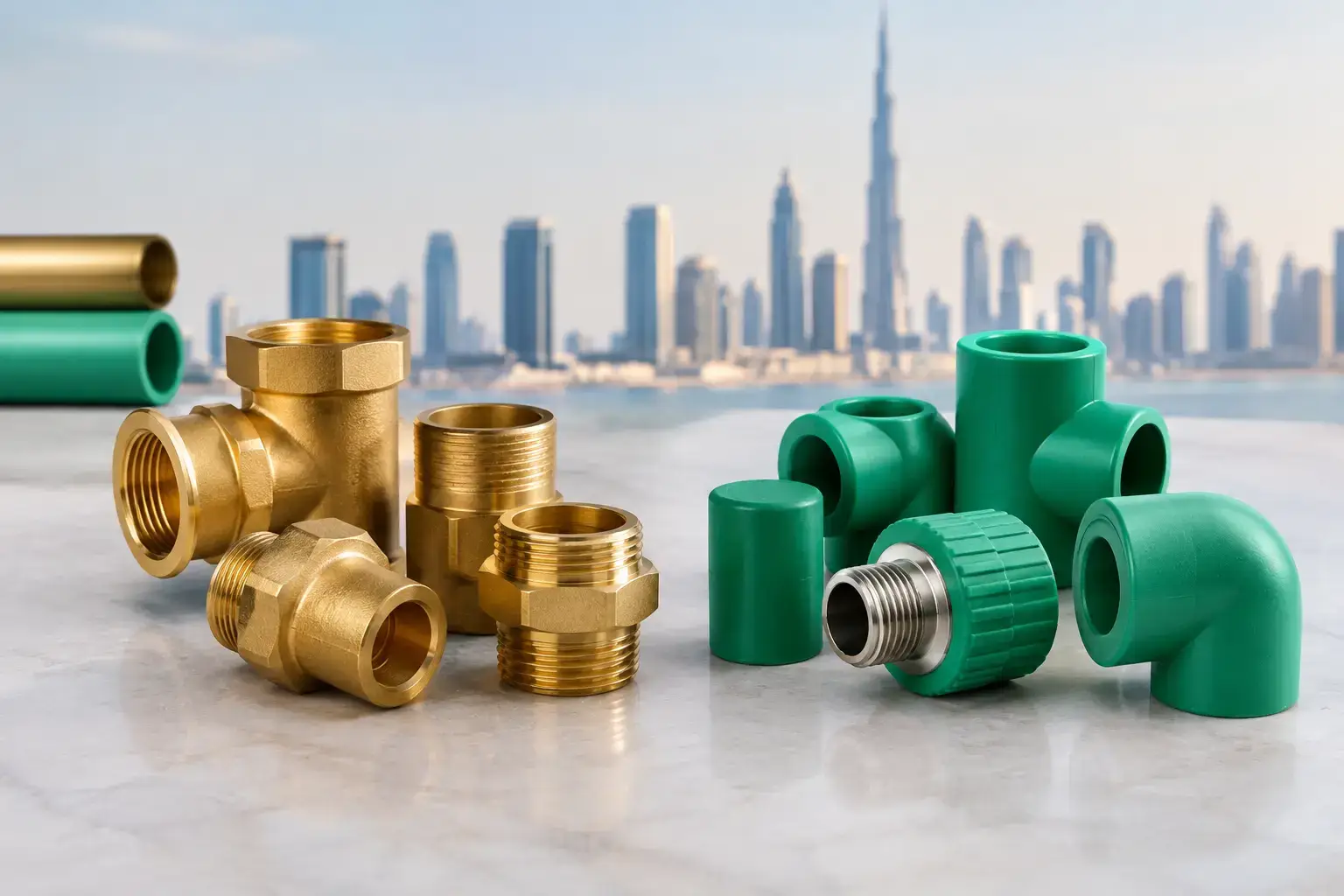
Brass Versus PPR Fittings for UAE Projects
A leaking connection behind a finished ceiling is rarely caused by a plumbing material in isolation. It usually starts with a mismatch between fitting type, pipe system, water conditions, installation method, and site handling. For contractors comparing brass versus PPR fittings, the practical question is not which material is universally better. It is which connection will remain reliable, compliant, and serviceable for the specific line being installed.
On UAE projects, that decision affects more than the plumbing package. It affects labor sequencing, pressure-test results, inspection readiness, maintenance exposure, and whether the finishing team can proceed on schedule. Brass and PPR fittings both have clear roles in professional plumbing installations. The right choice comes from understanding where each performs best and where mixed-material connections require closer control.
Brass Versus PPR Fittings: The Core Difference
Brass fittings are metal components commonly used for threaded connections, valves, manifolds, meters, pumps, water heaters, sanitary fixtures, and transitions to equipment. They provide mechanical strength and can be assembled, removed, and replaced using threaded joints or compression-style connections, depending on the fitting design.
PPR fittings are polypropylene random copolymer components designed to be heat-fused to compatible PPR pipes. A properly made fusion joint creates a continuous connection between the pipe and fitting, without a threaded joint or separate sealing compound at that point. PPR systems are widely used for hot and cold water distribution because they are corrosion-resistant, lightweight, and efficient to install when the crew has the correct fusion equipment and training.
The two materials are often used in the same building. A PPR riser or branch line may require a brass-threaded adapter at a valve, pump, water heater, meter, or sanitary connection. This makes material compatibility and installation discipline more important than simply selecting one category over the other.
Where Brass Fittings Make Sense
Brass is usually the practical choice where a connection must be threaded, mechanically strong, accessible for future service, or connected directly to metal equipment. It is common around isolation valves, pressure gauges, pump sets, water heaters, flexible hoses, and fixture outlets.
For MEP teams, the main advantage is serviceability. A threaded brass connection can be opened for repair or equipment replacement without cutting back the entire pipe run. That is valuable in plant rooms, service shafts, valve assemblies, and locations where future maintenance is expected.
Brass also handles localized mechanical stress well. Pipework near pumps, valves, or equipment connections may experience vibration, torque during maintenance, or repeated operation. A correctly selected brass fitting can provide a secure transition point, particularly where the connected item already uses a threaded metal port.
That said, not all brass fittings are equal. Procurement teams should confirm the fitting grade, thread standard, pressure rating, intended application, and manufacturer approval. Low-quality brass can create problems through poor thread accuracy, inconsistent wall thickness, or premature degradation. For potable-water systems, the specification should also align with project requirements and applicable municipal approvals.
Where PPR Fittings Are the Better Choice
PPR fittings are best suited to continuous PPR hot- and cold-water networks where fused joints can be installed correctly and protected after commissioning. In apartments, hotels, residential towers, staff accommodation, and commercial washroom networks, PPR can provide a clean, corrosion-resistant distribution solution with fewer threaded joints across the main pipe runs.
The primary benefit is the fusion joint. When pipe ends are cut square, heated at the correct temperature and duration, and joined without over-insertion or rotation, the connection becomes part of the pipe system. This reduces dependence on thread sealants and minimizes the number of potential leak points found in heavily threaded installations.
PPR also supports efficient handling on large projects. It is lighter than metal pipework, straightforward to transport through active sites, and available in a wide range of elbows, tees, reducers, couplers, unions, and threaded adapters. For repetitive residential or hospitality layouts, trained installation teams can maintain a consistent workflow across multiple floors.
Its limitations need equal attention. PPR requires dedicated fusion tools, calibrated heating sockets, clean working practices, and enough cooling time before stressing the joint. Poor fusion cannot be corrected by adding tape, sealant, or extra force. If a joint is overheated, underheated, contaminated, misaligned, or pushed too far into the fitting, it may restrict flow or fail during testing.
The Most Critical Point: Brass Inserts and Transition Fittings
The highest-risk area in a mixed system is often the PPR-to-brass transition. These fittings typically combine a PPR fusion socket with a brass female or male threaded insert. They are necessary at valves and equipment connections, but they must be selected and installed with care.
First, use transition fittings from a compatible, approved PPR system rather than mixing unrelated brands or generic inserts without verification. Dimensional tolerances, insert retention, and pressure performance can vary. A fitting that appears similar on a counter may not perform the same way after repeated thermal cycles.
Second, avoid overtightening the brass thread. Excessive torque can crack the plastic body around the insert or damage the threads. Use the correct thread sealant method specified for the fitting and connection, and support the pipework so the fitting is not carrying the weight of valves, hoses, or equipment.
Third, keep threaded brass connections accessible where possible. Fusion joints are intended to remain permanent, while valves, meters, and appliance connections may need future replacement. A thoughtful layout places the serviceable connection where maintenance teams can reach it without opening walls or ceilings.
Selection Factors for Contractors and Procurement Teams
A material comparison should start with the line’s operating conditions and the project specification. Water temperature, working pressure, flow demand, accessibility, exposure to sunlight, vibration, and connection type all influence the fitting decision.
For concealed domestic water distribution, PPR fittings are often the logical standard when the complete pipe system is PPR and the installer is qualified for fusion work. For equipment rooms and fixture terminations, brass fittings or brass transition points are often required because valves, pumps, heaters, and flexible connectors rely on threaded interfaces.
Do not select fittings by price alone. A low initial cost can disappear quickly if the fitting causes a pressure-test failure, rework after tile installation, or a maintenance callout during handover. The cost that matters is the installed cost: approved material, trained labor, correct tools, testing, and expected service life.
For project purchasing, confirm these items before issuing the order:
- Pipe and fitting system compatibility, including the exact PPR series and transition adapter type
- Pressure and temperature ratings for the intended hot- or cold-water application
- Thread type and size for valves, meters, pumps, water heaters, and sanitary fixtures
- Municipality-compliant documentation and project approval requirements
- Availability of matching valves, tools, supports, sealants, and replacement fittings
A consolidated material schedule helps prevent site teams from receiving PPR pipes without the required adapters, or brass valves without matching threaded transitions. Those small gaps are a frequent cause of urgent purchases and delayed pressure testing.
Installation Quality Decides the Result
The best fitting will not compensate for poor installation. Brass threaded joints need clean threads, correct alignment, suitable sealing material, controlled tightening, and adequate pipe support. Cross-threading or forcing an improperly aligned connection can damage a fitting before the system is even commissioned.
PPR fusion joints need equally strict control. The crew should use the correct fusion machine and socket sizes, maintain the appropriate heating temperature, remove pipe burrs, mark insertion depth where required, and avoid twisting the joint after insertion. Site supervisors should inspect early sample joints before full production begins, especially when new labor teams mobilize.
Pressure testing should follow the approved method statement and project requirements. Test only after joints have cooled and the system is properly supported. If a failure occurs, identify the underlying cause rather than replacing a fitting and repeating the same installation error elsewhere.
Procurement That Protects the Schedule
For active projects, the best material decision is one that can be supplied consistently through installation, testing, and handover. A contractor may need PPR fittings for a residential riser today, brass valves and threaded adapters for plant rooms tomorrow, and supporting tools, sealants, and fasteners before the next shift begins.
Yasu Trading supports this type of coordinated procurement with jobsite-ready plumbing materials, fittings, valves, tools, and related construction hardware. For projects across Dubai and the wider UAE, dependable stock availability and rapid dispatch help teams avoid splitting urgent requirements across multiple suppliers.
Specify brass where serviceable threaded strength is needed. Specify PPR where a properly fused distribution system is the right fit. Then make sure every transition fitting, installation tool, and approval document is ready before the crew starts work. That preparation is what keeps a plumbing decision from becoming a schedule problem.