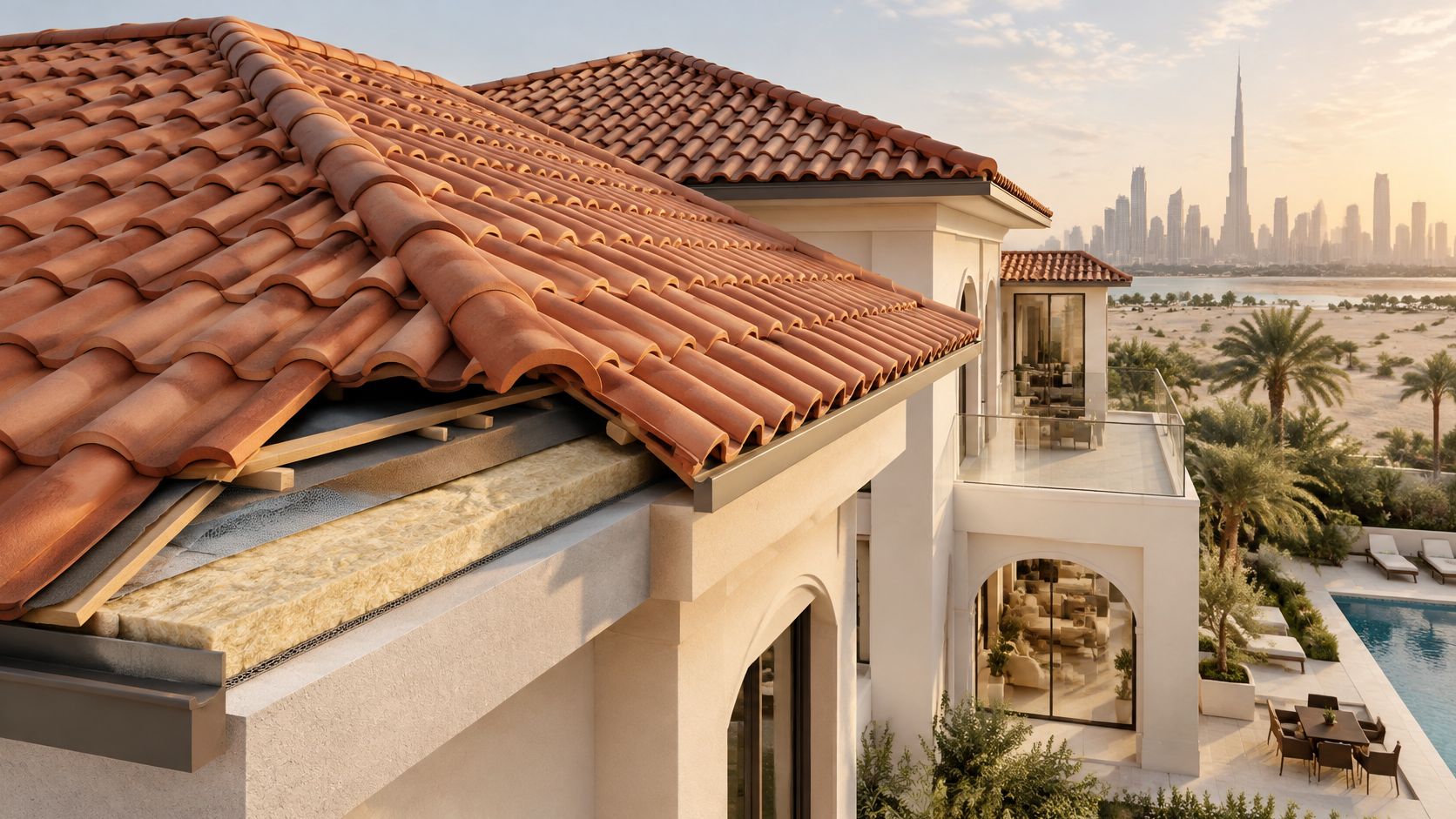
Clay Roof Tiles in the UAE: Types, Specs and Costs
Clay is cool, durable and sorts your roof for decades. That's the advice you'll hear most often, and I'd push back on all three parts if you're buying for a UAE project. A well fired clay roof tile can last, but it doesn't insulate a building by reputation, and it doesn't pass an approval because a brochure calls it energy efficient. What the authority assesses, what the occupant pays to cool, and what fails first on site is the whole roof assembly. Insulation thickness, a ventilated cavity, underlay, fixings, flashings and paperwork decide the outcome. Treat the tile as the weather surface on top of that system, not as the system itself, and you'll make sharper procurement decisions from day one.
Clay Roof Tile Types and Where Each Fits
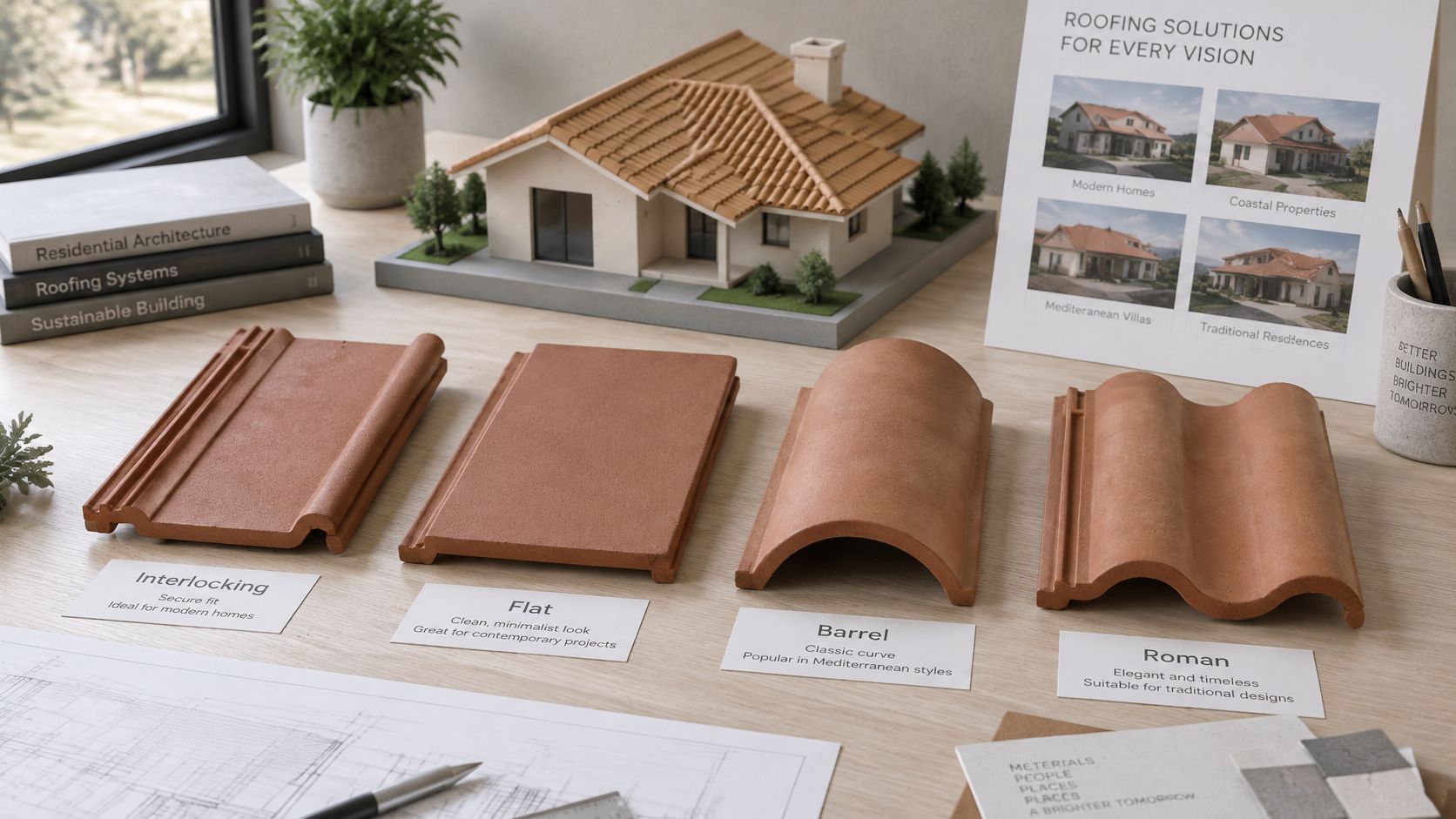
Start with the profile, because the profile sets weight, fixing method and detailing before colour ever enters the conversation.
Clay roof tile profiles and typical uses
| Tile type | Profile | Typical use | Watch for |
|---|---|---|---|
| Interlocking | Dry-fit interlocking edges | Residential pitched roofs | Needs battens and a drained underlay; lighter than plain tile |
| Pantile | Single curved S-profile | Traditional and Mediterranean-style roofs | Wide cover; ridge and verge detailing needs care |
| Plain tile | Flat, rectangular, double-lap | Heritage restoration and matching | Heavier; more fixings and stronger battens |
| Spanish barrel (Mission) | Half-round pairs | Villas and hospitality facades | Heavy; confirm structural capacity before ordering |
What Each Profile Asks From the Roof
Interlocking tiles are the practical default for most new pitched roofs. The side channels speed laying and improve resistance to wind-driven rain, but they still rely on correctly spaced battens and a drained underlay below. Don't let a dry-fit edge persuade anyone the underlay is optional.
Pantiles give you that single rolling S curve and cover ground quickly because each tile is wide. The trade-off sits at the edges. Ridge, hip and verge pieces must close a pronounced profile, and sloppy cutting there shows immediately and leaks first.
Plain tiles suit restoration and matching work where a flat, small-format finish matters. Because they're double-lap, you're paying for more tiles, more fixings and more labour per square metre, and the structure carries more weight. Order them for appearance or heritage fit, not for programme speed.
Spanish barrel tiles use separate pan and cover pieces, so the finished roof has deep shadow and a strong villa or hospitality character. They're also the heaviest conversation in the room. I wouldn't release an order until the designer confirms the deck, battens and fixings for that load in writing.
Glazed or Unglazed Is a Finish Decision
Glazing isn't a fifth profile. Any of the four can be specified glazed, which resists staining and makes dust easier to wash off exposed roofs, provided the declared finish data holds up. Unglazed tiles match restoration tones better and weather more naturally, but a poorly fired unglazed tile shows wear sooner.
Before you shortlist, answer three questions. What's the roof pitch? What load will the structure carry? Does the design need a traditional profile or a cleaner modern line? If a supplier can't tie a recommendation to those three answers, you're looking at a sales list, not a specification.
How Clay Tiles Handle UAE Heat and Wind
Clay tiles store heat. That's not the same as keeping heat out, and confusing the two is where cooling bills start rising.
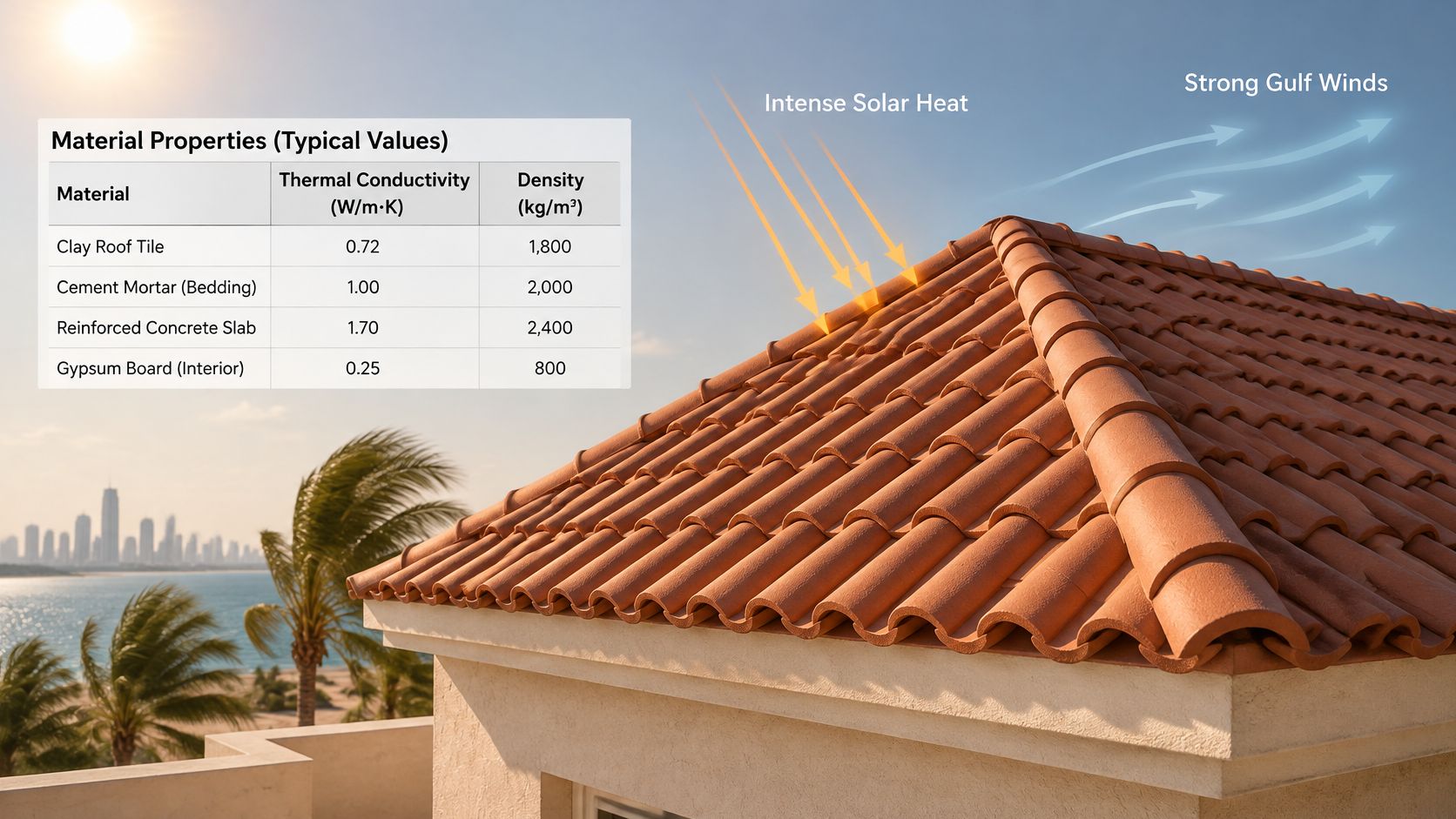
A comparative review of hot-dry roof data from the Gulf region reports tile thermal conductivity of approximately 1.06 to 1.73 W/m·K, density of about 1,500 to 2,243 kg/m³, and specific heat of roughly 840 to 920 J/kg·K. Read those figures plainly. The material conducts heat readily, it's heavy, and it holds warmth then releases it slowly. That's thermal mass, not insulation.
Reference thermal and material values for clay roof tiles
| Property | Reference range | What it means on a UAE roof |
|---|---|---|
| Thermal conductivity | 1.06 to 1.73 W/m·K | Conducts heat readily; the tile is not an insulation layer |
| Density | 1,500 to 2,243 kg/m³ | Heavy; confirm roof structure and batten capacity |
| Specific heat | 840 to 920 J/kg·K | Stores heat and releases it slowly into the roof space |
| Water absorption (experimental benchmark) | 9.8% after firing at 1,000°C with 15% ferrosilicon slag | Lower absorption limits moisture ingress; request the declared value for the exact model |
Why the Cavity Below Does the Real Work
Without an insulated, ventilated cavity, daytime solar gain moves through the tile into the deck and the air conditioning picks up the cost. Specify continuous insulation, a drained underlay, mechanically restrained tiles and a ventilated air gap that carries accumulated heat away before it reaches the ceiling plane. Thermal bridging at battens and fixings, plus airtightness at the ceiling, will usually influence HVAC performance more than a small difference between two tile brands.
Colour and finish matter, but they sit downstream of the assembly decision. A pale tile over thin insulation still underperforms a darker tile over a properly insulated, ventilated build-up. Ask for tested conductivity, density, water absorption and fire-class data for the exact model, not a generic range from a catalogue family.
The short video below is useful for site teams who need the heat and ventilation point in visual form before a toolbox talk.
Absorption, Firing and Thermal Shock
Durability here turns on three linked qualities. Water absorption controls how much moisture enters the body of the tile during wind-driven rain and wet-dry cycles. Firing quality sets strength and vitrification. Thermal shock resistance determines whether a tile tolerates fierce sun followed by sudden rain or washdown without cracking.
Use the absorption figure in the table carefully. A peer-reviewed roof-tile study found firing at 1,000°C with 15% ferrosilicon slag reduced water absorption to 9.8%, with specimens evaluated by quenching samples from 600°C to 25°C. That's an experimental formulation, not a product claim for anything you'll buy in Dubai. Its value is as a benchmark for the conversation. Request declared absorption and breaking-load results for the exact tile model and compare them against it.
On site, the three stresses that attack the surface and fixings are wind-driven rain, abrasive dust, and salt-laden coastal air. A tile can survive all three while plain steel fixings corrode beneath it. Check both the tile data sheet and the fixing specification before you judge durability.
Buyer's check: If a supplier can't produce declared absorption and breaking-load data for the named model, you don't have a durability specification yet. You have a colour sample.
Roof Assembly Rules for Dubai Compliance
A clay tile's reputation cannot establish roof compliance. Dubai assesses the full assembly, including insulation, installation details and supporting documents.
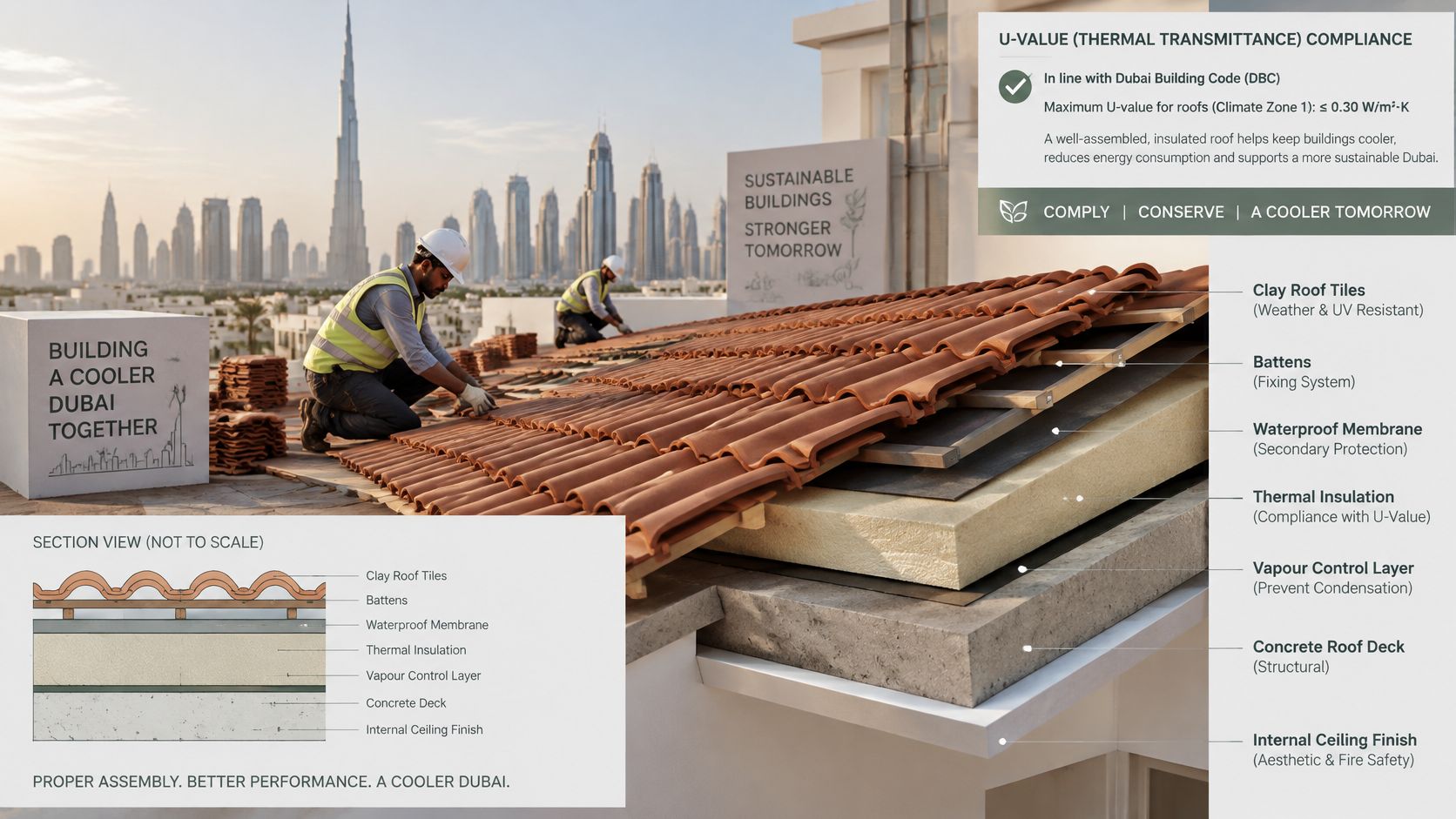
The Dubai Building Code sets a maximum average roof thermal transmittance of 0.30 W/m²K. The tile alone does not provide the insulation needed to meet that figure. A sunny-afternoon surface temperature reading or a manufacturer's cool-roof claim is not equivalent to the code-defined average transmittance.
Dubai's green-building rules also set minimum solar-reflectance requirements for a share of the opaque roof area. Confirm the applicable Solar Reflectance Index (SRI) thresholds for the project with the design consultant and authority. A dark terracotta tile may suit the design and remain durable, yet the roof can still miss its required thermal performance or reflectance if the actual build-up has not been assessed.
Build the Assembly From the Deck Up
Set out each layer and assign responsibility for its design and installation.
- Deck and ceiling plane: Confirm the structure, ceiling build-up and airtightness details. Gaps at this level can undermine the thermal calculation.
- Insulation: Specify the material and thickness used to achieve the calculated U-value. The tile does not replace this layer.
- Underlay: Specify a drained or reflective underlay, with sealed laps and terminations at eaves, verges and penetrations.
- Ventilated batten cavity: Detail batten and counter-batten dimensions so air can enter at the eaves and leave at the ridge without obstruction.
- Tile and ridge system: Show the tile, ridge, hip and verge components, with fixings set to the approved pattern.
Compare complete assemblies, not tile brands. A direct-fixed tile over insulation performs differently from a ventilated batten system over the same insulation. The difference affects the roof calculation even when the elevations look identical. For local approval context, consult this overview of Dubai building codes.
Documents That Prove Compliance
List these tender deliverables with an owner and submission date:
- Product reflectance data for the specified tile colour and finish.
- Tested or calculated roof-assembly U-value for the full build-up, not the tile alone.
- Insulation specification showing material, thickness and continuity at edges.
- Cavity ventilation details for eaves intake, ridge exit, and any fire or pest barriers.
- Approved installation drawings showing fixing patterns, underlay laps and junction details.
Require the design team to show the calculated U-value and SRI for the specified tile and assembly. Return submissions that quote only a surface temperature or marketing claim. For Abu Dhabi projects, confirm the applicable emirate rules and obtain project-specific cooling-load and energy-code requirements from the design consultant and authority. Confirm early that the supply chain provides municipality-compliant building materials; late substitutions can leave the approval documents out of step with the installed roof.
A reviewer should be able to trace one named tile through a drawn assembly to a calculated result. If any link in that chain is missing, the tender package is incomplete.
Clay Tiles Against Concrete, Metal and Bitumen
Purchase price is the easiest number to get and the least useful one to decide on. Service life, replacement timing and access for maintenance determine what a roof costs.
Typical lifespan and upkeep by roof covering
| Roof covering | Typical service life | Maintenance need | Main UAE concern |
|---|---|---|---|
| Clay roof tiles (well fired) | 50+ years | Low; periodic cleaning and fixing checks | Dust in valleys, salt air, underlay and fixing ageing |
| Concrete tiles | 30 to 50 years | Low to moderate | Coating wear and heavier roof load |
| Coated metal | 25 to 40 years | Low; coating checks | Thermal movement, noise and coating breakdown in salt air |
| Bitumen shingles | 15 to 25 years | Moderate | UV ageing and softening in high heat |
How to Read the Differences
Clay wins on longevity when firing quality is sound. The tile itself may outlast everything beneath it, which is precisely the trap. Underlay, sealants and fixings age on their own schedule, and a roof that looks perfect from the street can be leaking through a perished membrane. Budget for fixing checks and valley cleaning, not tile replacement.
Concrete tiles offer a familiar profile at a generally lower entry cost, but they are heavy and the surface coating does much of the visual work. As that coating wears under UV and dust abrasion, appearance fades even while the tile body remains serviceable. Check what the coating warranty covers.
Coated metal goes up fast, weighs little and suits tight programmes or limited structural capacity. In return you accept thermal movement at fixings, rain noise that hospitality guests notice, and coating inspections in coastal air. Once the coating breaks down at cut edges and fastener holes, corrosion follows quickly.
Bitumen shingles are the short-term answer. They're light and cheap to lay, but sustained heat softens them and UV ages the surface, so they're best kept for low-budget or temporary roofs where early replacement is already accepted in the plan.
Build a Cost Per Year Model
Don't compare single prices. Build the same model for every covering using figures from firm quotes in your own tender, since you'll get a defensible answer only from your project's numbers.
- Unit cost per square metre: Take the quoted supply and install rate for each covering.
- Fixings and access allowance: Add clips, fasteners, walkways and safe access for future inspections.
- Maintenance visits: Price periodic cleaning, coating checks or fixing inspections across the service life.
- Replacement timing: Add the cost of re-covering when the shorter-lived options expire inside your appraisal period.
- Repair stock: Allow for spare tiles, ridge pieces or matching shingles held from day one.
Divide the total by service life in years and you have a cost per year that boards and owner associations can compare accurately. Clay usually justifies itself on long-life, heritage and hospitality projects where appearance and longevity carry real value and the structure accepts the weight. Choose lighter or faster coverings when structural capacity is tight, the programme won't absorb careful detailing, or the asset will be redeveloped before clay's lifespan pays back. Heritage fit also deserves respect. Research on Dubai"s heritage architecture in a WIT Press paper on traditional Gulf construction records that pre-1900 homes commonly used palm-frond construction known as Bait Areesh, with clay tiles acting as a protective finishing layer over timber and woven palm rather than as the principal roof material. Restoration specifications should honour that layered logic instead of treating the tile as a stand-alone product.
Specifying Tiles, Fixings and Accessories
A tile-only quotation looks tidy and fails untidily. The gaps surface on site as extras, delays and junctions finished with whatever was in the van.
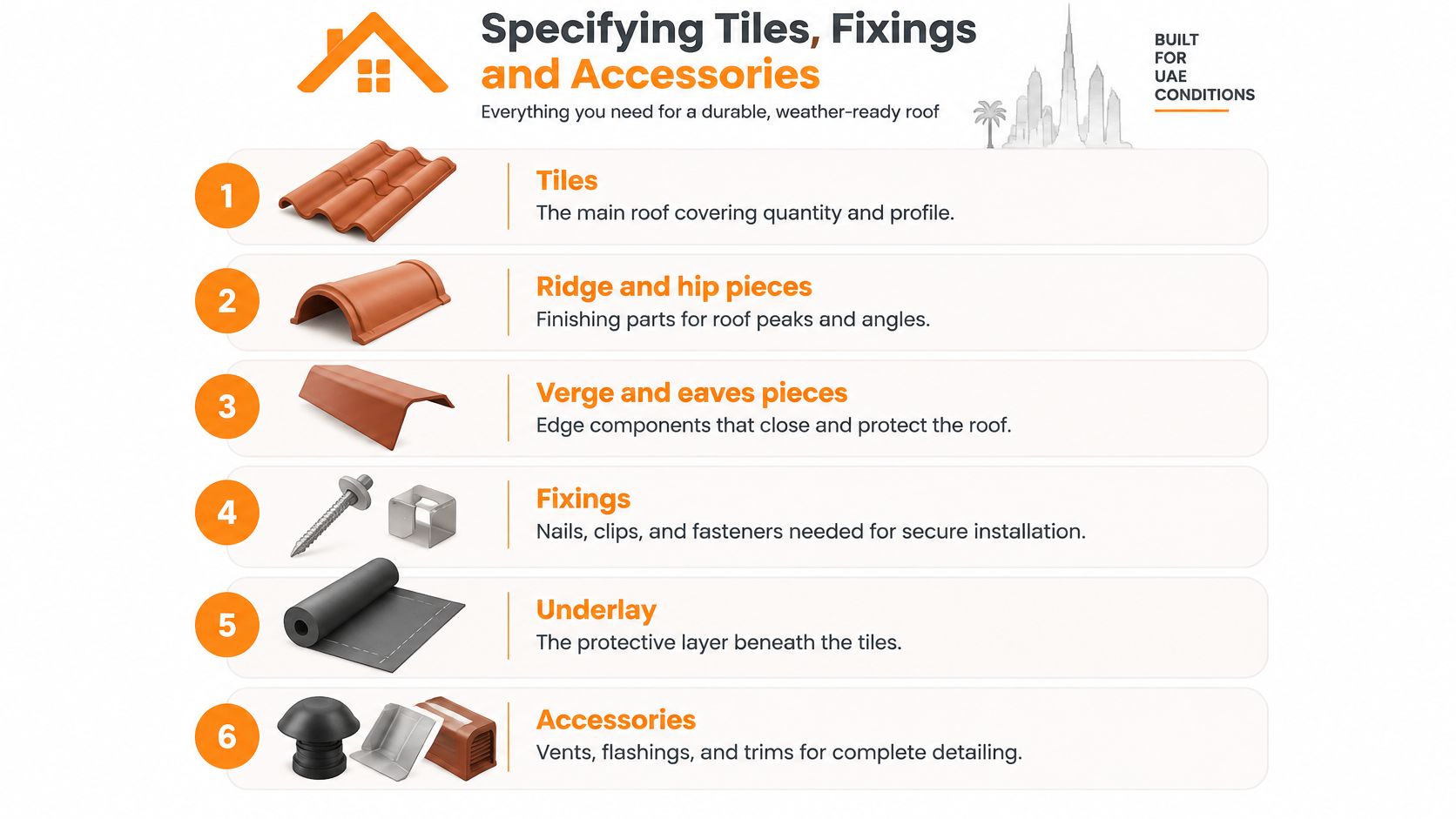
The Consolidated Bill of Materials
Specify the full package as one tick-off checklist during tender review.
- Tiles: Named model, profile, colour, finish and quantity including cutting waste. Without the exact model, test data means nothing.
- Ridge and hip pieces: These set the weather seal at the highest, most wind-exposed lines. Missing or substituted pieces leak and lift first.
- Verge and eaves pieces: Edge components close the profile against wind-driven rain and birds. Open verges are a maintenance complaint waiting to happen.
- Dry-fix components: Clips, ridge rolls and verge units that replace mortar bedding, which cracks and crumbles under thermal movement.
- Corrosion-resistant fasteners: Nails, screws and clips specified for coastal salt exposure. Plain steel fixings fail invisibly while tiles still look sound.
- Underlay: The secondary water barrier that carries water away when a tile cracks or lifts. No underlay means every tile defect becomes an internal leak.
- Flashings: Purpose-made details at abutments, valleys and penetrations. Sealant alone at a junction is a repair scheduled in advance.
- Sealants: Compatible products named for each junction, with movement capability suited to roof temperatures.
- Repair stock: Spare tiles and fittings from the same production batch, stored on site or with the facilities team.
Structural and Wind Checks With Named Owners
Convert the open questions into tender lines, each owned by a named party. The designer confirms dead load from tile weight against the roof structure and batten capacity. The designer also sets the fixing pattern and wind-uplift resistance, with closer fixing at edges, ridges and corners where uplift peaks. The contractor confirms substrate capacity on the actual deck before loading it. The supplier confirms replacement-tile availability and the lead time in writing.
A roof covering is not a trafficable surface. If rooftop plant needs servicing, the specification needs designated walkways, or your maintenance team will create the breakages you're paying to repair.
Agree the spare-tile quantity up front, while the batch is still in production and colour matching is easy. Trying to match a weathered terracotta three years later, from a discontinued profile, is how a small repair turns into a visible patch across an elevation. Tick every line, assign every owner, then price the package as one order.
Sourcing and Delivering Clay Tiles in the UAE
Regional supply is stronger than most buyers assume. An IndexBox GCC ceramic-tile market overview reports GCC ceramic-tile production of approximately 298 million square meters in 2024, with the UAE producing approximately 128 million square meters, second to Saudi Arabia at 170 million square meters, and UAE ceramic-tile exports valued at roughly USD 293 million, about 83% of total GCC ceramic-tile exports.
Use those figures for what they prove. They cover ceramic tiles broadly, not roof tiles alone, so they aren't a clay roof tile volume. They do show deep regional firing, glazing, quality-control and warehousing capacity, which supports project-scale supply and replacement quantities. Raw material still travels. A separate IndexBox overview of GCC construction and industrial clay notes common clay accounted for approximately 96% of GCC imports of that category in 2024, totalling 118,000 tons. Limited local raw clay is exactly why confirmed production slots matter more than warehouse promises.
Five Procurement Steps in Order
- Confirm the model first: Lock the tile model and declared test data before requesting prices, so every quote prices the same product.
- Group the order: Put tiles, ridge pieces, fixings and underlay on one order to prevent split deliveries stalling the work face.
- Agree spares and lead time: Fix the spare quantity and a written replacement lead time before the order is placed, not after the first storm.
- Sequence delivery to the programme: Schedule loads to the tiling sequence so pallets aren't stored in the open for weeks, gathering damage and dust.
- Check batches on arrival: Inspect colour consistency pallet by pallet and record batch numbers against the delivery note before anything goes up.
Mixing batches across one slope is a classic own goal. Slight kiln variation is invisible in a yard and obvious across a finished elevation in hard sunlight. Keep each slope to one batch where you can, and blend deliberately where you can't.
A sound sourcing plan passes three tests. Tiles arrive matched, the order arrives complete, and replacements can be sourced within the programme. If any test fails on paper, it'll fail expensively on the roof.
Installation Sequence and Site Handover
Good tiling is a sequence of verified stages. Each stage gets checked before the next one covers it, because the layers that matter most are the ones you can't see at handover.
The Seven Stages
- Confirm deck and structure: Verify the deck against the designer's dead-load and batten-capacity figures before any material is fixed. Loading pallets onto an unverified deck is the fastest route to deflection and cracked tiles.
- Lay insulation and underlay: Install continuous insulation and the drained underlay exactly as the approved assembly shows, with laps and terminations sealed at eaves, verges and penetrations. Photograph every lap direction before battens cover them.
- Fix battens and counter-battens: Set spacing to the approved drawings to create the ventilated air gap. Gauge the battens to the tile's actual coverage, measured from delivered stock, not a catalogue dimension.
- Set the first course: Start at the eaves and get the first course square and level. Every later course inherits its errors, and a wandering eaves line can't be hidden at the ridge.
- Tile and fix to pattern: Fix each tile with the specified clips or nails, following the drawn fixing pattern throughout the field. Check wind-uplift fixing at edges, corners and ridges against the designer's requirement, because that's where storms start unzipping roofs.
- Close ridges, hips and verges: Fit ridge, hip and verge pieces with the specified dry-fix components and sealant. Then water-test a representative section, including a valley and a penetration, before anyone talks about handover.
- Protect the finished surface: Mark designated walkways and keep foot traffic off the field of tiles for the remaining works. Other trades crossing a finished slope cause more cracked tiles than weather does in the first year.
The Handover Record
Hand over evidence, not assurances. The package should include dated photographs of the underlay, fixings and cavity taken before covering, batch numbers for tiles and fittings, the water-test result, and a signed record confirming the works followed the approved drawings. Add the location of stored spare tiles and the inspection schedule the facilities team inherits. When a leak appears in year three, that file tells the investigator whether they're looking at a product failure, a workmanship failure or damage from later access, and it protects the contractor who built it properly.
Maintenance Problems and How to Fix Them
Most clay roof failures announce themselves early and cheaply. The skill is reading the symptom correctly instead of replacing tiles at random.
Clay roof tile symptoms, causes and fixes
| Symptom | Likely cause | Fix |
|---|---|---|
| Cracked or chipped tiles after storms | Wind uplift or foot traffic on tiles | Replace with matched tiles; mark walkways and limit access |
| Dust build-up in valleys | Blocked drainage path | Clear valleys and gutters on a set schedule |
| Damp patches under eaves | Torn underlay or failed flashing | Repair underlay and flashing; check fixings |
| Stuffy loft and rising cooling bills | Blocked ventilation or thin insulation | Clear vents; check insulation against approved drawings |
| Loose ridge tiles | Corroded or missing fixings | Replace with corrosion-resistant fixings |
Reading the Symptoms Properly
Cracked tiles after a storm rarely mean the whole roof is failing. Check whether damage clusters along access routes to rooftop plant. If it does, feet caused it, and walkways plus an access rule fix it permanently. Damage at edges and corners points instead to uplift and fixing failure, which needs the fixing pattern reviewed, not just new tiles.
Dust in valleys is a UAE-specific drainage problem. Fine dust settles, compacts with dew, and dams the valley until wind-driven rain ponds and finds the underlay laps. Clear valleys and gutters on a set schedule and always after major dust storms. While you're there, check that ventilation openings at eaves and ridge haven't clogged with the same dust.
Damp patches under eaves usually mean the secondary defence has failed. Lift tiles locally, inspect the underlay for tears and UV embrittlement at exposed laps, and check flashings at abutments. Where a coating repair is being considered for adjacent roof areas, this guide to waterproof roof coating helps separate surface protection from genuine underlay repair. Don't seal over a torn membrane and call it fixed.
A stuffy loft with rising cooling bills is an assembly symptom, not a tile symptom. Blocked eaves vents, compressed insulation or insulation thinner than the approved drawings all produce it. Measure what's installed against what's drawn before blaming the covering.
Loose ridge tiles point to corroded or missing fixings, especially on coastal projects where salt air works on plain steel. Replace with corrosion-resistant fixings across the full ridge line. Spot-fixing one loose piece leaves its equally corroded neighbours ready for the next storm.
Inspect after every severe wind event, then once a year as routine. Log fixings, flashings, drainage and breakages each time, so the owner association or facilities team can see deterioration trends instead of rediscovering them.
Keep inspection access safe by design. Walkways, crawling boards and a rule that nobody steps on the field of tiles will save more tiles than any repair budget. Draw replacements from the stored same-batch stock first, record every tile taken, and reorder before the shelf empties.
Confirm the Specification Before You Order
A tile's reputation cannot confirm a roof's performance. Before raising the purchase order, check that the specification, approved drawings and bill of materials agree. The assembly determines thermal and compliance outcomes, while the itemised order makes clear what the project still needs.
Resolve any mismatch against the approved drawings before ordering. Assign an owner to each open specification item, then confirm the tile model and its declared test data and reflectance figures with the design team.
Three checks should be complete before procurement proceeds:
- Submit the tile model for review: Give the design team the named model, declared test data and reflectance figures for sign-off.
- Price the specified components: Check that the bill of materials accounts for the tiles, ridge and verge pieces, fixings, underlay, flashings and repair stock. Confirm pricing and availability with the relevant supplier.
- Match delivery to the programme: Agree load dates and batch allocation with the supplier in writing.
Yasu Trading Co. LLC supplies municipality-compliant building materials and stocks Plumbing, Power Tools, Electrical, Fire Protection, Safety Gears, and Adhesive & Sealant under one roof in Deira, Dubai. Send the roof drawings and bill of materials so the team can check which items it stocks, consolidate those into one wholesale order with site-direct delivery, and confirm current stock and compliance paperwork before the purchase order is raised.
The specification is ready to order when every checklist item is complete, each check has a named owner and the approved drawings are on file. If an item remains open, resolve it before committing to the purchase.