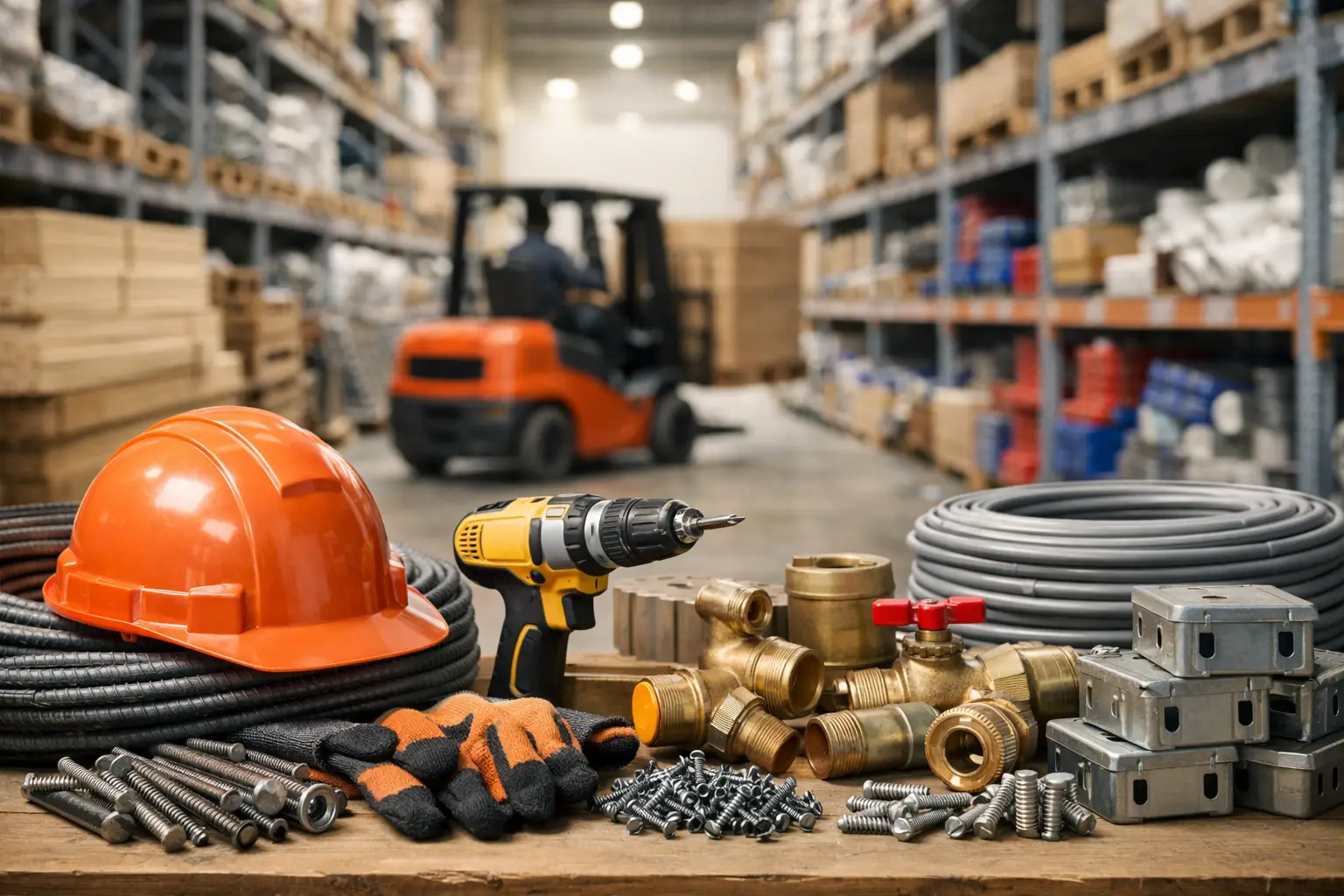
Deira Hardware Wholesale for Fast Project Supply
If your team is still calling five suppliers to complete one material request, the real cost is not only price. It is lost time, partial deliveries, approval risk, and site stoppages when one missing fitting, breaker, sealant, or anchor holds up the next activity. That is why Deira hardware wholesale remains a practical procurement route for contractors and MEP buyers who need speed, range, and pricing discipline without sacrificing compliance.
Why Deira hardware wholesale still matters to contractors
Deira has long been a buying zone for construction hardware in Dubai, but for professional buyers the value is not just market access. The real advantage is concentrated availability across core building material categories. A procurement team can source plumbing pipes and fittings, electrical components, hand tools, power tools, fasteners, adhesives and sealants, paint accessories, sanitary ware, and fire and safety items from one operating area instead of spreading orders across the city.
That matters when projects are running on compressed timelines. Fit-out contractors, MEP subcontractors, and maintenance teams rarely have the luxury of waiting several days for low-value but critical items. A missing valve, cable accessory, or fixing system can delay labor, rescheduling, inspections, and handover. In that environment, wholesale access is less about shopping and more about keeping work fronts active.
There is also a commercial reason. Small price differences across many line items add up fast on active projects. Wholesale buying can improve cost control, especially when the supplier can consolidate categories into one quote and one dispatch. That reduces hidden procurement overhead as much as it reduces material cost.
What professional buyers actually need from a Deira hardware wholesale partner
A trader with shelves full of products is not automatically a reliable project supplier. Contractors need a partner that can support execution, not just transactions. The first requirement is inventory readiness. If the supplier quotes aggressively but cannot dispatch on time, the low price does not help the job.
The second requirement is municipality-compliant materials. This is especially important in plumbing, electrical, and fire and safety categories where submittal alignment and inspection performance matter. Buying non-compliant or unverified products may look cheaper at purchase stage, but rework, rejection, and replacement costs are usually higher than the savings.
The third requirement is brand authenticity and warranty support. This comes up often with power tools, safety products, and specification-led materials. Procurement managers do not want arguments over product origin after delivery. They want authorized brands, clear documentation, and supplier support if a warranty claim needs to be processed.
The fourth requirement is logistics. For active sites, the difference between same-day dispatch and next-week delivery is not minor. Reliable site delivery across Dubai and nearby project zones changes how buyers plan replenishment. It allows leaner on-site stock, fewer emergency runs, and better labor continuity.
The categories that drive repeat wholesale demand
In practice, Deira hardware wholesale works best for buyers who want to consolidate recurring categories under one account. Plumbing materials are one of the clearest examples. Pipes, fittings, valves, thread sealants, clamps, and sanitary connections move constantly across residential towers, villas, retail fit-outs, and maintenance contracts. These are not one-time purchases. They are repeat procurement lines that need stable availability.
Electrical supply follows the same pattern. Conduits, accessories, cable management items, switches, breakers, connectors, and consumables often create urgent requirements because installation sequences move quickly. An electrical team cannot progress if even one accessory line is short. The supplier that can fill both planned and urgent orders becomes far more valuable than one that only handles scheduled bulk requests.
Fasteners and fixing systems are another high-frequency category where wholesale value is easy to see. Anchors, bolts, screws, threaded rods, washers, and support accessories are consumed across nearly every trade. They are simple products on paper, but wrong specifications create hold-ups and performance issues. Buyers need the right grade, coating, size, and application fit, not just a box that looks similar.
The same applies to adhesives and sealants. These items are often underestimated until the wrong product reaches site. Fire-rated, waterproofing, bonding, gap-filling, and general-purpose sealants all have different use cases. Procurement teams benefit when the supplier can guide selection based on substrate, movement, weather exposure, and compliance requirements.
When consolidated sourcing beats multi-vendor buying
Some buyers still split categories across multiple vendors to chase the lowest unit price. Sometimes that works, especially on very large-volume, highly standardized packages. But on mixed construction and maintenance demand, multi-vendor buying creates friction. Purchase orders multiply, delivery schedules become harder to track, and site teams spend more time coordinating than installing.
Consolidated sourcing is usually stronger when the project has many moving parts and frequent call-offs. One supplier can combine MEP materials, tools, consumables, sanitary ware, and safety products into a single delivery flow. That reduces inbound congestion, invoice fragmentation, and follow-up workload for procurement staff.
There is a trade-off. A specialized niche supplier may occasionally offer a better deal on one product line. But if that saving creates two days of delay or forces another emergency purchase elsewhere, the total buying outcome is worse. Professional procurement is not only about line-item price. It is about delivered value, timing, and risk control.
How to evaluate a wholesale supplier before you commit
Start with the quote structure. A good wholesale supplier should be able to handle mixed-category RFQs without confusion and respond with clear itemization, brand details, and practical alternatives where needed. Vague descriptions and inconsistent units are early warning signs.
Next, test technical support. Ask application-specific questions on plumbing fittings, electrical accessories, sealant compatibility, or tool selection. A serious B2B supplier should be able to advise on fit-for-purpose options rather than pushing whatever is overstocked. That is especially important when substitutions are proposed.
Then check dispatch capability. It is worth asking what is actually stocked, what needs lead time, and how deliveries are scheduled for active sites. Many suppliers claim fast service, but the real measure is whether they can deliver complete orders consistently. Partial fulfillment is one of the biggest causes of jobsite disruption.
Finally, verify how they handle compliance and warranty issues. If a product is rejected on site or fails under warranty, the response process matters. Buyers need quick replacement support and traceable documentation, not silence after invoicing.
The operational advantage of a Naif-based wholesale desk
A strong Deira base, particularly around Naif, gives buyers access to market-speed procurement while still supporting structured B2B supply. That combination matters. Contractors often want the pricing intensity associated with traditional trading districts, but they also need formal quotations, repeatable service, and logistics that fit project schedules.
This is where a supplier like Yasu Trading Co. LLC stands out when procurement teams want more than a counter sale. The value is in combining wholesale pricing with inventory-backed fulfillment, technical guidance, and site-direct delivery for professional buyers managing real deadlines. That model fits both planned project procurement and urgent replacement demand.
For companies operating across Dubai, Sharjah, Abu Dhabi, Fujairah, and Ras Al Khaimah, delivery capability also becomes part of the buying decision. A supplier may have the right stock in Deira, but if they cannot dispatch efficiently to the site, the benefit is reduced. Buyers should treat logistics performance as part of product quality.
Choosing better, not just cheaper
Deira hardware wholesale makes sense when it helps you simplify procurement, reduce delivery risk, and keep approved materials moving to site without delay. The strongest suppliers are not the ones with the longest product list. They are the ones that can quote accurately, supply consistently, support specifications, and deliver when the schedule is tight.
If your projects depend on continuous material flow, the better question is not where to buy the cheapest box today. It is which supplier can help your team buy once, receive on time, and keep the job moving tomorrow.