Fire Extinguisher Types and Uses: Which Class to Choose
You're walking a building you've just taken over. Every corridor has the same red cylinder on the same bracket, and every one of them carries the same label: ABC dry powder. There's one beside the server rack. There's one in the commercial kitchen, a few paces from the fryer.
Nothing on that wall is technically non-compliant, and that's the problem. The setup will pass a visual check and still fail the only test that matters, which is the night someone grabs the nearest unit and points it at the wrong fuel.
Sorting out fire extinguisher types and uses isn't a purchasing decision you make once for a whole building. It's a room-by-room decision, driven by what burns in that room, how far the unit sits from the hazard, and what the agent does to the fuel when it lands. Get it right and a small fire stays small. Get it wrong and you've fed it.
Table of Contents
- Why the Fire Type Decides the Extinguisher
- Fire Classes and the Extinguisher for Each
- How Each Extinguisher Agent Performs
- Choosing Extinguishers by Building Area
- Placement Rules and Limits Most Sites Miss
- How to Use an Extinguisher with PASS
- Check Your Extinguishers Before the Next Inspection
Why the Fire Type Decides the Extinguisher
A pan of cooking oil goes up on a gas ring. Someone grabs the water extinguisher off the wall because it's the closest thing and water is what you put on fire. The water hits the oil, sinks below the surface, flashes to steam and throws burning fat up and out of the pan. The fire is now on the wall, the extractor and the person holding the extinguisher.
That's the whole argument in one scene. An extinguisher is matched to the fuel it fights, not to the building it hangs in. Water is the right answer on a stack of cardboard and a catastrophic one on hot oil.
A portable extinguisher only gets its chance while a fire is still small. Detection is what creates that window: the sooner the alarm sounds, the more likely an occupant reaches a unit in time to knock the fire down in its first stage. Smoke detector requirements for UAE projects and extinguisher selection belong in the same specification conversation, because the best-matched cylinder behind a late alarm is a cylinder nobody reaches.
The wrong-agent risk runs the other way too. The same water that kills a store-room fire becomes a conductor in an electrical room and a spatter hazard in a kitchen, which is why a blanket spec of one extinguisher type only works where the fuel load is uniform. Corridors and offices burning paper and textiles can share water, foam or multipurpose ABC powder. Kitchens, server rooms and workshops each need their own agent on the bracket, sized and sited for that room's worst credible fire.
I'd walk the building room by room, name the fuel in each space, then check the bracket. The cylinder earns its place only if the agent inside matches the fire that room can produce.
Fire Classes and the Extinguisher for Each
The UAE Fire and Life Safety Code of Practice treats a portable unit as first-line protection for every occupancy, built to knock a fire down in its initial stage before it outgrows what an occupant can handle, and it maps each hazard to a defined set of agents (UAE Fire and Life Safety Code of Practice). Here is that framework in one place.
| Fire class | Fuel involved | Suitable extinguishers | Agent to avoid |
|---|---|---|---|
| Class A | Ordinary combustibles such as wood, paper and textiles | Water, foam, multipurpose dry powder | No major exclusion |
| Class B | Flammable liquids such as petrol, oil and paint | Foam, dry powder, CO2 | Water jet, which spreads the burning liquid |
| Class C | Energised electrical equipment | CO2, non-conductive dry powder | Water and foam, which conduct electricity |
| Class D | Combustible metals such as magnesium and sodium | Special-purpose dry powder | Water, foam and CO2, which can react with the metal |
| Class K | Cooking oils and fats | Wet chemical | Plain water, which causes violent splashing |
Class A is the everyday fire, and water earns its place because it removes heat rather than smothering. Multipurpose dry powder carries an A rating on most labels, though a deep-seated fire in a paper bale will keep smouldering under the powder. CO2 does not belong on this class at all: it displaces oxygen but cools nothing, so hot material reignites once the gas disperses.
Class B needs a blanket, not a jet. Foam floats on the liquid and seals the vapour, dry powder interrupts the flame, and CO2 works in a pinch. A water jet pushes burning petrol across the floor, which is how a drum spill in a store room becomes a wall of fire along the corridor.
Class C is about conductivity first. Water and foam put the operator in the circuit, so the code names CO2 and dry powder. Kill the power and the fire usually reclassifies itself as a Class A, which is why an electrical room stocked with both types gives the operator options.
Class D is the specialist corner. Magnesium and sodium react with water and with most general agents, so only a purpose-made powder identified for that metal goes near it. A workshop that machines magnesium needs that unit on the wall before the first job starts, not after the first flare-up.
Class K is engineered for oil. Wet chemical saponifies the fat and lays a cooling layer over it, which is the opposite of what water does to a fryer.
The same code fixes where the unit goes as well as what's inside it. Mounting height and clearance limits are set by the applicable code and local civil defence rules, and nothing may obstruct an escape path. Check the current requirement for the site rather than hanging units by eye, because an extinguisher two metres off the floor protects no one.
Read the room's main fuel first, then match the label. A single room often holds more than one class, and the higher hazard sets the choice.
How Each Extinguisher Agent Performs
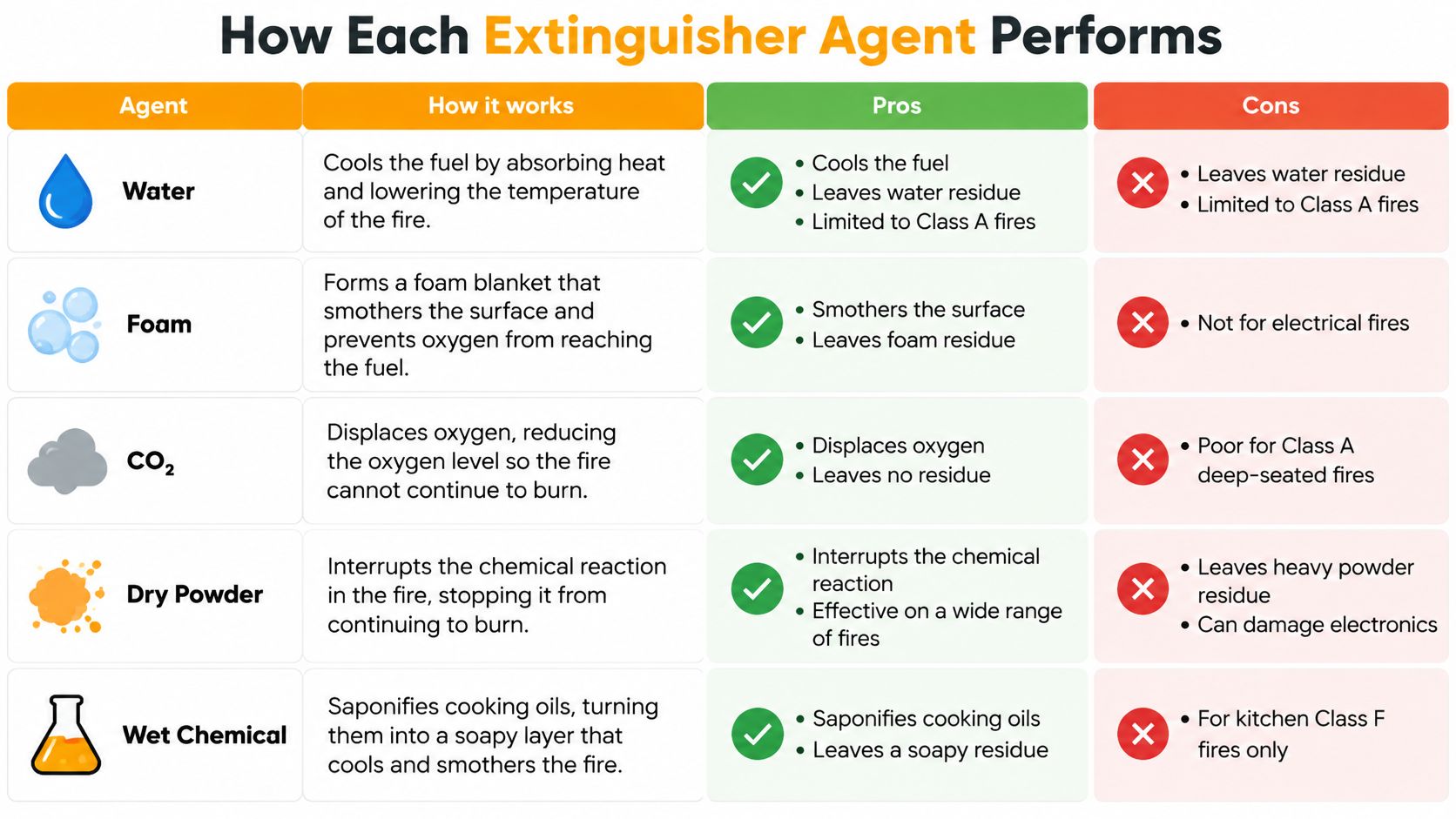
Five agents cover almost every portable unit you'll buy. They differ in how they stop combustion and in what they leave behind.
| Agent | Residue | Main limitation |
|---|---|---|
| Water | None | Conducts electricity and spreads flammable liquids |
| Foam | Foam blanket to clean up | Not safe on energised electrical equipment |
| CO2 | None | Short range, no cooling, risk in small enclosed spaces |
| Multipurpose ABC dry powder | Powder that corrodes electronics | Reduces visibility and is poor on deep-seated fires |
| Wet chemical | Soapy residue | Only for cooking-oil fires in kitchens |
Water absorbs heat faster than anything else on the list, which is why it's still the default for paper, timber and textiles. Foam does two jobs at once: its water content cools, and the film it leaves seals the surface so vapour can't reignite.
CO2 works by displacement, crowding oxygen out of the immediate area. It's clean, non-conductive and popular in server rooms for exactly that reason. It also disperses quickly outdoors and offers little cooling, so a hot surface can flare again minutes after the flames die. In a small plant room, a full discharge can leave the atmosphere unbreathable.
Dry powder is the generalist. It interrupts the chemical chain reaction and comes in ABC and BC formulations that are not interchangeable, plus specialist metal powders that are chosen per metal.
The trade-off in one line: the agent that leaves nothing behind does the least cooling, and the agent that cools best is the one you can never point at a live circuit.
Wet chemical is the only agent designed for cooking oil. It reacts with the fat to form a soap-like layer, cools it and holds the vapour down. Some units also carry a Class A rating; use only what the label states.
Dry powder's residue is its hidden cost. It settles into circuit boards, switchgear and lift controllers, corrodes contacts over time and drops visibility in a corridor during an evacuation. Where sensitive equipment must survive, CO2 or a clean agent is the better trade even at a higher unit price.
No single agent wins. Each one trades range against residue and against the classes it can fight. The label rating and the room hazard decide.
Choosing Extinguishers by Building Area
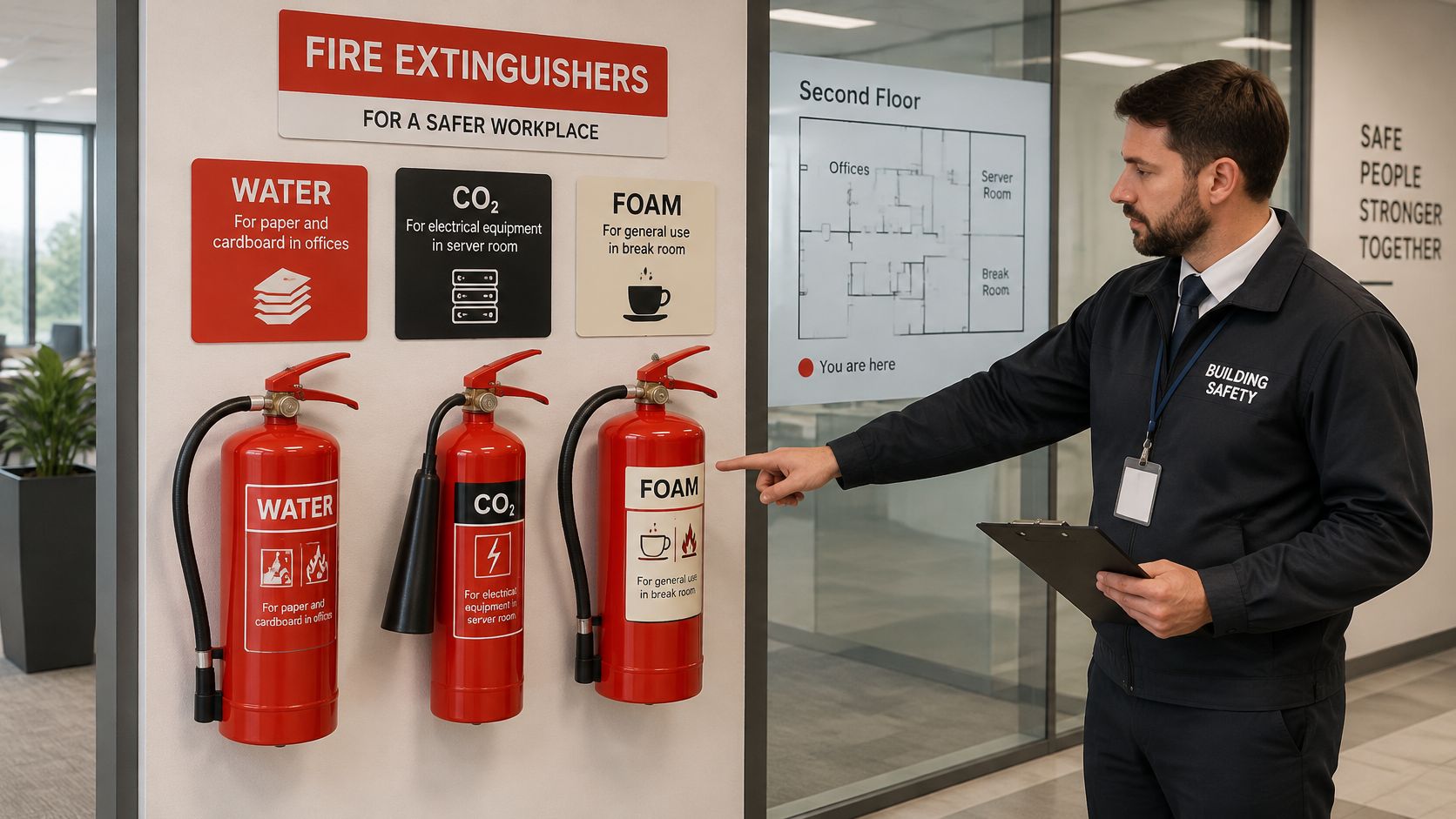
A building never has one hazard. It has a stack of them, room by room, and the extinguisher schedule should read like a floor plan.
| Area | Main hazard | Suitable extinguisher | Placement note |
|---|---|---|---|
| Offices and corridors | Paper, furniture, fabrics | Water or multipurpose ABC dry powder | Along escape routes and near exits |
| Electrical and server rooms | Energised equipment | CO2 or non-conductive dry powder | Near the doorway, visible from outside |
| Commercial kitchens | Cooking oil and fat | Wet chemical (Class K) | Within reach of the cooking line |
| Workshops and garages | Petrol, oils, solvents | Foam or dry powder | Close to the flammable-liquid store |
| Construction sites | Timber, fuel, cabling | ABC dry powder plus CO2 | Spread across floors and work zones |
| Metal-processing areas | Magnesium or aluminium chips | Special-purpose dry powder (Class D) | Beside the process, with specialist advice |
Two entries cause the most argument. Server rooms get ABC powder because it's cheap and already on the van, then a small electrical fire destroys the equipment the room exists to protect. Workshops get a single water unit near the door when the main risk sits at the parts washer and the fuel store.
Where a room is being built or converted rather than fitted out, modular fire protection from Material Handling USA covers how suppression gets designed into the structure itself, which changes what the portable units are there to back up.
For everything else, three questions settle the specification. Name the room. Name its largest fuel. Name the extinguisher whose label matches that fuel. If the answer is "the same one as the corridor", look again.
Placement Rules and Limits Most Sites Miss
Reach decides whether an extinguisher counts at all. A unit stored inside a locked plant room, behind a stack of chairs or at the far end of a corridor nobody uses might as well be back at the supplier's warehouse. Travel distance to the nearest suitable unit is a code provision, and in practice the test is simpler: can someone who has never worked in this building find it in ten seconds with smoke at ceiling level?
Uniformity causes the quieter failures. One bulk order of the same unit, mounted at whatever height the bracket landed, spread across kitchen, server room and reception. Consistent on the invoice, wrong in at least one of those rooms.
Four things go wrong on many sites:
- One type for the whole building: ABC powder everywhere, including the kitchen line and the comms room.
- Hidden units: behind doors, under stairs, inside joinery, or moved during a fit-out and never returned.
- Dead gauges: needles sitting below the green band for months because nobody's check includes the gauge.
- Wrong agent in the kitchen: dry powder near a fryer, where a wet chemical unit belongs.
That last one does more than fail to extinguish. A powder discharge hitting hot oil can splash the burning fuel across the cook line, which is exactly why the wet chemical unit exists for that room.
For the compliance paperwork behind these checks, including how inspection expectations fit together, the Edinhart Realty fire safety compliance guide is a useful reference before an inspection lands.
Extinguishers are built for the incipient stage. Once a fire has grown, spread across a ceiling or blocked your exit, the correct action is to leave, close doors behind you and call civil defence.
How to Use an Extinguisher with PASS
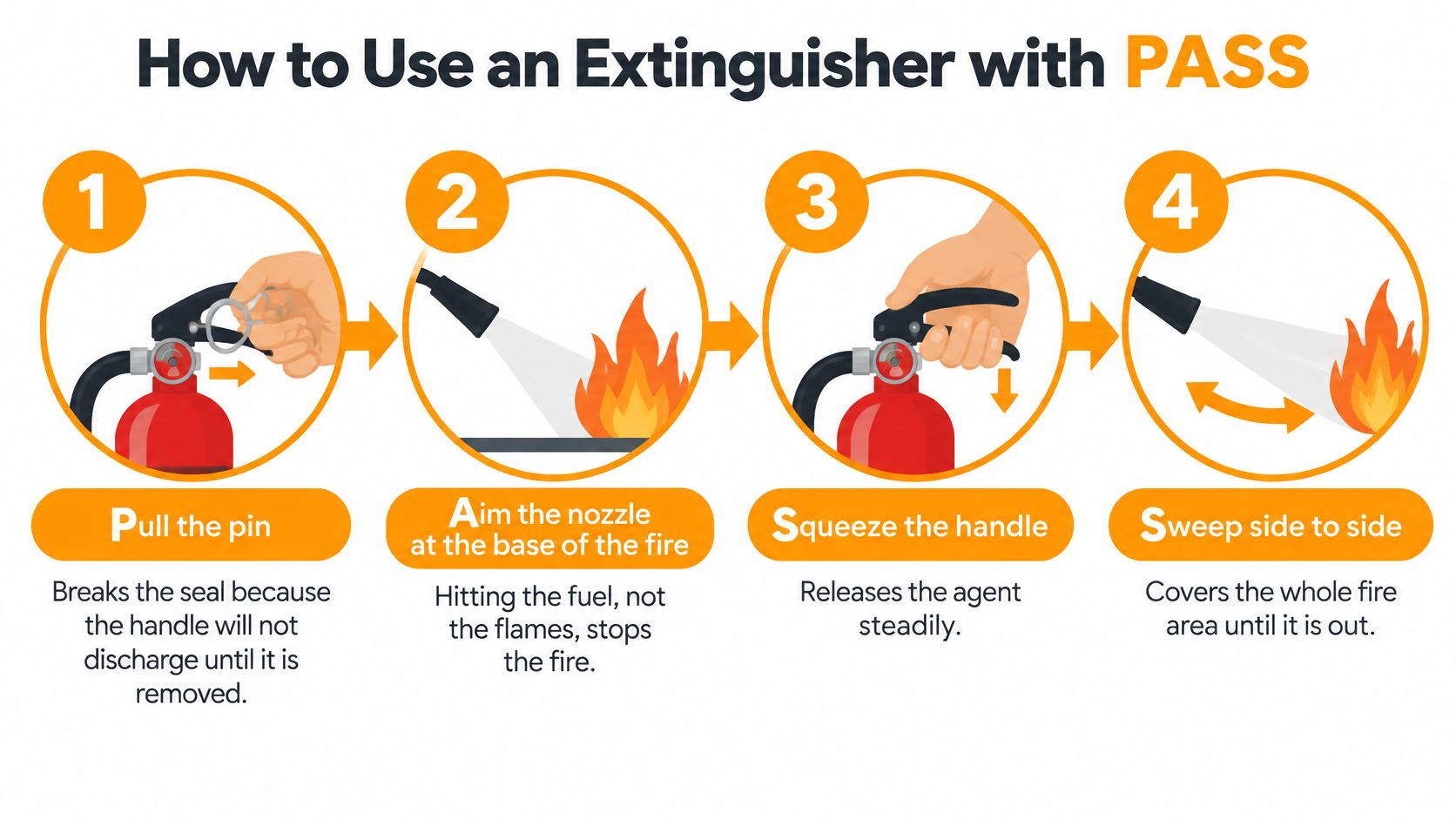
Training hangs on four steps, and each one exists for a reason worth knowing.
- Pull the pin. The handle won't move until the pin clears the tamper seal. If it won't come out, the unit has been tampered with and you need another one immediately.
- Aim at the base of the fire. Flames are the visible part; the fuel underneath is what's burning. Aiming at the tips does nothing but empty the cylinder.
- Squeeze the handle slowly and steadily. A panicked full squeeze dumps the agent in a few seconds and leaves you with an empty unit and a live fire. Controlled bursts last longer.
- Sweep side to side across the base. Cover the whole burning area rather than one spot, then watch for re-ignition, which is common with liquids and with anything still hot.
Two habits sit around those steps. Stand roughly 2 to 3 metres back, far enough that the discharge reaches the fuel without putting you inside the heat. Keep an exit behind you at all times, so you're never fighting a fire with your back to a wall.
For sites where a pan or a waste bin is the likely first fire, a fire blanket for construction sites and site kitchens often does the job faster than a cylinder, especially where the fuel is small and contained.
Here's the sequence performed properly, including how quickly a unit discharges.
If the fire doesn't visibly shrink in the first few seconds, stop. Back out, close the door and let civil defence take it.
Check Your Extinguishers Before the Next Inspection
A monthly walk-round takes minutes and catches almost everything. Gauge in the green. Pin and tamper seal intact. No dents, corrosion or cracked hose. Mounting height within the code limits. Clear access to the handle with nothing stacked in front.
Then the annual service by a competent person, with the date written on the tag. Any unit that's been discharged, even briefly, comes out of service for recharge or replacement; a half-used cylinder is worse than no cylinder because it looks like protection.
Check the unit against the room, not only the tag. Extinguishers get moved during fit-outs and refits, and a unit rated for the office can end up mounted outside the kitchen or the server room where its agent does nothing, or makes the fire worse. If a room's use has changed since the last inspection, its extinguisher needs to change with it.
Read the label before you buy, move or accept a unit. The letters tell you the classes it's rated for. The numbers before A and B indicate the test-fire size it can handle, so a 13A unit is a different proposition from a 27A.
When you order, match each unit to the room it protects. Yasu Trading Co. LLC lists its fire protection equipment as municipality compliant, stocked under one roof in Deira, Dubai alongside plumbing, power tools, electrical, safety gear and adhesive and sealant products, so a single site order can cover the full schedule.
Send your floor plan or your fire risk assessment to Yasu Trading Co. LLC, and the team can help you map each area to the right fire fighting equipment, then dispatch to your site in Dubai, Abu Dhabi, Sharjah or the Northern Emirates. Visit Yasu Trading Co. LLC to build the schedule and place the order.