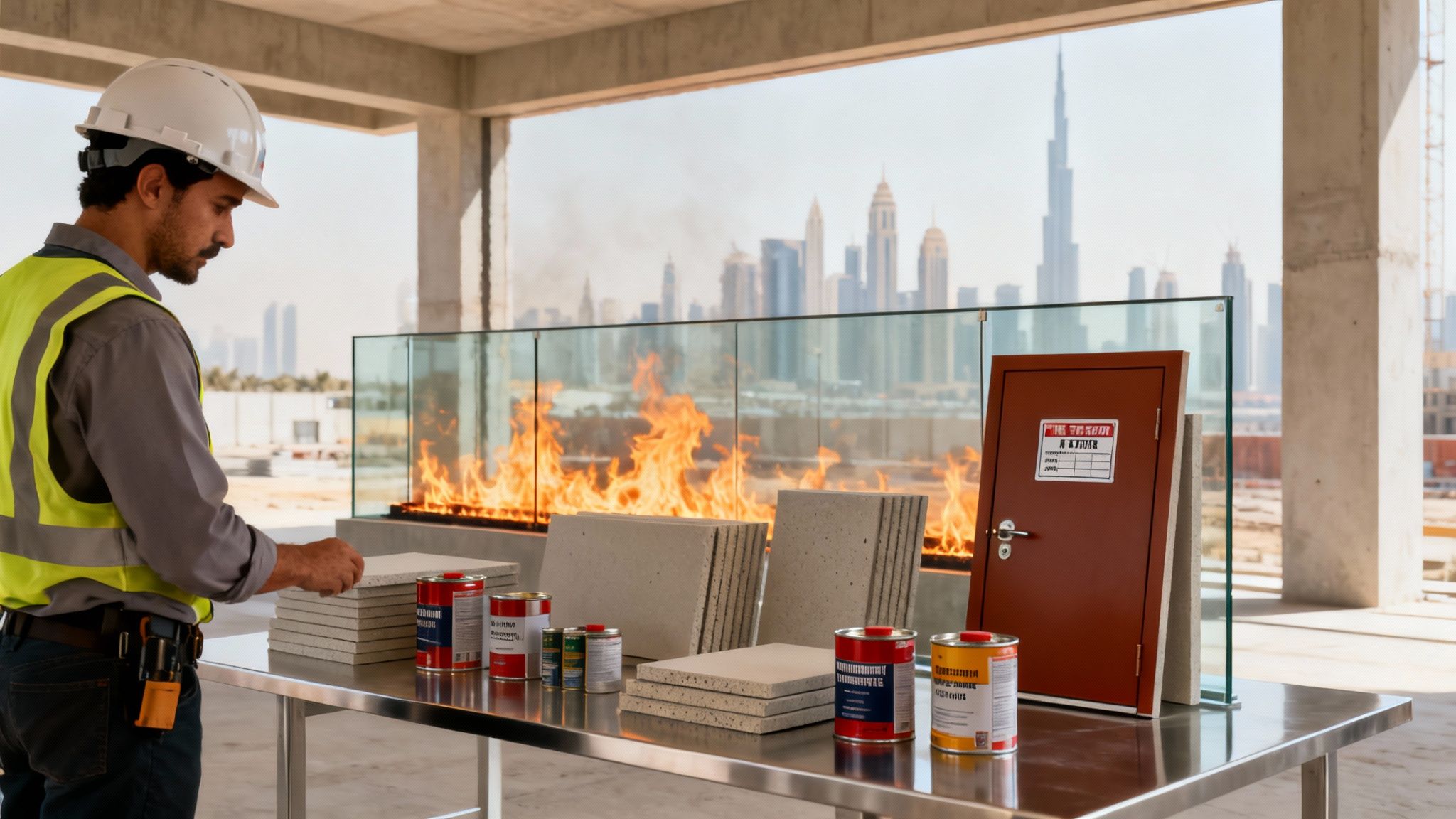
Fire Safety Compliance: Choosing the Right Fire-Rated Building Materials
When it comes to fire safety, you can't afford to cut corners. The UAE Fire and Life Safety Code isn't just a set of guidelines; it lays out strict, non-negotiable requirements for building materials. Getting this right isn’t just a good idea—it’s a mandatory step for getting your project approved, and it has a direct impact on both your timeline and your bottom line. Partnering with a trusted building materials distributor from day one is the key to a seamless project handover.
Why Are Certified Materials a Must-Have in the UAE?
In the UAE's high-stakes construction industry, the project completion certificate is the finish line. Today, that certificate is completely dependent on proving that every critical component in your building—from the doors and partitions right down to the sealants and insulation—has been rigorously tested and certified to meet fire safety standards.
This represents a huge shift in how we build. What used to be considered best practice is now a fundamental requirement, enforced by Civil Defence authorities across every Emirate.
How does non-compliance affect a construction project?
Non-compliance isn't a small hiccup; it can bring your project to a grinding halt, forcing expensive rework and putting your entire timeline and budget at risk. Picture this: you've just put the finishing touches on a new high-rise, but during the final inspection, the authorities find your fire doors are missing the correct third-party certification. That one oversight could derail the entire handover, lead to costly replacement orders, and seriously damage your reputation.
This means fire safety compliance has to start the moment you begin procurement. Every single material you specify for passive fire protection must come with a clear, verifiable paper trail. This includes:
- Third-Party Certification: Official documents from accredited bodies like UL or Intertek.
- Technical Datasheets: Detailed specs straight from the manufacturer.
- Proof of Origin: Confirmation that the materials are genuine and not counterfeit.
By making certified materials a priority from the very beginning, compliance stops being a hurdle and becomes just another streamlined part of your workflow. It's an upfront investment in peace of mind, guaranteeing a much smoother path from tender to final handover.
What is the core fire safety requirement for materials?
At its heart, the mandate is simple: use materials that are proven to hold back a fire for a specific amount of time—whether that’s 60, 90, or 120 minutes. Since the UAE updated its Fire and Life Safety Code, this has become law. In fact, it's estimated that over 80% of new buildings now require certified fire-resistant components to get the green light from Civil Defence.
Working with a reliable supplier in Dubai means every component you order has already been vetted for compliance with local standards. For a deeper dive into the specific regulations, check out our comprehensive guide on Dubai building codes. This proactive approach is your best defence against unexpected regulatory roadblocks.
What Are the Key Fire Rating Standards for UAE Projects?
Before you can even think about fire safety compliance, you have to speak the language. And in the UAE, that language is a unique mix of British (BS), European (EN), and American (ASTM) standards. Getting your head around these codes isn't just good practice; it's a non-negotiable part of the job for anyone involved in UAE construction standards.
Think of a fire rating as a performance guarantee under the worst possible conditions. It’s a certified promise, backed by rigorous testing, that a door, wall, or seal will hold back a fire for a set amount of time. This is precisely what a Civil Defence inspector is looking for when they walk onto your site in Dubai.
Crucially, these standards aren't interchangeable. A product tested to a European Norm (EN) might have different performance benchmarks than one tested under an American (ASTM) standard. This is where a sharp building materials distributor becomes your best friend—they'll know exactly which certifications are recognised locally and required for your project to pass inspection.
What is a fire resistance rating?
A fire resistance rating tells you how long a building component, like a door or wall, can contain a fire and prevent it from spreading. When a product has a 90-minute fire rating, it means it has been tested and proven to block fire and excessive heat from passing through for at least that long.
But it’s not just about stopping the flames. The rating also confirms the material can maintain its structural integrity and, just as importantly, limit how hot the other side gets. This prevents materials on the non-fire side of a wall from suddenly bursting into flames, a critical detail for keeping escape routes clear and protecting people in adjacent areas.
To a Civil Defence inspector, that 90-minute rating is a firm commitment. It’s their assurance that the building's passive fire protection will buy precious time for people to get out safely and for first responders to arrive and do their job.
What is a flame spread index?
A Flame Spread Index (FSI) measures how quickly fire can race across a material's surface, which is vital for finishes like coatings and ceiling tiles. A lower FSI number is always better. Materials are graded into classes based on how they perform:
- Class A: FSI of 0-25 (Excellent flame resistance)
- Class B: FSI of 26-75 (Good flame resistance)
- Class C: FSI of 76-200 (Moderate flame resistance)
For high-traffic, critical areas like exit corridors and stairwells, UAE construction standards strictly require Class A materials. This is to stop a small fire from becoming a big one in a matter of seconds. Checking the FSI on a product's technical datasheet is a quick but essential step to ensure your specifications are up to code.
How do fire ratings apply to a Dubai construction site?
On the ground, your job is to match the product's certified rating to the specific needs of the building. For instance, the partition wall separating a high-risk zone like a commercial kitchen from a busy corridor will need a much higher fire resistance rating than a simple internal office partition. It's all about risk and location.
Any reputable supplier in Dubai should be able to hand you a full documentation package without you even having to ask. This includes third-party test certificates and datasheets that clearly state the standard the product was tested against (like BS 476, EN 13501, or ASTM E119) and the final rating it achieved. This isn't just paperwork; it's the hard evidence of compliance your project needs for final approval. Get this right from day one, and you're building on a foundation of safety and compliance.
What Types of Fire-Rated Materials Are Essential for Compliance?
When it comes to passive fire protection in the UAE, you’re not just buying a single product; you’re building an entire system. Think of it as a chain – every link must be strong to compartmentalise a fire, contain it, and slow its spread. This is where partnering with a knowledgeable building materials distributor becomes invaluable. They can guide you through the full spectrum of certified products needed to create a fire safety strategy that actually works.
Navigating the different categories can seem daunting at first, but each material plays a specific, vital role. From the walls and ceilings down to the smallest gap around a pipe, every component has to work in harmony to create a continuous fire-resistant barrier. Let's break down the essential materials you'll be working with on any project in Dubai.
What are the most common fire-rated partition materials?
The most common fire-rated partition materials are fire-rated gypsum and cement boards, which form the backbone of reliable wall and ceiling assemblies. These are specifically engineered with glass fibre reinforcement and other additives, allowing them to resist intense heat and maintain their structure during a fire.
The market for these boards in the UAE is substantial, valued at around USD 1.2 billion, largely because local fire safety regulations are so strictly enforced. Gypsum and cement boards dominate because they offer proven performance, are relatively simple to install, and fit perfectly with common construction methods here. This is just one piece of a much larger puzzle; the entire UAE fire protection market is expected to grow beyond USD 4.11 billion by 2033. For a closer look at the data, you can read the full research report on UAE fire protection systems.
To get a better handle on how these boards are specified and used in projects, take a look at our guide on choosing the right fire-rated gypsum board.
How do fire-rated coatings protect structures?
Fire-rated coatings, also known as intumescent paints, protect structural steel by swelling up when exposed to high heat. This reaction creates a thick, insulating char layer that acts as a heat shield, isolating the steel from the fire's crippling temperatures. This simple action delays the point at which the steel weakens and could collapse, buying precious time for people to evacuate and for firefighters to arrive, all in line with UAE construction standards.
What is the function of fire stopping sealants?
Fire stopping sealants are flexible materials designed to fill gaps around penetrations for pipes, cables, and ducts in fire-rated walls and floors. If left unsealed, these openings become superhighways for fire and toxic smoke, undermining the integrity of the entire barrier. These sealants are rigorously tested to ensure they block a fire for the exact same duration as the wall or floor they are installed in. Sourcing a certified sealant from a trusted supplier in Dubai isn't just a good idea—it's a non-negotiable step for passing your inspections.
The diagram below shows how the key international standards—British (BS), European (EN), and American (ASTM)—form the basis for the UAE's fire safety codes.
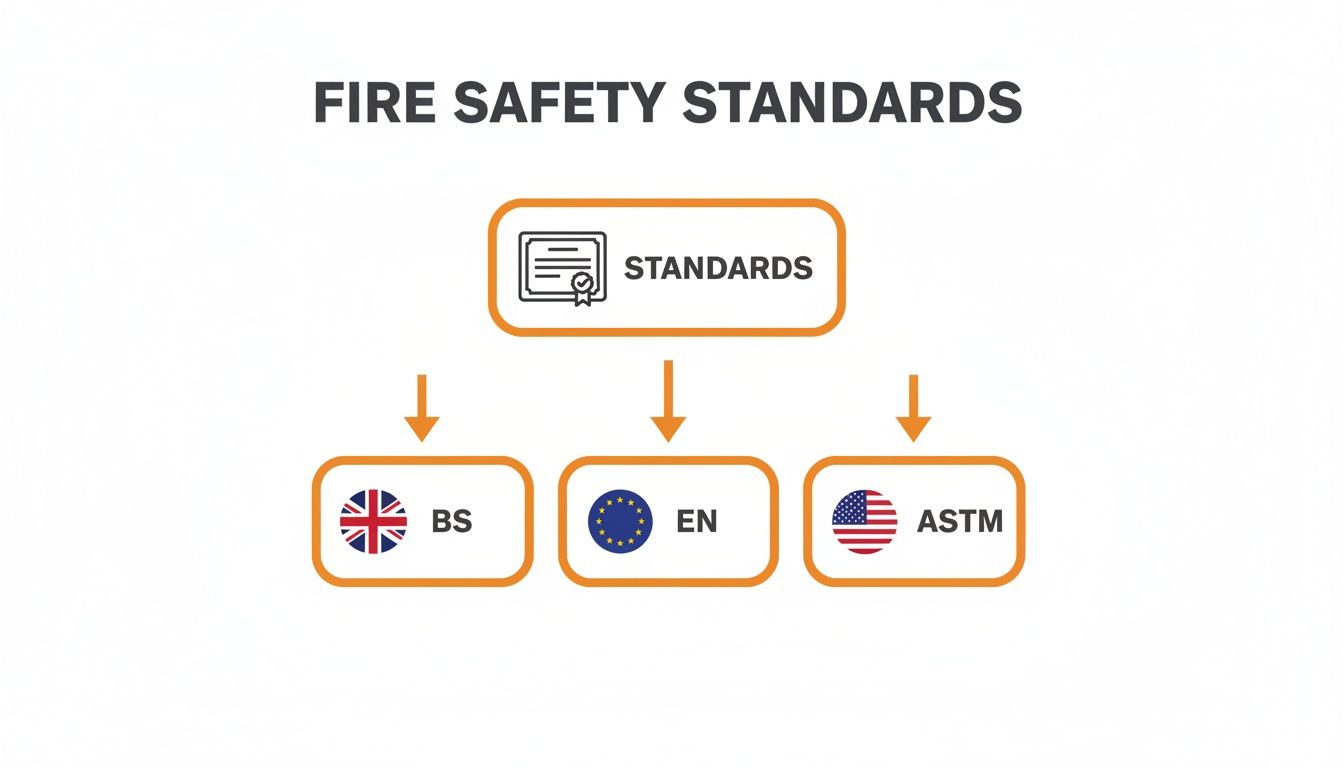
As you can see, compliance isn't a vague concept. It means sourcing materials that have been tested and certified against these specific, internationally recognised benchmarks.
To help you connect these materials to real-world projects, here’s a quick-reference table.
Common Fire-Rated Materials and Their Applications in UAE Projects
| Material Type | Primary Function | Common Application Example (UAE Context) |
|---|---|---|
| Gypsum & Cement Boards | Compartmentalisation | Creating 60- or 120-minute fire-rated walls separating apartments in a residential tower in Dubai Marina. |
| Intumescent Coatings | Structural Protection | Protecting the exposed steel beams and columns in a shopping mall's atrium or an industrial warehouse in JAFZA. |
| Fire Stopping Sealants | Penetration Sealing | Sealing gaps where electrical cables and plumbing pipes pass through concrete floor slabs in a new office building. |
| Fire Door Assemblies | Egress & Access Control | Installing complete, certified door sets for stairwells and service corridors in a hotel on Sheikh Zayed Road. |
| Fire-Rated Insulation | Thermal Barrier | Insulating HVAC ductwork and mechanical service shafts to prevent fire spread between floors of a high-rise. |
| Fire-Resistant Glazing | Visibility & Compartmentalisation | Used in fire-rated partitions for office meeting rooms or atriums, maintaining an open feel while ensuring safety. |
This table shows how each component fits into the bigger picture of a building's passive fire protection strategy, from large partitions to the smallest seals.
Why are complete fire door assemblies so important?
A complete fire door assembly is important because it is an engineered system where every component is tested to work together as a single unit. For a fire door to be compliant, the entire system—including the door leaf, frame, hardware, and intumescent seals—must be certified.
This includes:
- The Door Leaf: The main body of the door, built with a special fire-resistant core.
- The Frame: Must be rated to perfectly match the door leaf’s performance under fire conditions.
- The Hardware: Hinges, latches, locks, and closing mechanisms must all be individually fire-rated.
- Intumescent Seals: These are crucial strips fitted into the door or frame. When heated, they expand to seal the gap, effectively blocking the passage of smoke and flames.
If even one small component, like the hinges or the latch, isn't certified, the entire door assembly loses its fire rating. This is one of the most common reasons for failure during Civil Defence inspections, which makes it absolutely critical to source complete, certified door sets from a reliable building materials distributor.
How Can You Select Compliant Fire-Rated Materials?
Choosing the right fire-rated material goes way beyond just spotting a sticker on the packaging. To guarantee genuine fire safety compliance in the UAE, you need a methodical approach that respects the region's stringent regulations. A minor oversight at the specification stage can easily snowball into failed inspections, project delays, and costly rework orders from Civil Defence.
Think of this checklist as a practical framework to keep your selection process on track. By following these steps, you can confidently specify and source materials that not only meet but often exceed UAE construction standards, ultimately paving the way for a smooth project handover. Each step logically builds on the last, creating a solid verification process from start to finish.
How do you match the fire rating to building requirements?
First, you must align the material's fire resistance period with the specific needs of its location, as defined in the UAE Fire and Life Safety Code. A high-risk electrical room needs a much higher rating (e.g., 120 minutes) than a standard office partition (which may only require 60 minutes).
Always begin by referring to your project's approved fire strategy report or the relevant sections of the UAE code. This is your rulebook. It will clearly state the required fire resistance ratings—typically 60, 90, or 120 minutes—for different parts of the building, like walls, floors, doors, and structural components. Your chosen material must match these mandated time ratings.
What is the best way to verify certifications?
The best way to verify certifications is to request the complete third-party test certificate from your supplier and confirm its validity. It must be issued by an accredited body like UL, Intertek, or Warringtonfire, and be recognized by local authorities such as Dubai Civil Defence.
Here’s a simple three-step process to get it right:
- Request the Certificate: Ask your building materials distributor for the complete third-party test certificate for the exact product you're considering.
- Check the Details: Scrutinise the document. Does it list the specific product model you're buying? Does it specify the standard it was tested against (e.g., BS 476, ASTM E119) and the final fire-resistance rating?
- Confirm Validity: Don't just take their word for it. Many certification bodies have online databases where you can plug in the certificate number and confirm it hasn’t expired or been withdrawn.
A reliable supplier in Dubai won’t just hand over this documentation; they’ll do it proactively. More importantly, they’ll have the technical know-how to explain what the certificate actually means for your project. This paper trail is your non-negotiable proof of compliance when the inspector shows up.
How can you ensure system compatibility?
You can ensure system compatibility by using only components that have been tested and certified to work together as a complete system. Passive fire protection relies on assemblies, not just individual products. For example, a fire-rated wall is only as strong as its weakest link.
This is especially critical for fire door assemblies. The door leaf, the frame, the hinges, the latch, and the intumescent seals must all be part of a single certified set. If you use a non-rated hinge on a 90-minute fire door, you've just voided its certification entirely. The same logic applies to partitions—the boards, studs, and sealants must all be compatible and installed exactly as detailed in the test report.
Why must you consider environmental factors?
You must consider environmental factors because issues like high humidity, moisture, or physical impact can degrade a product's performance over time. This can compromise its ability to function correctly in a fire.
For instance, a standard fire-rated gypsum board might be a poor choice for a damp basement. In that scenario, a moisture-resistant fire-rated board is the only correct specification. Talking through the application environment with your supplier helps ensure you choose a material that is not only compliant today but will remain effective for the entire lifecycle of the building.
While selecting the right materials is a huge part of the puzzle, remember that true fire prevention is a much broader effort. For a more complete picture, consider these effective workplace fire prevention tips to help build a safer environment from the ground up. This holistic view of safety is what truly protects people and property.
What Are the Hidden Costs of Non-Compliant Materials?
Thinking you can save a few dirhams by using unverified fire-rated materials is one of the most expensive mistakes you can make in the UAE construction sector. It's a short-sighted gamble that almost never pays off. Instead, it sets the stage for massive financial headaches, project delays, and reputational damage down the line.
The fallout from a single failed inspection isn't just a slap on the wrist. It can bring your entire project to a grinding halt. Suddenly, you're dealing with a cascade of problems: blown timelines, spiralling labour costs, and the mad scramble to rip out the bad material and find a compliant replacement. Your budget is shredded, and your project schedule is in tatters.
What’s the real financial damage of non-compliance?
The real financial damage comes from mandatory retrofits, project delays, and reputational harm when a building is found non-compliant with UAE construction standards. This can involve tearing out and replacing entire systems like walls and doors, often in a fully operational building.
Imagine trying to do this in a fully operational hotel or a busy office building. It means shutting down floors, losing revenue, and dealing with angry tenants. The property’s value takes a nosedive, and so does the owner's reputation. This is why getting it right from the start isn’t just good practice—it's the only smart financial move.
Choosing compliance from day one is an investment in certainty. It protects your budget, your timeline, and your reputation from the severe and avoidable costs of rework and retrofitting.
How significant is the issue of non-compliance in the UAE?
The issue is quite significant; a 2022 study highlighted that roughly 30% of commercial buildings across major emirates required major upgrades to meet modern fire safety codes. This was often due to the original materials not being compliant. Authorities are cracking down, and mandatory retrofits are becoming more common, costing exponentially more than specifying the correct products during initial construction. The data doesn't lie: cutting corners is a high-stakes financial risk. You can dig deeper into these fire protection market findings.
The aftermath of a real fire, which often requires comprehensive fire damage restoration services, serves as a grim reminder of the costs—both human and financial—when fire safety is compromised.
How can you protect your project and investment?
You can protect your project by working with a reputable building materials distributor from the very beginning. A good supplier is your first line of defense against non-compliance, ensuring every product delivered to your site has the correct and valid documentation.
A strong supplier partnership brings three critical advantages:
- Verified Documentation: They provide current, valid third-party certificates and technical data sheets for every product, no excuses.
- Expert Guidance: A knowledgeable supplier in Dubai knows the local regulations inside and out and can guide you toward the right, compatible systems.
- Traceability: You get a clear, unbroken chain of custody, proving the materials are authentic and meet the exact specifications required.
By treating your building materials distributor as a crucial partner in your fire safety compliance strategy, you turn procurement from a liability into an asset. It’s a proactive move that ensures your project not only satisfies the strict demands of Civil Defence but also secures the long-term value of your investment.
How Do You Find a Reliable Fire-Rated Materials Supplier in Dubai?
Choosing the right fire-rated materials is only half the battle. Your choice of supplier is just as critical to achieving genuine fire safety compliance, especially here in Dubai.
Think of an experienced building materials distributor less like a vendor and more like a compliance partner. They are your first line of defence, safeguarding your project from the very real risks of using unverified products. Their job isn't just to sell materials; it's to provide unwavering assurance.
This partnership hinges on trust and, more importantly, verifiable proof. A top-tier supplier knows the high stakes of meeting UAE construction standards and is already prepared for the tough documentation scrutiny from authorities like the Dubai Civil Defence. They essentially provide a vital layer of quality control long before a single product arrives on your site.
What should you look for in a supplier?
When vetting a supplier, you should look for complete and valid documentation, a deep inventory of approved products, and technical expertise. A great partner offers comprehensive support that protects your project's budget and timeline.
Here’s what to zero in on:
- Complete and Valid Documentation: This is non-negotiable. The supplier must provide valid, current third-party test certificates and technical datasheets with every single order. No exceptions.
- Deep Inventory of Approved Products: They should have a wide range of materials in stock that are already well-known and pre-approved for use by local municipalities and authorities.
- Technical Expertise: Their team shouldn't just be order-takers. They need the know-how to guide you in selecting compatible systems and understanding the fine print of different certifications.
A truly valuable supplier offers more than just logistics. They provide the critical guidance and documentation needed to satisfy Civil Defence requirements, ensuring your project stays on schedule and avoids costly compliance pitfalls.
How does a supplier guarantee material authenticity?
A professional supplier in Dubai guarantees material authenticity through a transparent and unbroken chain of custody. They achieve this by sourcing directly from trusted manufacturers and keeping meticulous records from the factory to your construction site.
This process ensures that the fire-rated gypsum board or intumescent paint you receive is the real deal—guaranteed to perform exactly as its certificate claims. This traceability is your best defence against the counterfeit materials that can unfortunately find their way into the market. It’s the hard proof you’ll need to show inspectors that your commitment to safety is backed by legitimate, tested products.
Why is local knowledge so important in a supplier?
Local knowledge is important because the UAE's regulatory landscape is unique and constantly evolving. A building materials distributor with deep local roots knows precisely what Dubai Civil Defence inspectors look for and understands which international standards are accepted.
This local expertise is priceless. It saves you an enormous amount of time, prevents frustrating specification errors, and gives you peace of mind that every material you install is fully aligned with the latest UAE construction standards. By vetting your supplier as carefully as you vet your materials, you build a much stronger foundation for compliance and, ultimately, project success.
What Are the Most Common Questions About Fire-Rated Materials?
When you're dealing with fire safety compliance, it's natural for questions to pop up. Let's tackle some of the most common ones we hear from contractors, architects, and facility managers across the UAE.
What paperwork does Dubai Civil Defence actually need?
Dubai Civil Defence requires a valid third-party certificate from a recognised body (like UL or Intertek) for every fire-rated product. You will also need the manufacturer's technical data sheet (TDS) and their specific installation guide.
This certificate proves the material's fire resistance rating and the standard it was tested against. A reputable supplier in Dubai will hand you this full documentation package with your delivery. Think of it as the passport for your materials—without it, they won't pass the site inspection.
Can I mix and match fire-rated products from different brands?
No, you should not mix and match fire-rated products from different brands, as this is a common and dangerous mistake. Fire protection systems are tested and certified as a complete, single assembly where every component is designed to work together.
If you install a fire door from one brand with a frame or hardware from another, you instantly invalidate the certification. It's a gamble that compromises the entire system's performance in a fire. Always stick to the manufacturer's test reports, which detail every approved configuration. A good building materials distributor will be able to confirm which products have been tested to work together.
The integrity of a fire-rated system is only as strong as its weakest link. Using uncertified or incompatible components, even small ones like hinges or seals, negates the entire assembly's fire rating and will lead to a failed inspection.
When a fire door is rated, what does that actually cover?
A fire door's rating covers the entire assembly, not just the door panel itself. To meet UAE construction standards, every single component must be fire-rated and certified to function together as a complete system.
This means the complete, certified system includes:
- The door leaf (the main door slab itself)
- The door frame
- All hardware, including hinges, latches, and closing mechanisms
- Intumescent seals, which expand when heated to block smoke and flames
One of the most frequent (and serious) errors we see is a rated door leaf installed with non-rated hardware. It's a guaranteed way to fail a Civil Defence inspection.
What's the difference between fire-retardant and fire-resistant?
Fire-retardant materials are treated to slow down the spread of flames across a surface, while fire-resistant materials are engineered to act as a barrier to contain a fire for a specific duration. The distinction is vital for fire safety compliance.
UAE building codes focus on fire resistance because it's about structural integrity and compartmentalisation—creating safe zones. It’s a much higher performance standard that is critical for saving lives.
Achieving full fire safety compliance starts with sourcing certified, authentic materials from a trusted partner. At Yasu Trading Co. LLC, we provide a complete range of municipality-approved fire-rated products, backed by the essential documentation and technical support your project needs. Ensure your project meets UAE standards by visiting the Yasu Trading website to explore our inventory and speak with our experts.