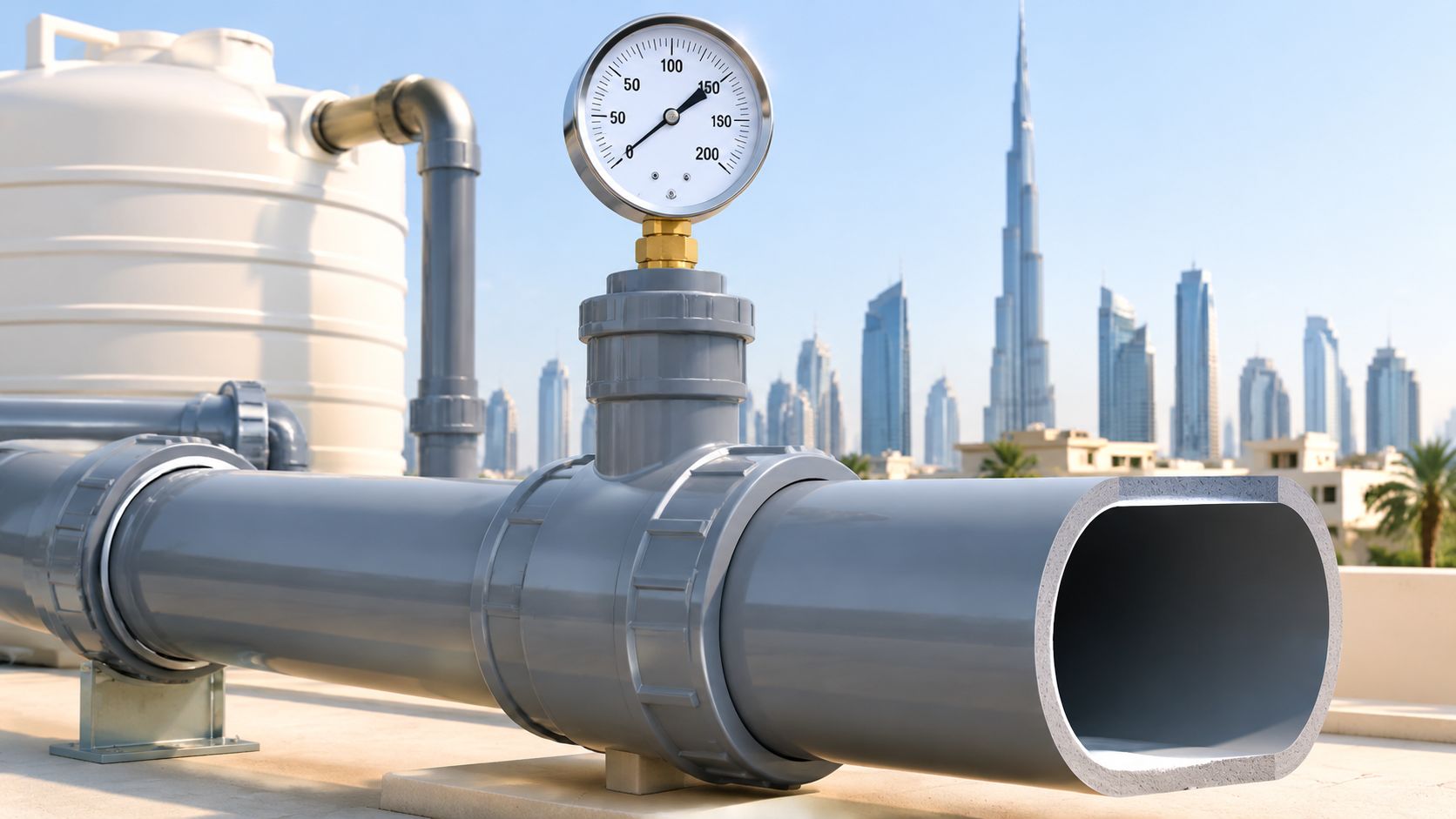
High Pressure PVC Pipe Ratings for UAE Projects
“Choose a higher pressure class and you'll be safe” is incomplete advice for a UAE project. A higher-rated pipe can still be the wrong choice when the designer overlooks heated water, pump shut-off pressure, sudden valve closure, or a weaker fitting.
For high pressure PVC pipe, procurement should start with the actual system duty, not the largest number printed on a pipe in the yard. Establish the pressure and temperature the installation must withstand, confirm that the authority accepts the material, and then select the complete pipe-and-fitting system.
What the Pressure Mark Really Means
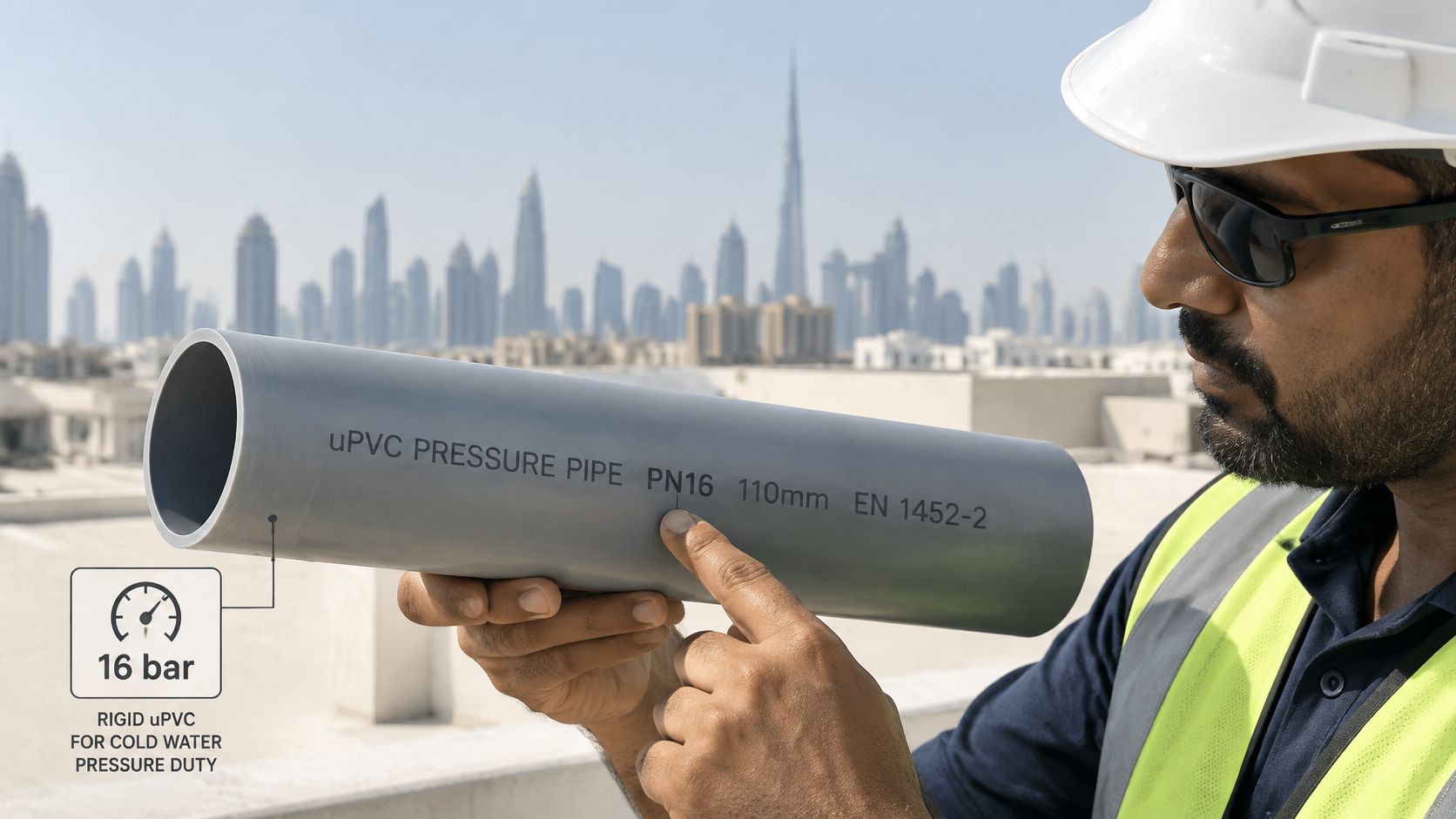
On a Dubai roof, a contractor checks a gray pipe stamped with a pressure class and assumes it can carry that pressure in full sun. The stamp is useful identification, but it isn't permission to operate under every site condition. The designer still needs the manufacturer's operating limits.
High-pressure uPVC is rigid, unplasticized PVC manufactured for cold-water pressure duty. Drainage pipe and electrical conduit may look similar, but neither appearance nor color establishes suitability for pressurized water.
Separate service pressure from pipe capacity
The Department of Energy's 2024 Water Supply Regulations Guide requires distribution companies to maintain at least 1.25 bar, equivalent to 12.75 meters of water head, at the end of a customer's main service pipe during normal operation. That's a utility service-level requirement, not a recommended working pressure for the pipe.
A building's booster pump, elevation changes, and operating sequence create a different design problem. The pipe wall, joints, fittings, and valves must withstand that duty together, while the installation must also accommodate external loads and environmental exposure.
Procurement rule: A utility's minimum delivery pressure doesn't define your pipe's required pressure class.
For a buried line, the specification also needs suitable bedding and protection against contamination. For an exposed run, it needs an assessment of solar exposure and operating temperature. Neither condition can be resolved by measuring wall thickness with a caliper and guessing the class.
Begin the purchase description with pressure class and outside diameter, then attach the dimensional and installation requirements. A nominal size alone doesn't identify an acceptable pressure-water product.
Pressure Classes Buyers Should Read First
High-pressure uPVC classes at the reference-temperature nameplate
The following class labels and representative wall measurements are identified in Dubai pressure-pipe market documentation; the walls belong to cited catalogue products, not every diameter in each class.
| Pressure class | Nameplate pressure at the reference temperature | Representative wall | Buying note |
|---|---|---|---|
| Class 6 / PN6 | 6 bar | Not stated in the cited catalogue | Consider for modest head or low-pressure irrigation only after checking design pressure |
| Class 10 / PN10 | 10 bar | 2.0 mm | Cold-water duty only where heat and surge remain within allowable limits |
| Class 12.5 / PN12.5 | 12.5 bar | 2.3 mm | A possible step above the lower class for pumped duty |
| Class 16 / PN16 | 16 bar | 2.7 mm | Higher duty, still subject to temperature and component limits |
PN means nominal pressure class, not the pressure the pump will necessarily produce. The manufacturer's certified table establishes the pressure-temperature relationship for the actual product.
Read the wall measurements correctly
The table shows the relationship between class and wall construction, but it isn't a complete outside-diameter chart. Don't copy a representative wall measurement into a requisition for an unrelated size.
For an ordered diameter, compare the manufacturer's stated outside diameter, minimum wall thickness, and class. Use the dimensional certificate to confirm that the delivered product matches the approved submittal.
- Reject size-only substitutions. Matching the nominal diameter doesn't make a lower-class pipe an equivalent replacement.
- Check the complete assembly. A suitable straight pipe doesn't validate an unverified socket, union, or valve.
- Keep hydraulic sizing separate. Diameter must also deliver the required flow without unacceptable pressure loss.
A thicker wall can reduce the internal bore when the outside diameter stays unchanged. That means a class change may require a hydraulic check, not merely a revised purchase description.
The buying decision is therefore a combination: correct class, correct dimensions, and correct governing standard. None can substitute for the others.
How UAE Heat Changes the Nameplate
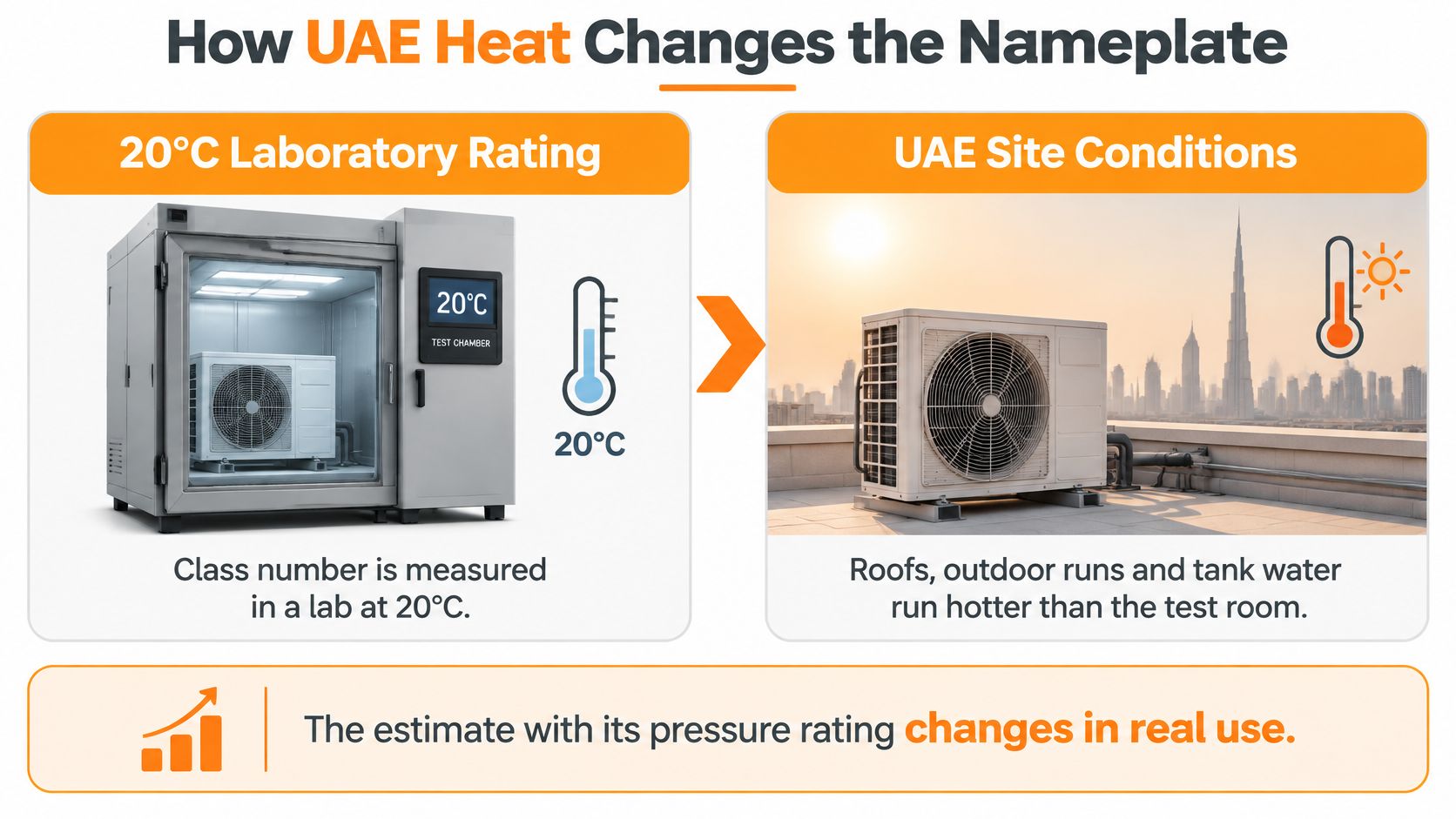
Read a pressure pipe's markings and you can still end up with the wrong pipe. The printed PN is a laboratory rating: Dave Pools' pressure-rating explanation uses 20°C as the reference temperature and estimates that a PN10 pipe can fall from 10 bar at that temperature to approximately 7.5–8 bar at 40°C. The stamp stays identical whether the pipe sits in a test rig or on a Dubai roof. What moves is the pressure it can safely carry.
A nameplate works like a fuel-economy figure: measured on a controlled cycle, useful for comparing products, and optimistic under real load. UAE installations supply that load through rooftop exposure, warm storage tanks, and sun-heated shallow trenches. Only the manufacturer's derating chart for the specific product converts the printed class into an allowable working pressure, so treat any published example as the method rather than the answer.
Calculate pressure without double-counting it
Derating lowers what the pipe is allowed to carry. It does not change what the system demands, so both sides of the comparison need a real number:
- Record normal operation. Establish the pressure profile along the route.
- Evaluate shut-off conditions. Combine pump head, inlet pressure, and elevation correctly, without adding normal pump pressure again when shut-off pressure already replaces it.
- Assess transients. Account for water hammer from pump trips, check valves, and rapid valve closure.
- Apply temperature derating. Use the expected operating conditions and the maker's chart.
- Check every component. Compare fittings, valves, and joints at the same temperature, including any separate transient limits.
How installation heat changes a PN10 nameplate
| Installation | Temperature to use | Effect on PN10 | What to do |
|---|---|---|---|
| Laboratory nameplate | 20°C reference | 10 bar reference rating | Treat the published class as the starting point |
| Warm tank or above-ground water | About 40°C | About 7.5–8 bar, only if the maker's chart agrees | Derate before comparing with design pressure |
| Buried or shaded run | Expected ground, water, and shaded-pipe conditions | May remain closer to the reference rating | Verify temperature, surge, and component limits |
| Exposed roof or temporary site pipe | Expected water and pipe-wall conditions, including solar heating | Can fall further if operating temperature rises | Assess shading, protection, or a different class using the maker's chart |
The video below applies the same rating logic to practical pipe selection.
A higher class chosen because it beats the everyday pump reading still fails the moment heat, surge, or an underrated valve enters the picture. Rooftop tanks, pools, irrigation lines, and temporary site services are the usual casualties, because their operating conditions differ most from the assumptions written on the purchase order. Match the derated rating to the worst credible condition, and the nameplate goes back to being a starting point rather than the whole decision.
Where High Pressure uPVC Is Specified
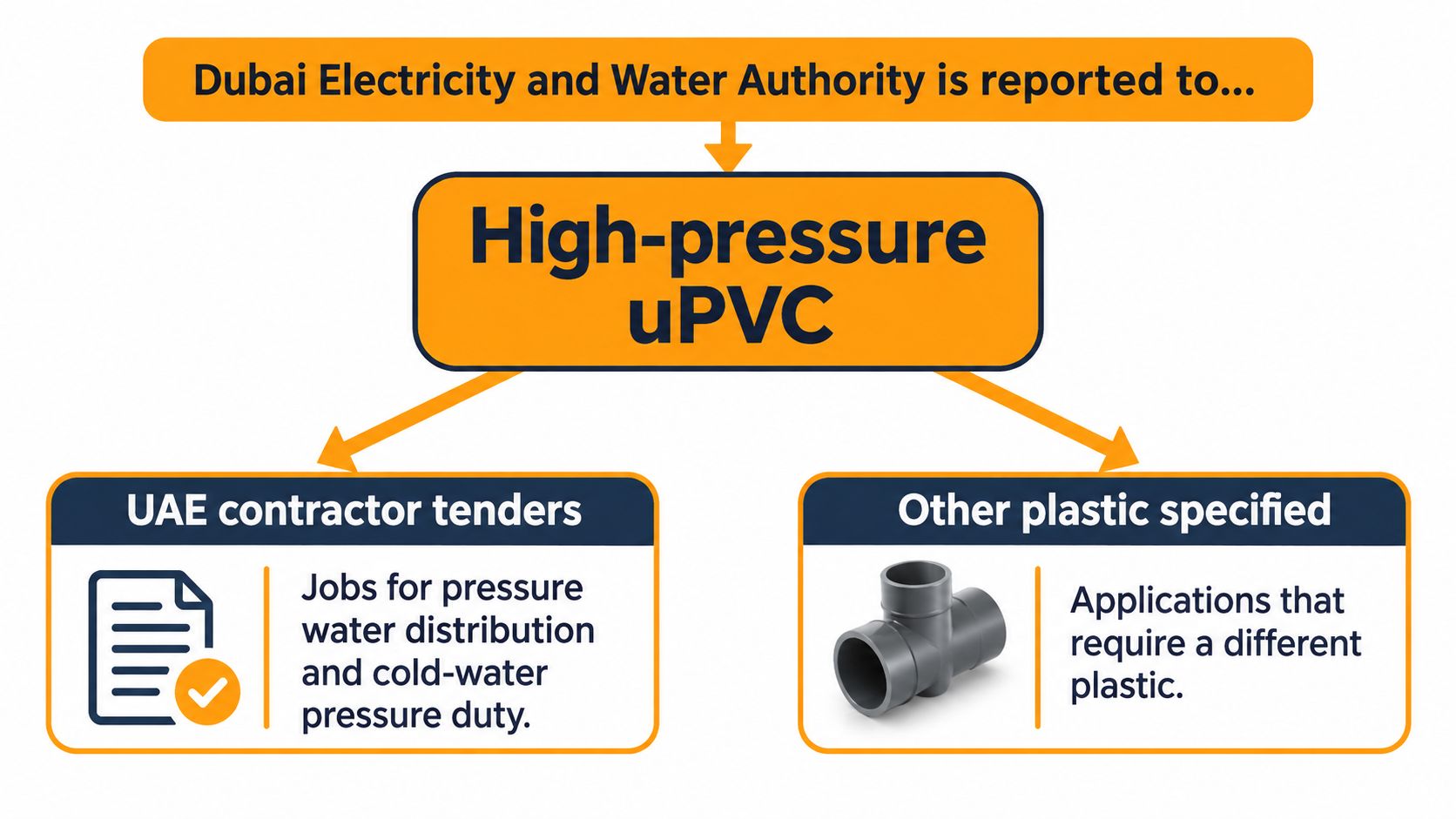
According to Nexdigm's UAE plastic pipes and fittings market overview, Dubai Electricity and Water Authority is reported to operate more than 14,000 kilometers of water distribution networks. At that infrastructure scale, contractors must consider leakage control, durability, and installation efficiency together.
The overview identifies pressure-oriented PVC products commonly spanning 20 mm to 630 mm, with ratings broadly ranging from 6 to 16 bar. Treat those figures as market ranges only. The size and class a project needs still has to be manufactured, stocked, and approved for the duty.
Match the product to the duty
Smaller pressure pipes can serve building connections and local distribution. Larger products may suit irrigation mains, site-development networks, and permitted municipal applications. The designer chooses the diameter from required flow, route length, elevation, and allowable pressure loss, never from the application name alone.
A developed site illustrates the distinction. The irrigation main experiences pump operation and valve cycling, while a nearby gravity drain carries water without the same internal pressure duty. Both may use PVC, yet their product requirements differ in class, joints, and approvals.
The same caution applies to broad market categories:
- Water supply and plumbing. Confirm approval for the intended water service, including potable-water suitability where applicable.
- Irrigation and landscaping. Check pump behavior, zone-valve closure, and exposure along the route.
- Wastewater and drainage. Establish whether the line is a pressure main or a gravity system before selecting the product.
- HVAC and industrial infrastructure. Identify the actual fluid and duty. A sector label alone doesn't authorize PVC for every service within that sector.
Corrosion resistance and a smooth internal bore help explain the material's relevance to water infrastructure. Chemical compatibility, water quality requirements, and the installation environment still need checking on each project. Whatever the duty, the printed PN remains a 20°C laboratory rating, so confirm the derated capacity and surge margin under real site conditions before fixing a class.
Authority approval can change the material
Some UAE authorities require polyethylene for service connections rather than uPVC. The exact pipe grade, SDR, and governing standard are set out in each authority's own specification, so read that document first. The required material may already be decided before the pressure calculation even begins.
If the authority requires polyethylene for a service connection, a pressure-rated uPVC alternative does not become acceptable because its pressure capability appears adequate. Material approval and pressure adequacy are separate acceptance criteria.
A contractor should resolve the following before pricing an alternative:
- Permitted material. Check the authority specification, consultant's schedule, and approved material list.
- Service classification. Identify potable, irrigation, process, or utility duty explicitly.
- Connection requirements. Confirm compatibility with meters, existing mains, isolation valves, and approved transitions.
- Approval route. Obtain written acceptance before treating a proposed substitution as part of the tender.
For building systems where several plastics are under consideration, our comparison of PPR, PVC, and CPVC for UAE construction projects helps distinguish material selection from pressure-class selection.
A technically capable pipe can still be the wrong procurement choice when the authority specifies a different material.
An infrastructure diagram or a general market listing isn't an approved product register. Submit the proposed manufacturer, exact product, intended application, and supporting certificates for the actual project.
Standards That Make a Tender Line
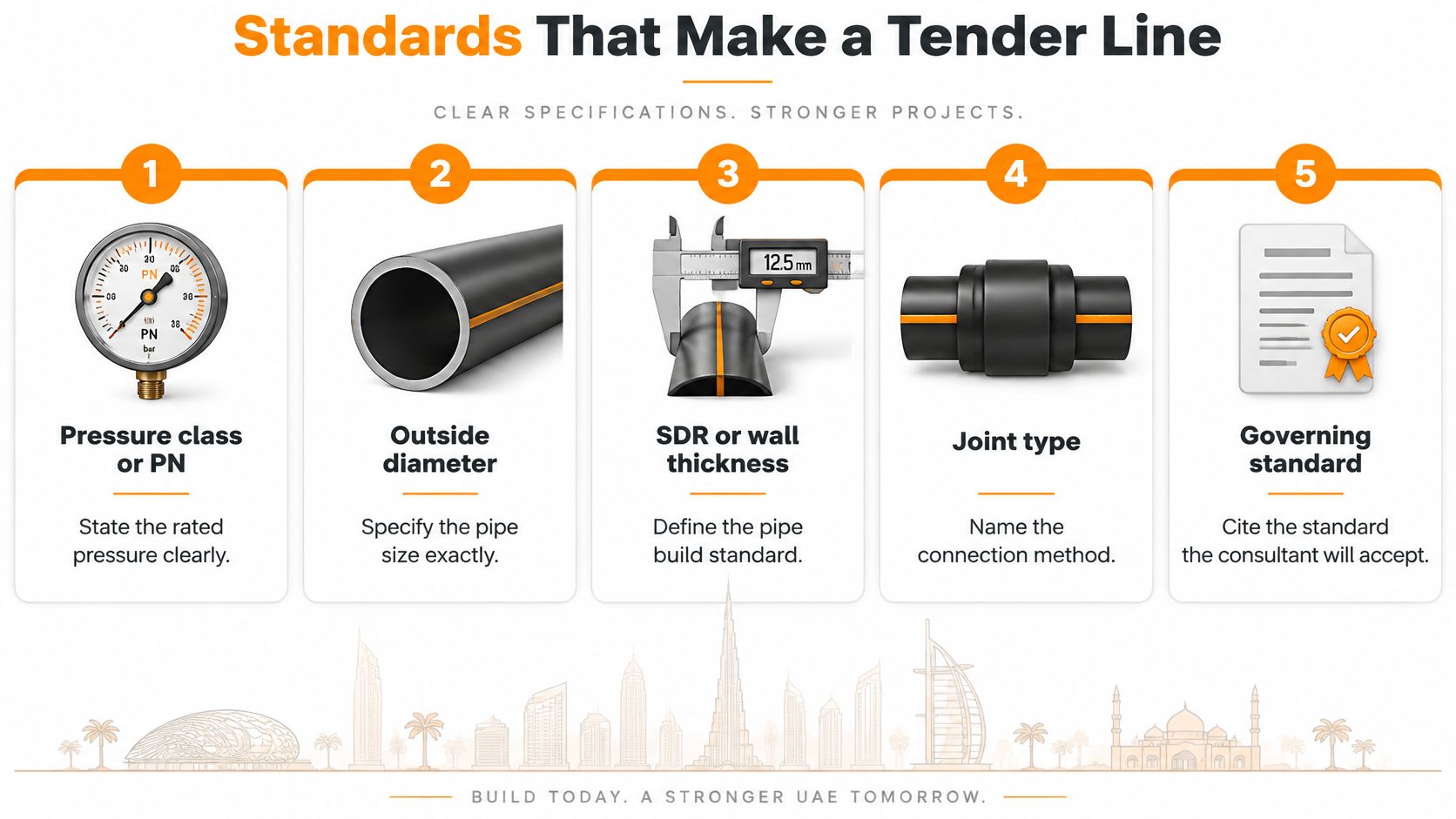
A tender description that says only “PVC pressure pipe” leaves too much unresolved. The supplier needs a defined pressure class, outside diameter, wall construction, joint type, and governing standard to offer a product the consultant can evaluate.
Write a usable specification line in this form:
Supply pressure-water uPVC pipe to the project-approved standard, in the scheduled outside diameter and class, with certified wall dimensions, compatible pressure-rated fittings, the specified joint system, and the manufacturer's pressure-temperature documentation.
Complete that line from the approved design. Don't let a supplier fill missing requirements with whichever product happens to be in stock.
Give each standard a clear purpose
The following commonly named benchmarks address different product descriptions and dimensional systems. Listing them together doesn't mean they're interchangeable, or that a certificate to one automatically satisfies another.
Standards commonly named for UAE pressure uPVC
| Standard | What it is used to show |
|---|---|
| ISO 1452 | PVC-U pipes and fittings for water under pressure |
| DIN 8061/8062 | German PVC-U material and dimensional requirements |
| ASTM D1785 | North American schedule-based PVC pipe |
| BS 3505 | British unplasticized PVC pressure pipe |
| UAE.S 9:2011 | UAE benchmark identified for uPVC cold-water pipes |
Ask for the applicable edition and product scope required by the consultant. A certificate covering a manufacturer's drainage range doesn't establish compliance for its pressure-water range.
Schedule-based pipe also needs careful reading. A schedule identifies a dimensional series; it isn't a universal pressure value across all pipe sizes. The manufacturer's pressure table must match the ordered product and diameter.
Understand SDR before accepting an equivalent
Standard dimension ratio, or SDR, is outside diameter divided by minimum wall thickness. Think of two hoses with the same outside diameter: the one with the thicker wall has less internal space and a lower diameter-to-wall ratio.
Within the same material and design basis, a lower SDR generally means a thicker wall and greater pressure capacity. It doesn't prove equivalence between different materials or unrelated standards.
This matters when a proposed substitution changes the internal bore. The replacement may satisfy pressure requirements yet alter flow velocity or pressure loss. Have the designer review the hydraulic consequences instead of approving the substitution solely from a wall measurement.
Assemble the submittal in a useful order
A reviewer should be able to follow the proposed product from its pressure rating to its installed condition.
- Manufacturer's class table. Highlight the ordered diameter and product designation, not an unrelated catalogue page.
- Dimensional certificate. Identify outside diameter, minimum wall thickness, and the relevant tolerances.
- Hydrostatic test evidence. Provide documentation that applies to the proposed product and the specified test requirements.
- Product declaration. State the governing standard and identify the product as pressure-water uPVC.
- Component documentation. Include fitting, valve, union, and transition ratings at the intended operating temperature.
- Installation notes. Address burial, solar exposure, support, and potentially contaminated ground.
Keep the manufacturer and product references consistent across these documents. A catalogue from one range, a test report from another, and an untraceable delivery label don't form a coherent approval package.
Drainage and conduit products can share a color and nominal size with pressure pipe. Don't cross-use them without written engineering approval, even when a socket appears to fit. Product identification should remain clear from submittal through delivery inspection and installation.
Joints and Ground That Cut the Rating
A correctly selected pipe can leak because the joint was assembled badly. Solvent welding and threading solve different connection needs, and each introduces installation requirements that the printed pipe class can't override.
Solvent cement softens the mating PVC surfaces so they fuse. For a solvent-welded pressure joint, cut the pipe square, deburr and chamfer the end, check socket fit, and mark the insertion depth before assembly.
Build the joint before testing it
Clean and dry the mating surfaces, use the specified cleaner or primer where required, and apply cement approved for pressure PVC. Insert the pipe fully according to the joint manufacturer's procedure and hold it against push-out.
Cure time is not the same as handling time. The time needed before pressurization depends on the cement, pipe size, temperature, humidity, and intended test conditions. Record the assembly time so the test crew doesn't rely on whether the joint feels dry.
- Cement compatibility. Use the pressure-service cement specified for the pipe and fitting material.
- Dimensional compatibility. Match the actual socket system and tolerances, not just the size printed on the packaging.
- Connection compatibility. Use engineered adapters between metric sockets and threaded equipment. Don't force mismatched threads together.
Threading removes wall material when a thread is cut into pipe. Prefer approved molded threaded fittings rather than site-cut threads in thin pressure pipe, and use sealants compatible with the plastic.
Avoid overtightening a plastic female fitting around a metal male thread. The connection needs a seal, not enough torque to distort the fitting. Use the fitting maker's assembly instructions and support nearby equipment so its weight doesn't load the connection.
For equipment interfaces, our guide to the role of valves in high-pressure plumbing systems helps focus attention on isolation and component selection.
Diagnose the fault before changing the class
Leak symptoms and their likely causes
| Symptom | Likely cause | Fix |
|---|---|---|
| Weep at the socket | Poor insertion, poor preparation, or an early pressure test | Isolate and depressurize; replace the defective joint, allow full cure, then retest |
| Split beside a thread | Wall weakened by a site-cut thread or excessive tightening stress | Replace damaged parts with an approved molded threaded connection |
| Flat spot after backfill | Bedding or external-load fault rather than the printed class | Expose and re-bed the line; assess ovality and replace damaged pipe before retesting |
These are diagnostic starting points, not proof of the cause. Inspect the failed component and installation records before deciding on the repair.
Site check: A cured solvent-welded joint can't be repaired by pushing it farther into the socket or brushing cement around the outside.
Ground conditions need the same care. Provide the required protection at metal transitions against galvanic corrosion, and assess plastic pipe compatibility where soil may contain oil or fuel.
During storage and backfilling, prevent dragging, deep scoring, and concentrated loads. Inspect bedding beneath the barrel and around joints, then place suitable surround material without forcing the pipe out of alignment. Joint preparation, curing, support, and trench construction are part of the installed pressure system, not finishing details.
Freeze the Spec Before You Order
Freeze the purchase only when the requisition records the duty, allowable pressure at operating temperature, outside diameter and class or SDR, and approved standard. If a field is blank, hold the order rather than matching a nominal size in the yard.
Write the duty precisely: cold-water distribution, irrigation main, buried utility, or temporary service. Attach the accepted design conditions and identify the material approval so the buyer doesn't accidentally substitute uPVC where the authority requires polyethylene.
Release the order against evidence
Check the requisition against the approved submittal:
- Pressure acceptance. Record the selected class and its allowable pressure under the design temperature and transient conditions.
- Document acceptance. Name the governing standard, dimensional evidence, and hydrostatic documentation the consultant requires.
- Assembly readiness. Include compatible fittings, valves, joints, and installation materials, with delivery planned early enough for assembly, curing, and testing.
A general supplier statement of compliance doesn't replace the documents named in the specification. Require traceable product markings and check delivered items against the approved schedule before releasing them to installers.
At Yasu Trading Co. LLC, our plumbing range includes PVC, copper, and steel fittings. That breadth is useful when a requisition includes transitions, but it doesn't remove the need to identify the correct material, joint arrangement, and pressure duty.
Keep approved substitutions in writing and update the purchase description before dispatch. A clear order gives the receiving crew something definite to inspect and gives the testing team a system whose components can be traced.
Yasu Trading Co. LLC specializes in municipality-compliant construction hardware and brings plumbing, power tools, electrical, fire protection, safety gear, and adhesives and sealants together under one roof in Deira, Dubai. Bring your approved pipe schedule, pressure-temperature requirements, and fitting list when you visit Yasu Trading Co. LLC to discuss the materials for your project.