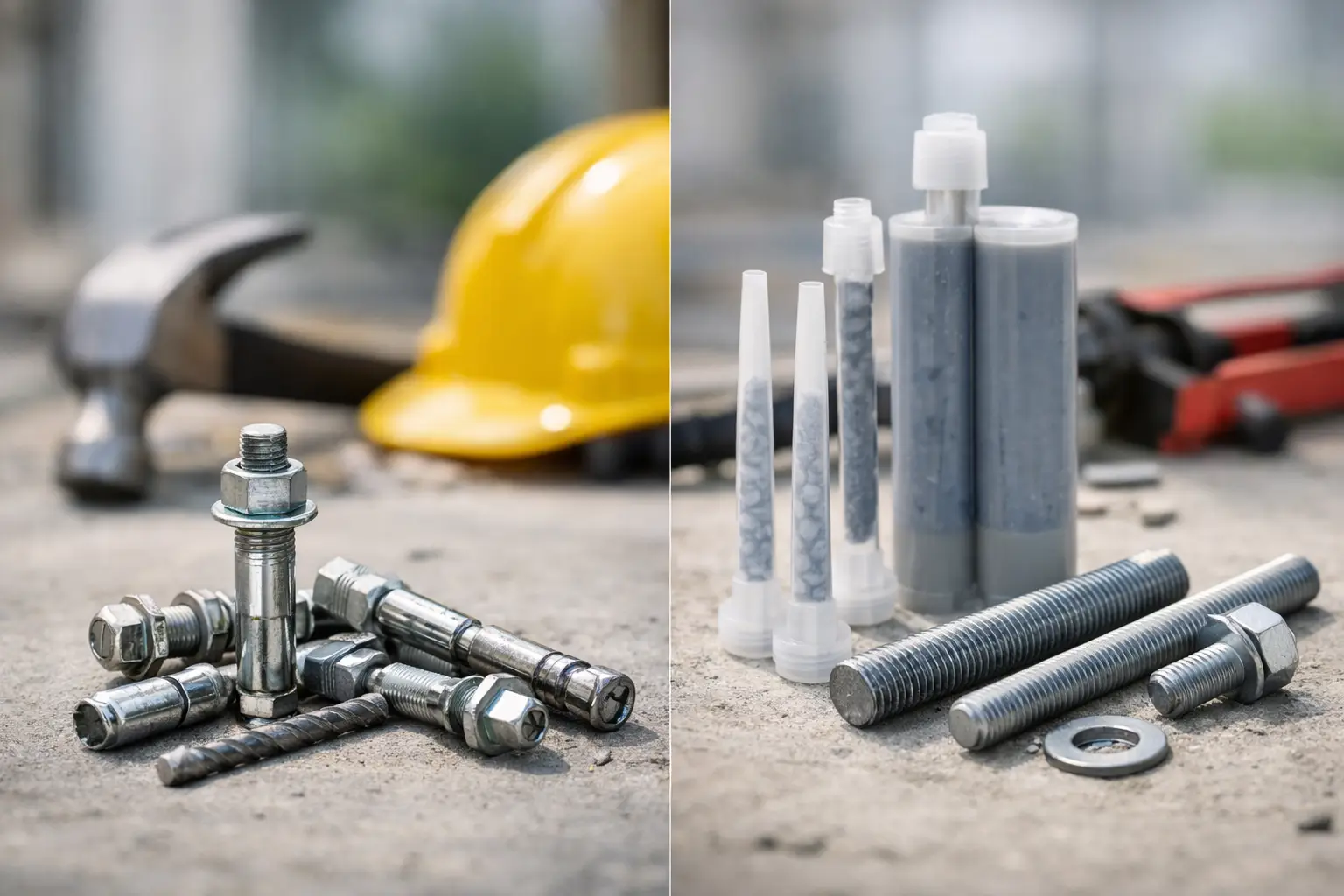
Mechanical Anchors vs Chemical Anchors Compared
A suspended MEP support, handrail base plate, cable tray bracket, or structural steel connection can all fail for the same reason: the fixing was selected for speed rather than the actual condition of the concrete. The mechanical anchors vs chemical anchors decision affects load performance, edge-distance allowances, installation sequencing, inspection requirements, and ultimately whether work proceeds without costly rework.
For contractors and procurement teams, there is no universal “best” anchor. A mechanical anchor can provide fast, predictable installation on sound concrete. A chemical anchor can solve demanding applications where high loads, close edge distances, or irregular holes make expansion-based fixings unsuitable. The correct choice starts with the approved design load, substrate condition, and site installation constraints.
Mechanical Anchors vs Chemical Anchors: The Core Difference
Mechanical anchors develop holding power through physical expansion, undercutting, or screw-thread engagement within the base material. Common examples include wedge anchors, sleeve anchors, drop-in anchors, concrete screws, and heavy-duty bolt anchors. Once installed and tightened to the specified torque, many mechanical anchors can be loaded immediately.
Chemical anchors, also called adhesive anchors, use an injectable resin to bond a threaded rod, rebar, or internal-thread socket into a drilled hole. The resin fills voids and transfers load to the concrete or masonry after it has cured. Epoxy, vinylester, polyester, and hybrid resin systems have different cure times, temperature limits, and approved applications.
The practical difference is simple. Mechanical anchors rely largely on pressure or mechanical interlock. Chemical anchors rely on a prepared bond between resin, steel, and the base material. That distinction drives nearly every selection and installation requirement.
When Mechanical Anchors Are the Better Site Choice
Mechanical anchors are often the efficient option for repetitive work in sound, normal-weight concrete. They suit applications such as pipe support brackets, cable tray supports, machinery bases, guardrails, light structural steel, and equipment mounting where the engineer’s approved load data supports their use.
Their main advantage is installation speed. Drill the correct diameter and depth, clean the hole as required, set the anchor, tighten it to the stated torque, and proceed with the next activity. For a crew installing hundreds of supports, avoiding resin injection and cure waiting can protect the daily output target.
Mechanical anchors are also easier to inspect visually. Anchor diameter, embedment, washer arrangement, and tightening torque can be checked at the point of installation. This is particularly useful when site supervisors need consistent quality across multiple trades and installation teams.
However, expansion anchors place radial force on the concrete. They may require larger edge distances and spacing than chemical anchors, especially at higher loads. Installing them too close to a slab edge, corner, or another anchor can crack the concrete or reduce the approved load capacity. They are also less forgiving in weak, cracked, honeycombed, or poorly consolidated concrete.
Concrete screws and certain screw-bolt anchors can be a practical alternative when removability or reduced expansion pressure matters. They still require accurate hole diameter, correct embedment, and clean drilling. A screw anchor that feels tight is not automatically compliant if the hole has been overdrilled or the substrate is unsuitable.
When Chemical Anchors Earn Their Extra Time
Chemical anchors are typically specified when the application demands high load capacity, deep embedment, close spacing, or installation near concrete edges. They are widely used for starter bars, rebar doweling, structural connections, façade brackets, heavy equipment bases, and post-installed threaded rods where approved design calculations call for bonded anchoring.
Because a chemical anchor does not expand against the hole wall in the same way as a wedge anchor, it can perform well where expansion pressure would be a concern. This can make it the preferred option in narrow concrete members, close-to-edge connections, and selected cracked-concrete applications, provided the resin system has the appropriate approval and the design follows the manufacturer’s published data.
Chemical systems can also be used in hollow masonry with the correct sleeve or screen tube. The resin forms a bond around the sleeve and prevents uncontrolled loss into cavities. Mechanical expansion anchors may be unsuitable in the same substrate because the wall face or block web can break under expansion force.
The trade-off is process control. Hole cleaning is not optional. Dust left inside the hole can reduce bond performance significantly. The installer must use the prescribed drilling method, brush and blow out the hole in the required sequence, discard the initial unmixed resin, fill the hole correctly, rotate the rod into place, and allow full curing before loading.
Cure time is a planning issue, not a minor detail. It changes with resin type and base-material temperature. A fast-cure product may support quick progress in warm conditions, while a high-performance epoxy can require substantially longer before the connection is loaded. Resin cartridges also have shelf-life and storage requirements that should be managed through site material control.
Select by Substrate, Not Just by Load
Anchor selection begins with the base material. Sound, solid concrete provides the broadest range of mechanical and chemical options. Cracked concrete, low-strength concrete, old slabs, blockwork, hollow block, and stone each need a more specific assessment.
For concrete, confirm the concrete strength, whether cracking is expected in service, slab thickness, reinforcement location, and available edge distance. Scanning before drilling can prevent damage to reinforcement, embedded conduits, and post-tensioning strands. Never treat a generic anchor load table as permission to drill without verifying these conditions.
For masonry, identify whether the units are solid or hollow. A resin anchor with a suitable sleeve may work effectively in hollow block, while a conventional wedge anchor may not. For lightweight block or deteriorated masonry, the holding capacity can be limited regardless of the anchor selected. In such cases, a revised fixing location, spreader plate, through-bolt arrangement, or engineered support detail may be needed.
The fixture itself matters too. A thick steel plate, stand-off bracket, or oversized hole changes how load reaches the anchor. Tightening a mechanical anchor against an uneven fixture can introduce bending. With chemical anchors, a long stand-off may create combined tension and bending that requires engineering review rather than a simple pull-out value.
Installation Quality Decides the Real Capacity
Anchor manufacturers publish tested capacities, but those values assume a correct installation. The most common site failures are avoidable: incorrect drill bit diameter, shallow embedment, dust-filled holes, improper torque, damaged threads, expired resin, and loading before cure completion.
For mechanical anchors, crews should use the specified bit size and drilling depth, remove loose debris, set the anchor to the required embedment, and apply torque with a calibrated wrench where the specification requires it. Over-torquing can damage the anchor or base material. Under-torquing can leave the expansion mechanism incompletely set.
For chemical anchors, use the exact cleaning method required for the hole type and resin system. Standard hammer-drilled holes, diamond-cored holes, and water-filled holes may have different preparation requirements. Select the correct mixing nozzle, inject from the back of the hole to avoid air pockets, and observe gel time and cure time before attaching loads.
On critical installations, pull testing may be specified to verify site conditions and workmanship. Testing should follow the project method statement and approved acceptance criteria. It is a quality-control measure, not a substitute for selecting the right anchor system in the first place.
Procurement Checks That Prevent Delays
Before issuing a purchase request, confirm the anchor type, diameter, embedment, steel grade, corrosion protection, approved base material, and required quantity. For chemical systems, also confirm resin type, cartridge size, nozzles, dispensing gun compatibility, threaded rod grade, hole-cleaning brushes, and blow-out pumps.
In coastal UAE conditions, external areas, plant rooms, wet zones, and exposed steelwork may require corrosion-resistant materials. Zinc-plated carbon steel may be acceptable for protected interior work, while galvanized, hot-dip galvanized, or stainless steel can be necessary for more aggressive environments. The specification and project approval should determine the final selection.
For safety-critical or inspection-sensitive work, request manufacturer documentation that matches the product supplied. Substituting an anchor because it appears similar can create a compliance gap. Approved load data, installation instructions, and traceable brand supply are part of the fixing package, not paperwork added afterward.
Make the Fixing Decision Before the Crew Arrives
Mechanical anchors are usually the right answer when the concrete is sound, the connection allows sufficient spacing and edge distance, and immediate loading supports the work sequence. Chemical anchors are often the stronger option for demanding loads, close-edge details, deep embedment, and selected masonry or retrofit applications, but only when the crew can control cleaning and curing properly.
For a project with mixed MEP, fit-out, and structural support requirements, consolidate the anchor schedule early. Yasu Trading can support contractors with jobsite-ready fasteners, chemical fixing systems, threaded rods, installation accessories, and specification guidance for municipality-compliant material selection. Send the approved fixing detail, substrate information, and required delivery date before work starts, and the right anchor system can arrive ready for installation rather than becoming the next site delay.