Mild Steel Angle: A Guide for UAE Construction
If you're pricing a Dubai project right now, mild steel angle probably isn't the line item getting the most attention. Rebar, concrete, façade packages, chillers, and cable trays tend to dominate early meetings. Then the drawings develop, MEP coordination tightens, secondary steel starts multiplying, and suddenly angle sections are everywhere.
That’s when the usual procurement mistakes show up. The wrong leg size. The wrong coating. Material ordered as a generic angle instead of a municipality-compliant structural item. Stock that arrives fast but creates approval delays because the paperwork is thin. On UAE projects, mild steel angle is rarely the most expensive steel item, but it often causes avoidable disruption if it’s treated as a commodity.
In practice, specifying mild steel angle well comes down to four things. Know what load path the angle is serving. Match the section to the fabrication method. Protect it properly for the site environment. Buy it with the right documentation from the start.
The Essential Role of Mild Steel Angle in UAE Construction
A project manager in Dubai usually meets mild steel angle in fragments, not as one big package. A support frame under a water tank skid. Brackets for duct risers. Edge reinforcement around an opening. Roof truss members. Plantroom framing. Stair supports. Small pieces on drawings become a significant quantity once procurement starts.
That’s why mild steel angle remains one of the most useful rolled sections in the UAE market. Its L-shaped profile gives you a simple way to create stiffness, form connections, support loads, and build practical frames without moving immediately to heavier channels or bespoke fabricated members.
The local context matters. Dubai had over 1,200 active construction projects valued at AED 548 billion as of 2024, and construction contributed 8.7% to Dubai’s GDP in 2023 according to this UAE mild steel angle market analysis. On projects at that scale, mild steel angle is not a niche product. It’s part of the daily steel flow that keeps sites moving.
Where it earns its keep
On UAE jobs, mild steel angle usually works best in three roles:
- Secondary structure: Bracing, framing, edge support, and infill steel where you need a practical section that fabricators can cut and weld quickly.
- MEP support steel: Trapezes, brackets, condenser platforms, service frames, and light-duty equipment supports.
- General fabrication: Workshop-built assemblies, maintenance repairs, access frames, and ad hoc support details arising from site coordination.
Why contractors keep choosing it
Mild steel angle stays popular because it balances capability with speed. It’s straightforward to stock, straightforward to cut, and straightforward to integrate with common site fabrication methods. You can bolt it, weld it, drill it, and pair it with flat bar, plate, channels, and hollow sections without making the workshop overcomplicate the job.
Practical rule: If a support detail needs to be fabricated quickly, inspected easily, and adjusted on site without specialised processing, mild steel angle is often the first section worth checking.
It also helps when drawings are still evolving. On live projects, that flexibility has real value. A section that fabricators understand well usually causes fewer surprises in the yard and fewer arguments when installation teams are under schedule pressure.
Understanding Mild Steel Angle Properties and Grades
A Dubai project usually runs into this decision early. The drawing says “MS angle,” the fabricator asks whether equal or unequal is acceptable, procurement asks what grade to price, and the consultant expects a submittal that ties back to a recognised standard. If those points stay vague, approvals slow down and substitutions start appearing in quotations.
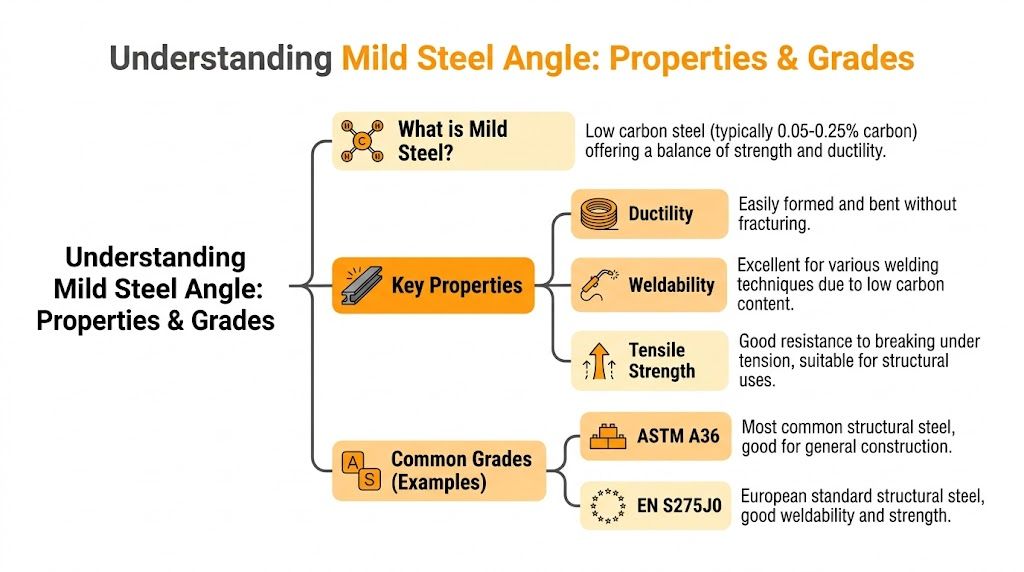
Mild steel angle is a hot rolled L-section made from low-carbon steel. For UAE project work, the useful part is not the textbook definition. It is the combination of weldability, shop availability, and predictable fabrication for brackets, frames, cleats, support steel, and secondary members.
What the material properties mean on site
Low-carbon steel is easier to cut, drill, fit, and weld than higher-carbon alternatives. That matters in local workshops handling mixed building packages, where speed of fabrication often affects programme more than small differences in theoretical material performance.
The trade-off between mild steel and higher-strength or more corrosion-resistant materials is significant. Mild steel is usually easier to source and fabricate at a lower cost, but it depends heavily on the right coating system once it is exposed to UAE humidity, chlorides, or rooftop condensate.
From a specification standpoint, project teams should focus on a short list of practical properties:
- Weldability: Mild steel angle suits standard workshop welding procedures and routine site modifications.
- Ductility: It tolerates fitting, drilling, and minor fabrication adjustments without becoming difficult to handle.
- Strength level: It is suitable for many secondary and light structural duties, but the engineer still needs to check the actual section capacity.
- Surface condition: Mill scale, rust bloom, and storage condition affect coating quality and inspection acceptance, especially on projects near the coast.
Equal and unequal angles are not interchangeable
Equal angle is the default market item. It is common in frames, simple cleats, edge members, and support steel where both legs serve a similar function.
Unequal angle is often the better choice when connection geometry is one-sided, when the bolt line needs more edge distance on one leg, or when a support must project in one direction while keeping the back leg compact. In practice, such situations frequently initiate detailing errors. The consultant sketches an angle. The fabricator prices the easiest stocked equal section. The installed piece then fails the intended connection layout or clashes with adjacent services.
That is why the angle type needs to be stated clearly on drawings, RFQs, and purchase orders.
Geometry affects structural behaviour
Angle sections do not behave like flat bar with a corner. Their eccentric shape affects bending, buckling, torsion, and connection design. A single angle in compression, for example, can become slender quickly if the unsupported length grows. A bracket angle loaded through one leg also introduces eccentricity that changes the actual stress pattern.
For project managers, the procurement lesson is straightforward. Do not approve an angle by leg size alone. Approval should follow the engineer’s required section properties, grade, and intended connection detail. That is particularly important on Dubai jobs where authority review, consultant comments, and contractor value engineering all happen under tight timelines.
Grades and standards to call up
The grade should never be left as “mild steel” without a governing standard. On UAE submittals, a common reference is BS EN 10025, which defines structural steel grades and delivery conditions. The market report published on OpenPR notes that Yasu Trading Co. LLC has supplied MS angles to the UAE market in equal and unequal configurations aligned with BS EN 10025 requirements for infrastructure demand through 2024. That matters because it reflects how the product is specified and traded locally, not just how it is described in generic catalogues.
You will also see projects reference ASTM A36 for general carbon structural steel. According to the ASTM A36 material specification summary published by Matmatch, A36 steel has a minimum yield strength of 250 MPa. That gives the engineer a clear baseline for design checks and gives procurement a defined grade to request on MTCs and mill offers.
In live UAE procurement, the main distinction is practical:
- Secondary supports and general fabrication: A standard structural mild steel grade is often acceptable if the drawings and submittals state the governing standard clearly.
- Primary or load-critical duty: The engineer should define the exact grade, design basis, and required certification.
- Exposed external use: Material grade alone does not control service life. Coating selection, preparation, and maintenance plan usually decide whether the steel survives the environment.
What usually causes trouble
The recurring problem is not that mild steel angle is unsuitable. The problem is incomplete specification.
These are the checks I insist on before release for a UAE project:
- State the section type clearly. Equal or unequal.
- State the grade and standard clearly. BS EN 10025, ASTM A36, or the project-specific equivalent.
- Match the angle to the duty. Secondary support, structural member, bracket, frame, or miscellaneous steel.
- Confirm the corrosion protection route. Primer only, full paint system, hot-dip galvanizing, or another approved system.
- Require mill documentation where the contract demands it. This is often where municipality, consultant, or third-party inspection comments start.
That approach saves time. It also reduces the common UAE project problem where steel is available in the market, but the delivered item still cannot pass submittal review because the paperwork, grade callout, or coating basis does not match the specification.
A Practical Guide to Dimensions and Weights
A Dubai project can lose a week over a small angle order. The drawing says 75 x 75. The buyer assumes 6 mm. The fabricator prices 5 mm. The consultant reviews the submittal against a different section table. By the time the mismatch is found, the steel is already cut or on the truck.
That problem starts with section notation and ends with cost, rework, and programme pressure.
How to read the size correctly
For an equal angle, the notation is Leg x Leg x Thickness. A 50 x 50 x 5 mm angle has two equal 50 mm legs and a 5 mm thickness.
For an unequal angle, use Leg 1 x Leg 2 x Thickness. A note that says only 75 x 50 is incomplete. It still leaves thickness open, and that changes weight, connection detailing, and sometimes availability.
Stock length matters as well. In the UAE market, angles are commonly supplied in mill stock lengths, often 6 metres, but that should be confirmed at enquiry stage because available lengths vary by mill, import batch, and whether the material is black steel or already galvanised. If the site has restricted lift capacity or the job needs high cut efficiency, that stock length should be on the RFQ, not left for the fabricator to guess.
Common Mild Steel Angle Sizes and Approximate Weights
The market usually carries equal angles from small support sizes up to sections used for heavier frames and brackets. Actual mass per metre and section properties should be checked against the relevant manufacturer table before final ordering. For reference values, engineers and buyers can cross-check standard dimensions against the steel section data published by Roy Mech.
| Size (mm) | Thickness (mm) | Typical weight range (kg/m) |
|---|---|---|
| 25 x 25 | 3 to 5 | approx. 1.1 to 1.8 |
| 30 x 30 | 3 to 5 | approx. 1.4 to 2.2 |
| 40 x 40 | 4 to 6 | approx. 2.4 to 3.5 |
| 50 x 50 | 5 to 6 | approx. 3.8 to 4.5 |
| 65 x 65 | 5 to 6 | approx. 5.0 to 6.0 |
| 75 x 75 | 6 to 8 | approx. 6.8 to 8.9 |
| 90 x 90 | 6 to 8 | approx. 8.2 to 10.9 |
| 100 x 100 | 6 to 10 | approx. 9.2 to 15.0 |
These are working figures for early estimating, logistics planning, and comparing options. They are not a substitute for the mill certificate, approved section table, or the engineer’s design check.
Why dimensions and weight affect site decisions
Section size is not only a buying issue.
Weight per metre affects the total tonnage booked, the trailer loads sent to site, and the crane or hoist plan for upper-floor delivery. On a large MEP package, a small undercall in weight repeated across hundreds of supports can distort the purchase quantity enough to create a shortage. An overcall ties up budget in steel the project does not need.
The chosen size also affects fabrication yield. A support detail that looks efficient on the drawing can produce poor cut optimisation from standard stock lengths. That matters in the UAE because imported material may be available, but not always in the exact quantity or lead time needed once a project is already under installation pressure.
A 50 x 50 x 5 mm angle is a common example for secondary supports. It is often adequate for light frames, cleats, and brackets. It is not automatically suitable for every frame member. Once spans grow, bolt holes reduce the net section, or the load sits eccentrically, the simple angle starts to behave less kindly than teams expect.
What to put on the RFQ and PO
For UAE procurement, the order description needs to be complete enough to pass both commercial review and technical submittal review. At minimum, state:
- Section type: Equal or unequal
- Leg sizes: Both dimensions in millimetres
- Thickness: In millimetres
- Length: Stock length or cut length
- Quantity basis: Number of lengths, total metres, or total mass
- Finish: Black, primed, or galvanised
- Applicable standard and grade: As required by the project specification
- Documentation: Mill test certificate, coating records, and any third-party inspection requirement if called for
That level of detail prevents the common Dubai problem where material is physically available in the market but still cannot be released because the submitted section, mass, or paperwork does not match the consultant requirement.
Structural vs Non-Structural Uses and Fabrication
Not every mild steel angle on a project deserves the same level of scrutiny. Some pieces are part of the load-bearing system. Others are there to organise services, mount equipment, or solve everyday installation problems. Mixing those categories is where teams either overspend or under-specify.
Where it is structural
Structural use means the angle contributes directly to carrying or stabilising load. In that role, the section cannot be treated as a general workshop item.
Typical examples include:
- Truss members
- Bracing elements
- Lintel support components
- Connection cleats within engineered steel assemblies
- Load-bearing frames around plant or rooftop structures
In these applications, the angle size, grade, hole pattern, weld detail, and corrosion system all matter together. A change in one affects the whole assembly.
Where it is non-structural
Non-structural use is broader and far more common on building services packages.
You’ll see mild steel angle used for:
- MEP support frames: Cable tray supports, pipe stand frames, AHU bases, service trapezes
- Equipment mounting: Pump skids, panel supports, small platforms
- Architectural and maintenance work: Edge trims, access details, workshop-made brackets, repair pieces
Mild steel angle earns its reputation as a practical fabricator’s section because it gives enough stiffness for many support details without forcing the team into heavier steel or slower fabrication routes.
The real trade-off between the two
Structural steelwork rewards precision. Non-structural steelwork rewards speed, flexibility, and ease of modification. Mild steel angle can serve both, but the approach should change.
For structural use, the wrong shortcut is usually under-documenting the product.
For non-structural use, the wrong shortcut is over-engineering simple support steel and slowing the package down.
A support frame can be non-structural and still fail in service if the connection detail, corrosion protection, or installation quality is poor.
Why fabricators like working with it
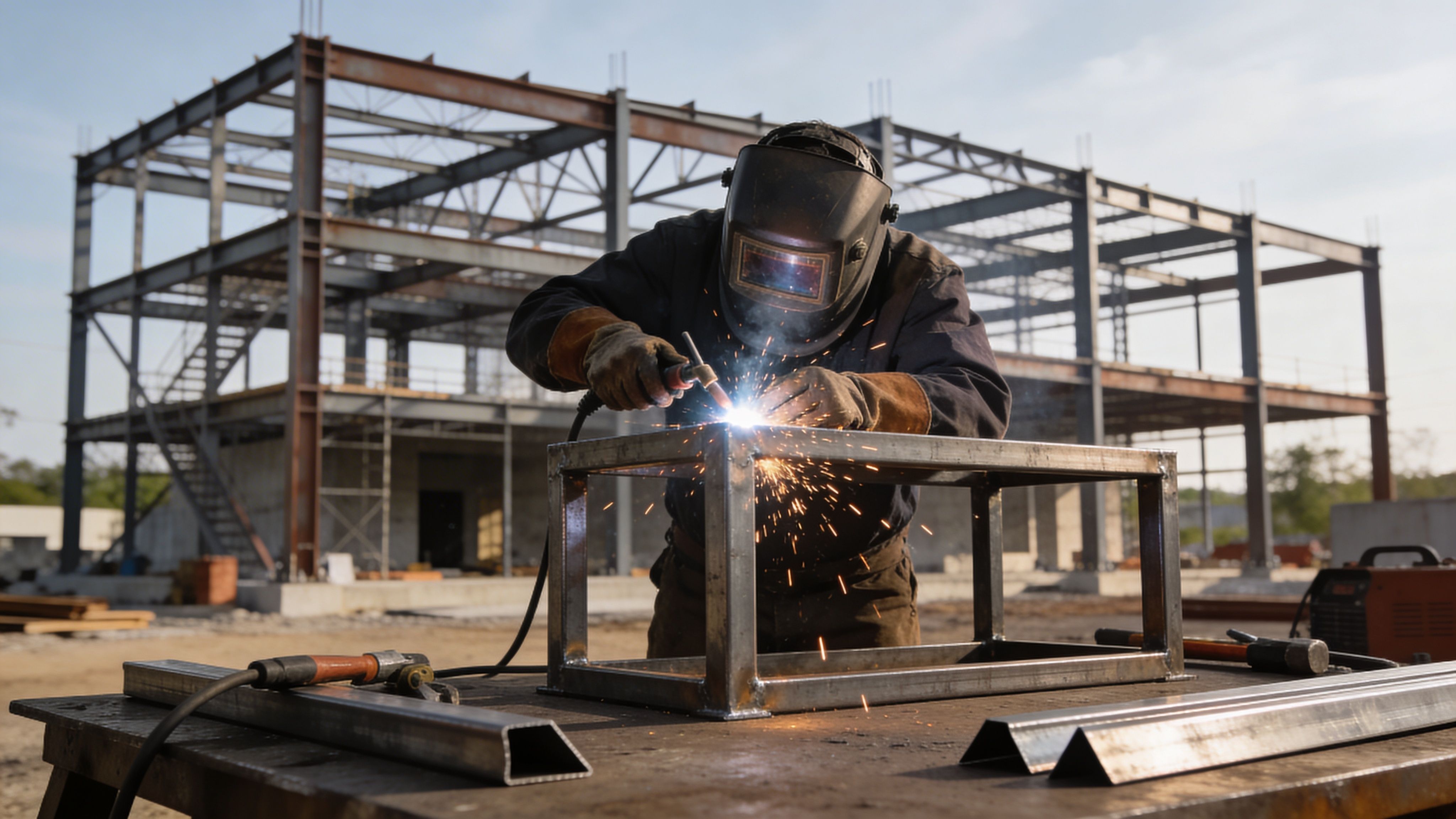
The low-carbon composition makes mild steel angle cooperative in the workshop. It cuts cleanly, aligns well for tack welding, and tolerates routine drilling and notching without the material fighting back.
The UAE supplier data cited earlier notes that its weldability and formability can reduce on-site fabrication time by 30% to 40% compared to higher-grade steels like S355 for relevant applications, based on stock used for sheds and transmission towers in the UAE market. That’s a meaningful distinction on projects where support steel is being fabricated around live site conditions.
Common fabrication methods
Most angle fabrication on building projects falls into a familiar set of workshop operations.
Cutting and mitring
Bandsaw cutting is standard for clean production work. Abrasive cutting still appears in faster workshop settings and on site. Mitred corners are common in rectangular frames, but they should be detailed with enough tolerance to avoid forcing the fitter to close poor cuts with oversized welds.
Drilling and slotting
Angles used for bolted supports often need hole patterns that allow adjustment. Slotting can help installation teams, but too much adjustment range weakens the detail and invites poor alignment.
Welding and assembly
Fillet welds are common because the geometry suits them. That doesn’t mean every angle connection is forgiving. Thin legs distort faster, and long intermittent welds can introduce twist if the fit-up is poor.
A brief fabrication reference is useful here:
Bending and modification
Angle is formable, but once you start heating, kinking, or forcing sections to suit a late site condition, you need to stop pretending the member is still as originally specified. Improvised reshaping is one of the fastest ways to create a detail that passes visually but performs badly.
What works on UAE sites
A few habits consistently save time:
- Fabricate repetitive supports in the workshop: Site welding should be the exception, not the default.
- Use angle where access matters: Installers can manoeuvre angle sections more easily than bulkier fabricated members.
- Keep the detail honest: If the support is carrying real load, get it engineered and documented as such.
- Sequence coating properly: If hot-dip galvanising is part of the spec, finish the heavy fabrication first where possible.
What tends to fail
Three mistakes show up repeatedly:
- Treating all supports as “light duty” without checking actual service loads
- Using angle because it is available, not because it is the right section
- Ignoring how weld access, coating damage, and installation tolerance affect long-term performance
On straightforward support steel, mild steel angle is hard to beat. On high-demand connections or compression-sensitive members, it needs more discipline than many teams assume.
Corrosion Protection and Sizing for UAE Projects
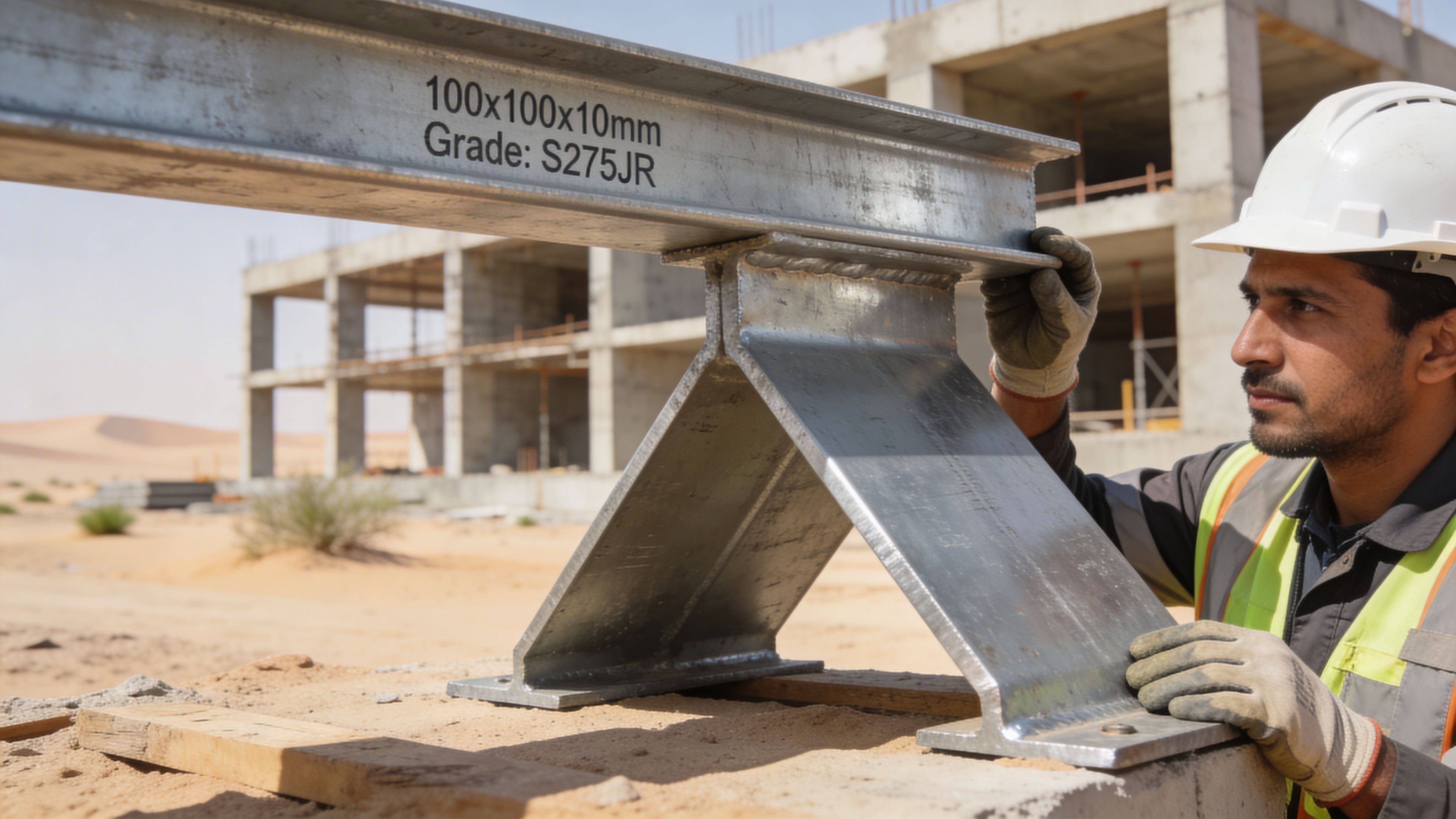
In the UAE, corrosion protection is not a finishing detail. It is part of the steel specification. If your mild steel angle is exposed to coastal air, roof moisture, washdown, or humid service zones, untreated material will disappoint you quickly.
What the UAE climate does to untreated steel
In coastal zones, untreated mild steel can corrode at 0.1 to 0.3 mm per year, according to this corrosion-focused reference on mild steel angle. The same verified data notes that inland rates can be lower, but Dubai and Abu Dhabi projects near saline air should not be designed around best-case conditions.
That’s the practical reason many failures begin with a seemingly minor omission. A support detail that looks acceptable at handover can be the first steel item showing distress during operation if the coating system was weak, cut edges were left unprotected, or galvanising was omitted to save time.
What protection usually works
For exposed or humid environments, hot-dip galvanisation to at least 85 microns is the benchmark identified in the same source as Dubai Municipality-compliant under BS EN ISO 1461. That level of protection can extend service life from under 10 years to over 25 years, while reducing lifecycle costs by more than 25%.
The UAE supplier data adds a practical coating detail. In Dubai’s humid, saline conditions, applying a 75 to 100 µm zinc-rich primer post-galvanising has been used to extend service life from 10 to 15 years to 25+ years by reducing pitting corrosion. For contractors handling MEP framing in hotels and high-rises, that’s not theory. It’s a useful field decision.
For a broader view of coating choices in local marine conditions, this note on sustainable fasteners and coatings for UAE coastal corrosion is worth reviewing alongside your steel package.
Site warning: Galvanised steel only performs as intended if drilled areas, weld zones, and damaged transport points are repaired properly after fabrication and installation.
Protection options compared
| Finish option | Best use case | Limitation |
|---|---|---|
| Black mild steel | Indoor dry areas, temporary works, protected internal fabrication | Poor choice for exposed or humid service without follow-up protection |
| Primer and paint system | Internal supports and some sheltered applications where maintenance access is available | Depends heavily on surface preparation and maintenance discipline |
| Hot-dip galvanised | External steel, roof steel, plantroom supports, coastal and humid zones | Needs planning around fabrication sequence and post-weld repair |
How to size it sensibly
Sizing a mild steel angle should start with the actual duty, not with whatever stock is easiest to source that day.
For a small support bracket or frame member, check:
- Load type: Point load, distributed load, uplift, vibration, or combined loading
- Support condition: Bolted at one end, fixed in a frame, or spanning between supports
- Deflection sensitivity: MEP supports often fail functionally before they fail structurally
- Connection geometry: Bolt holes and eccentric loading can reduce the margin quickly
- Exposure: The right size with the wrong finish is still a bad specification
A common mistake is sizing the leg dimensions only by visual stiffness. That’s not enough. Angles can twist, especially when the load is not passing cleanly through the shear centre or when the connection detail is eccentric.
A practical worked approach
Take a small MEP support frame carrying a modest service load. Teams often default to an equal angle because it’s easy to stock and easy to fabricate. That may be fine if the span is short, the bracket is braced, and the deflection limit is acceptable.
A 50 x 50 x 5 mm angle is a common candidate because it’s practical to handle and has known section properties in the UAE market. But that doesn’t mean it should be approved from memory. The engineer still needs to check bending, deflection, and the connection detail. If the support is asymmetrical or the bolt line sits off-centre, an unequal angle may be the better answer even if the total steel quantity is similar.
The point is simple. Sizing is not just section selection. It is section plus connection plus environment.
What usually saves money
The cheapest-looking angle is not always the lowest-cost choice across the project.
These decisions usually pay back:
- Specify galvanising early: Late changes to a black steel package create rework and approval friction.
- Match the finish to the actual exposure: Don’t galvanise every hidden internal support by reflex, but don’t under-protect roof and coastal steel.
- Standardise repeat sizes: Fewer section variants simplify stock control and workshop output.
- Design for coating continuity: Avoid details that trap moisture or leave inaccessible cut surfaces untreated.
The UAE climate is unforgiving to vague steel specifications. If the angle will see humidity, saline air, or repeated maintenance washdown, corrosion protection should be written into the purchase decision, not added as an afterthought.
Procuring Compliant Mild Steel Angle in the UAE
The technical choice is only half the job. Mild steel angle has to arrive in the right size, with the right finish, and with enough paperwork to pass submittal review without turning into a chasing exercise.
Start with the purchase description
A weak purchase order creates most downstream confusion. “MS angle” is not a usable procurement description for a real project.
A workable line should include:
- Section form: Equal or unequal
- Full dimensions: Leg sizes and thickness
- Length requirement: Stock length or cut length
- Grade or standard: If required by design or authority submission
- Finish: Black, primed, or galvanised
- Documentation: Mill test certificate, coating compliance, and any project-specific submittal requirements
If any of those are missing, suppliers will fill the gaps with assumptions. Assumptions are where delays start.
Ask the compliance questions early
For Dubai and Abu Dhabi work, approval risk often sits in the supporting documents rather than the steel itself.
Ask for these before release:
- What standard is the angle supplied to?
- Is the coating thickness stated where galvanising is required?
- Will the supplier provide mill test certificates with the delivery?
- Are the dimensions and tolerances consistent with the approved submittal?
- Will material markings or bundle traceability remain clear through delivery?
This is also where a distributor with local stock and compliance familiarity can help. Yasu Trading Co. LLC supplies building materials and hardware in the UAE and can support municipality-compliant procurement where angle-related accessories, coatings, fasteners, and site delivery coordination need to be handled in the same purchasing flow.
Keep an eye on equal versus unequal
A useful procurement shift is already visible in the market. For 2025 to 2026, the UAE is seeing greater use of MS unequal angles in seismic-resistant designs and asymmetrical MEP supports, where they can offer 15% to 20% better moment resistance in certain applications and reduce material use by 10% to 15% compared with equal angles, according to this UAE-focused discussion of MS angle applications. Treat that as a project-specific design trend, not a blanket rule for every job.
That matters commercially because many buying teams still default to equal angles out of habit. On some support and renovation packages, that habit may no longer be the most efficient choice.
Commercial judgement matters too
A supplier can be technically correct and still cause programme trouble if stock reality is ignored.
Check these points before placing the order:
- Delivery split: Do you need a full release now, or staged deliveries by area?
- Fabrication route: Are you buying stock lengths for workshop processing or finished cut lengths?
- Site constraints: Can the site receive six-metre lengths, or do you need pre-cut bundles?
- Protection in transit: Galvanised and painted surfaces both need handling discipline.
- Price timing: For a live market snapshot that helps frame buying decisions, this overview of the steel rate in UAE is useful context.
Buy the steel package the way the site will actually install it. That usually saves more time than arguing over a small per-tonne difference.
A short procurement checklist
| Checkpoint | Why it matters |
|---|---|
| Section fully described | Prevents wrong-size or wrong-type deliveries |
| Grade and standard confirmed | Supports submittal and design compliance |
| Finish clearly specified | Avoids corrosion and approval problems |
| Certificates requested up front | Reduces document chasing after delivery |
| Delivery format agreed | Keeps fabrication and installation moving |
On UAE projects, compliant procurement is mostly about removing ambiguity. The teams that do it well don’t rely on “standard material” language. They write the requirement precisely and buy it once.
Frequently Asked Questions
Can I use the same mild steel angle for structural and MEP support work
Sometimes, yes. But don’t assume so by default. Structural use needs engineering checks, proper material identification, and connection design. MEP support work is often more forgiving, but deflection, vibration, and corrosion still matter.
Is equal angle always the right first choice
No. Equal angle is common because it’s easy to stock and easy to detail. But if the support is asymmetrical, the connection is eccentric, or the load path favours one leg, an unequal angle may be a better fit.
Can galvanised mild steel angle be welded
It can, but the process needs care. The coating at the weld area will be affected, and that zone needs proper repair after welding. On exposed steel, that repair step is part of the corrosion system, not an optional touch-up.
What paperwork should I ask for from the supplier
Ask for the mill test certificate and any coating or galvanising compliance documents required by the project. The purchase order should also align exactly with the approved size, finish, and standard so site deliveries remain traceable to the submittal.
How should mild steel angle be stored on site in Dubai
Keep it off the ground, separated from standing water, and protected from contamination. Don’t leave bundles sitting where packaging traps moisture. If the material is galvanised or primed, inspect handling damage early so repairs happen before installation.
What is the biggest mistake buyers make
Treating mild steel angle as a generic commodity. The recurring problems are usually specification gaps, not material shortages. Wrong finish, vague dimensions, and incomplete documentation cause more trouble than the steel section itself.
If you need help specifying or sourcing compliant mild steel angle, Yasu Trading Co. LLC supports UAE contractors with practical procurement guidance, fast material coordination, and direct delivery for building material requirements across Dubai and the wider UAE.