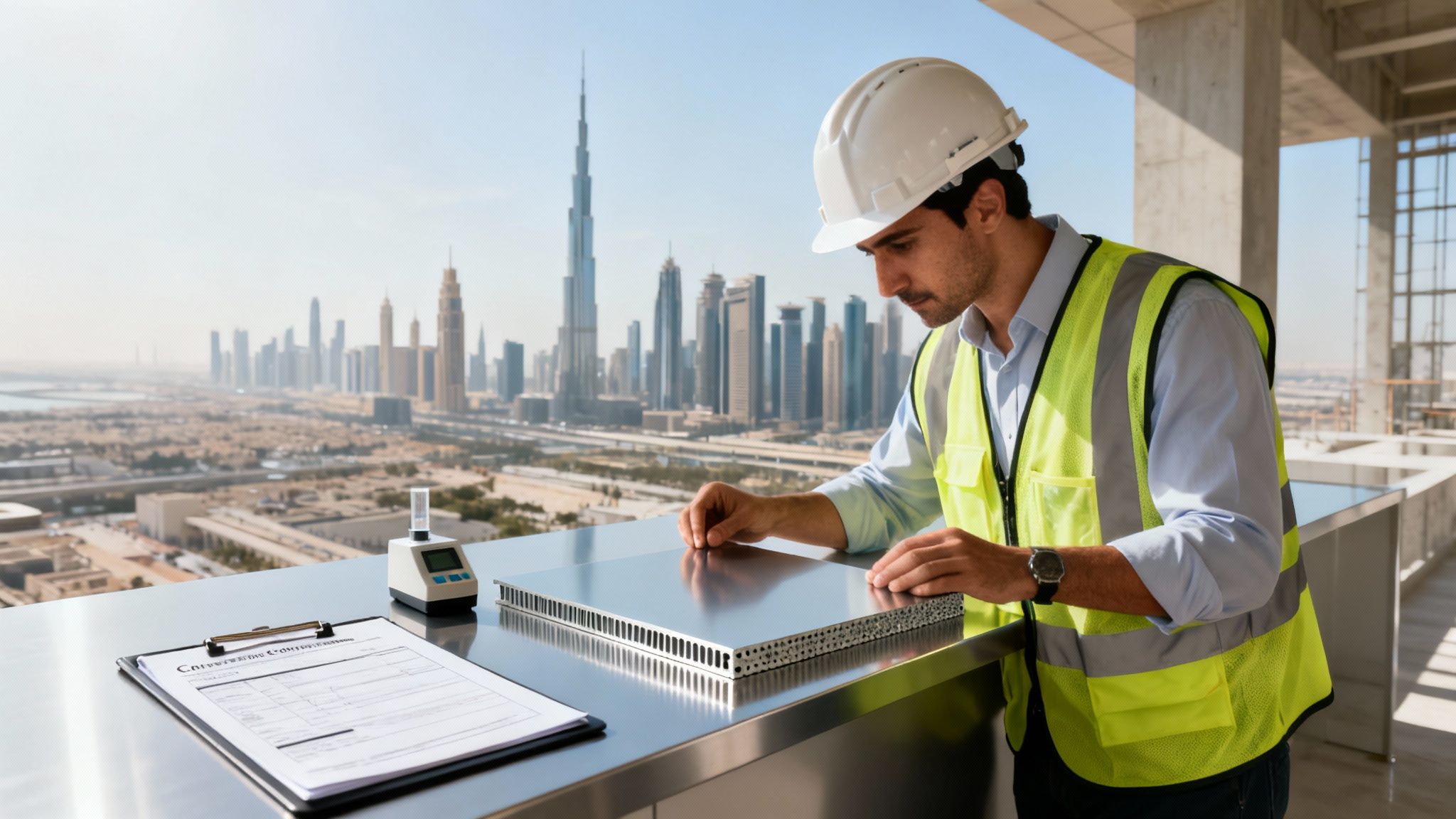
Alert: new fire safety codes in dubai: is your building material compliant?
Getting your head around Dubai's new fire safety codes can seem daunting, but it boils down to one crucial thing: your building material isn't compliant unless it has a DXB-Specific Certificate of Conformity (CoC). This is a big shift. Those generic international certifications you used to rely on? While still important, they are no longer enough on their own to pass muster in Dubai.
What Are Dubai's New Fire Safety Mandates?
The ground is shifting for construction in Dubai, thanks to the updated UAE Fire and Life Safety Code of Practice. This isn't just a minor tweak to the rulebook; it’s a complete overhaul of how building materials are approved and tracked across the emirate.
For years, many projects moved forward with globally recognised certificates. The new rules, however, insist on a local verification process. This ensures every critical building component is tested and proven to handle the specific conditions and fire risks we face here in the UAE, effectively closing loopholes that previously allowed subpar products to slip through the cracks.
Why Is a DXB-Specific Certificate of Conformity Required?
A DXB-Specific CoC is now the ultimate proof that a building material has been rigorously tested and approved by a local, Dubai Civil Defence (DCD)-authorised body. This local seal of approval ensures materials can stand up to the unique challenges of Dubai's dense, high-rise environment—something a generic test in a different climate just can't guarantee.
This change really comes down to accountability. In January 2024, the DCD brought in these new standards to tighten up the supply chain. Before this, you'd see issues like fire doors getting installed with approvals that weren't based on UAE-specific tests, creating very real safety risks. These new rules, covering everything from fire-rated doors to cladding and ducts, are designed to stop that from happening.
What Is the Role of the Emirates Safety Lab?
The Emirates Safety Lab (ESL) is the official third-party organisation handpicked by the DCD to handle the testing and issue these mandatory DXB-Specific CoCs. As the sole issuer, an ESL certificate is the gold standard. It's what inspectors will be looking for on every job site, whether it's a brand-new tower or a major renovation.
The rule of thumb is simple: No ESL-issued CoC, no compliance. This new system puts the responsibility squarely on manufacturers and suppliers to prove their products meet the tough UAE construction standards.
To see how these changes play out in practice, let's look at the key differences between the old way of doing things and the new requirements.
How Do the New Dubai Fire Safety Codes Differ From the Old Ones?
The new codes introduce a more localised, stringent, and traceable system designed to enhance safety across the board. Key changes include mandatory local certification, product QR codes, and direct approval by Dubai Civil Defence.
| Compliance Area | Previous Standard (Pre-Code Update) | New Requirement (Current Code) |
|---|---|---|
| Certification Validity | Often relied on international certificates (e.g., UL, BS) alone. | Requires a DXB-Specific Certificate of Conformity (CoC) issued by ESL. |
| Testing Authority | Testing could be from various international, accredited labs. | Mandatory testing and certification by the Emirates Safety Lab (ESL). |
| Product Traceability | Limited traceability once materials arrived on site. | Materials must be labelled with a QR code linking to the CoC. |
| Approval Body | General acceptance of reputable global standards. | Direct approval and authorisation by Dubai Civil Defence (DCD) is required. |
| Enforcement | Based on documentation review, often during final inspection. | Proactive, on-site verification of QR codes and CoC validity. |
This extra layer of verification is a critical checkpoint. For any project manager or procurement officer, the first question for any supplier should now be, "Can you provide a valid, DXB-Specific CoC for this product?" A reliable supplier won't just have the certified materials; they'll provide all the paperwork upfront to prevent headaches and delays during official inspections. You can learn more about the wider regulatory landscape in our detailed guide on navigating Dubai building codes.
Which Building Materials Are Most Affected by the New Codes?
The updated UAE Fire and Life Safety Code isn't just a minor tweak; it’s a laser-focused overhaul on materials known to be high-risk in a fire. The new rules put the building envelope and internal passive fire protection systems front and centre. A material's performance is no longer just about looks or strength—it's about proven, certified fire resistance.
What Facade Material Is Under the Most Scrutiny?
Aluminium Composite Panels (ACPs) are the most scrutinised material under the new code. This is due to the historical use of ACPs with highly flammable polyethylene (PE) cores, a material directly linked to the rapid spread of fire up the sides of high-rise buildings in Dubai.
We’ve all seen the news reports showing how a small fire can race up a tower in minutes. What’s truly eye-opening is that an estimated 70% of Dubai's buildings put up before 2013 were clad with these non-fire-rated ACPs. This massive vulnerability, brought to light by several high-profile fires, was the primary driver for the code update. Now, there are no exceptions: all new projects must use verified fire-resistant materials.
What Other Materials Require Strict Compliance?
It's not just about the outside of the building. The code aims for a complete, holistic fire safety system where every component plays its part. One weak link can compromise the entire strategy.
These materials now need specific performance ratings, and you have to prove it with a DXB-Specific Certificate of Conformity (CoC). As a building materials distributor on the ground here, we’re seeing just how non-negotiable this paperwork has become for getting project approvals.
Here’s what else is under review:
- Fire-Rated Doors and Glazing: Think of these less as doors and more as engineered fire barriers. They must carry a specific fire-resistance rating (like 60, 90, or 120 minutes) that’s been verified through local testing. The glass inside them is just as important and must meet tough standards to stop it from failing under extreme heat.
- Insulation Materials: Combustible insulation, especially foam plastics chosen for their thermal properties, is a massive red flag. The code now demands that any insulation used in exterior walls passes stringent fire propagation tests, like NFPA 285, to ensure it won’t act as fuel.
- Firestopping Sealants and Systems: Every time you cut a hole in a fire-rated wall for pipes or cables, you create a potential breach. Firestopping sealants are required to plug these gaps effectively, maintaining the wall's integrity and preventing smoke and flames from travelling between different parts of the building.
A classic mistake we see is a contractor building a perfect fire-rated wall but then using the wrong sealant for the MEP penetrations. That one shortcut invalidates the entire assembly. Your supplier in Dubai needs to provide certified systems, not just standalone products.
How Are Coatings and Finishes Affected by the New Fire Codes?
Even materials that seem secondary, like coatings and paints, are now regulated. It’s not just about the big structural elements; accessories like specialised fire-retardant coatings are critical to a building's overall fire safety.
These products are often applied to structural steel or wood to buy precious time in a fire. Under the new UAE construction standards, these coatings must have their own CoC, proving they deliver the specified level of protection for the required time. It’s a clear message: every single layer matters.
How Do You Conduct a Fire Safety Compliance Audit?
The best way to handle the new fire safety regulations is to get ahead of them. A proactive compliance audit is your strongest defence against costly project delays, failed inspections, and some seriously hefty fines. Instead of waiting for a Dubai Civil Defence (DCD) inspector to show up and find a problem, you can build an internal process to catch these gaps early.
Think of it less as a chore and more as a crucial part of your quality control. A well-run audit shows you’re on top of your game and makes official inspections feel like a formality, not a final exam. The trick is knowing exactly what to look for and where.
This really boils down to three core actions: identifying every material, verifying its compliance, and replacing anything that doesn't make the cut.
The path is clear: every single material has to be identified and its paperwork confirmed before it ever gets installed. There are no shortcuts here.
What Should an On-Site Inspection Look For?
A solid audit starts with a hands-on inspection of materials, focusing on the mandatory QR code label. The new rules are firm on this: compliant products must have a QR code that links directly to the material's DXB-Specific Certificate of Conformity (CoC). This is your first and most critical checkpoint.
- Look for the QR Code: Is it there? Is it easy to read on the product or the packaging?
- Scan and Verify: Use your phone. Does it take you to a valid, current CoC from the Emirates Safety Lab (ESL)?
- Match Product to Certificate: Does the product description on the certificate perfectly match what you're holding in your hands?
Any mismatch here is a massive red flag. If a QR code is missing, broken, or links to a generic company website, that material needs to be quarantined immediately. Don't even think about installing it until its compliance is proven beyond a shadow of a doubt.
How Do You Verify Supplier Documentation?
Verifying supplier documentation is the second pillar of your audit, and your relationship with your building materials distributor is central to this process. A good supplier should provide a complete documentation package with every delivery, including the DXB-Specific CoC, third-party lab reports, and technical data sheets.
Expert Tip: Your goal should be to build a comprehensive 'compliance binder' for your project. Whether it's a physical file or a digital folder, it should contain all the necessary paperwork, organised and ready to show a DCD inspector at a moment's notice.
For any given material, a complete documentation file must include:
- The DXB-Specific CoC: This is the non-negotiable certificate issued by ESL.
- Third-Party Lab Reports: These reports are the proof, showing detailed performance data from the tests needed for certification.
- Technical Data Sheets (TDS): These manufacturer sheets provide essential specs and installation guidance.
When you're sifting through these documents, check that certificate numbers match up across all the paperwork and that the validity dates are current. An expired certificate is worthless.
How Can You Best Vet Third-Party Lab Reports?
Vetting third-party lab reports requires focusing on the specific performance metrics that matter for UAE construction standards. These dense, technical documents hold the evidence behind a certificate, detailing exactly how a material performed under intense fire testing.
When looking at a report from a lab like ESL, zoom in on the performance metrics that matter. For instance, a fire door’s report will specify its fire-resistance rating in minutes (e.g., 60, 90, 120 minutes). An insulation panel’s report might detail its performance in a demanding NFPA 285 wall assembly test. Don't just file these reports—use them to confirm the material is genuinely fit for purpose in your design.
How Do You Properly Assess a Supplier in Dubai?
A proper assessment involves vetting your suppliers to ensure they are a reliable compliance partner, not just a vendor. A trustworthy supplier in Dubai does more than just move boxes; they should be able to answer key questions about their compliance processes before you sign a purchase order.
- Can they show you sample CoCs for the products you’re looking to buy?
- What's their internal process for making sure all their stock is certified under the new codes?
- Can they guarantee that all the required paperwork will be provided with the delivery, every time?
If you get hesitant or vague answers, that’s a sign you'll be facing documentation headaches later on. A proactive, knowledgeable supplier will have these processes locked down, making your audit smoother and ensuring your project stays on the right side of the new fire safety codes in Dubai.
What Should You Do With Non-Compliant Materials On-Site?
Finding non-compliant materials on-site requires immediate action, but it doesn't have to be a catastrophe. Dubai Civil Defence (DCD) has established clear procedures for fixing these issues. The most important thing is to act fast, be transparent, and use only DCD-approved methods like retrofitting or replacement.
Your first move should always be to isolate the non-compliant products and immediately stop any further installation. This simple action contains the problem and shows you're serious about following the new fire safety codes in Dubai. From that point, you're looking at two main options: retrofitting what you have with an approved solution or a complete replacement.
Can You Retrofit Non-Compliant Materials Instead of Replacing Them?
Yes, retrofitting is a DCD-approved option in certain situations, allowing you to bring a non-compliant material up to code without full replacement. This is a lifesaver for your budget and schedule, particularly for older buildings, as it involves applying a certified product or system to upgrade the existing material to meet UAE construction standards.
A classic example is dealing with under-protected structural steel. If steel beams don't have the right fire protection, you can often apply a certified intumescent paint. This coating swells up when exposed to heat, creating a protective char layer that insulates the steel. It's a DCD-approved remedy that buys precious time for people to evacuate in a fire, hitting the core life-safety goals of the code.
Firestopping systems are another common area where this comes up. Let’s say an audit finds that the gaps around pipes and cables running through a fire-rated wall were sealed with the wrong product. You don't necessarily have to start demolishing the wall. The fix involves carefully removing the incorrect sealant and applying a DCD-approved firestopping system that’s rated for that specific wall assembly.
It's crucial to understand that some materials are simply beyond saving. You can't just slap a coat of paint on a flammable Aluminium Composite Panel (ACP) with a polyethylene core and call it a day. For high-risk applications like that, a full replacement is the only acceptable and safe path forward.
What’s the Best Retrofit Solution for Wall Penetrations?
The best retrofit for wall penetrations is a complete, DCD-approved firestopping system specifically certified for the application. This means using a product—be it a sealant, collar, or wrap—that has been tested and listed for both the type of item penetrating the wall (e.g., plastic pipe vs. metal conduit) and the wall's specific fire-resistance rating.
How Does the Cost of Replacement Compare to Retrofitting?
Deciding between replacing and retrofitting is a financial balancing act. While retrofitting often has lower material and labour costs and causes fewer project delays, full replacement offers higher compliance certainty for high-risk components. A knowledgeable building materials distributor can help by giving you accurate pricing for both routes.
Here's a quick way to compare them:
| Consideration | Full Replacement | Approved Retrofitting |
|---|---|---|
| Material Cost | Higher. You're buying new, fully certified products. | Lower. You're mostly purchasing enhancement products like coatings or sealants. |
| Labour Cost | High. This involves demolition, removal, and brand-new installation. | Moderate. The work is focused on surface prep and careful application. |
| Project Delays | Significant. Can easily throw off the entire project schedule. | Minimal. Can often be done with less disruption to other ongoing work. |
| Compliance Certainty | High. New certified materials are simple to verify. | High, but only if it’s executed perfectly with DCD-approved products and methods. |
| Best For | High-risk components like facade cladding or primary structural elements. | Firestopping, upgrading fire doors, or adding protective coatings. |
Ultimately, the right choice comes down to what's feasible, safe, and acceptable to the authorities. For a facility manager of an older building, a phased retrofitting plan is often the most practical way to bring the entire property up to code over time. But on a new build, if you catch a bad delivery early, opting for a full replacement is almost always the smarter and safer decision. Partnering with a reliable supplier in Dubai ensures you get the right advice and the correct certified materials, whichever path you take.
How Can You Source Certified Building Materials in Dubai?
Let's be clear: your project's compliance is only as solid as your supply chain. When you’re navigating the tough UAE construction standards, picking the right partner is no longer just about getting the best price. It’s about having verified, certified compliance from the get-go. A trustworthy building materials distributor is now a core part of your risk management strategy.
Ultimately, the buck stops with the contractor. If you source from a distributor who doesn't grasp—or worse, ignores—the new rules, you're setting yourself up for project delays, failed inspections, and expensive rework. The right supplier is your first line of defence, making sure every product that lands on your site is already vetted and certified.
The UAE's fire safety rules took a huge leap forward with the 2023 Fire and Life Safety Code update. This update didn't just mandate fire-resistant materials in all new construction; it helped fuel a USD 1.2 billion Fire Protection Construction Materials Market. With the January 2024 DCD standards adding DXB-Specific CoCs to the mix, procurement has changed for good. You can read more about the scale of these market changes and safety initiatives here.
What Should You Look for in a Building Materials Supplier in Dubai?
A great supplier in Dubai delivers more than just pallets and boxes; they deliver confidence. You need to find a distributor with a deep inventory of certified products from authorised brands, in-house technical expertise, and the readiness to provide all necessary paperwork—especially the critical DXB-Specific Certificate of Conformity (CoC)—without being chased.
Their team should understand the nitty-gritty requirements for different applications. They can guide your procurement managers to the right fire doors, the correct sealant, or the proper insulation, saving you from making a very costly mistake.
Why Is a Deep Inventory of Certified Products So Important?
A deep inventory ensures you get the compliant materials you need, when you need them, without compromising your project timeline. A well-stocked building materials distributor like Yasu Trading has already pre-vetted thousands of items, removing the risk of accidentally buying uncertified products and saving your team a massive amount of time.
This proactive approach means that whether you need fire-rated pipes for a skyscraper or specialised firestop sealants for MEP penetrations, the products are on the shelf and guaranteed to meet DCD standards. That’s a huge advantage over suppliers who only order materials as needed, which almost always introduces uncertainty and delays. For more on this, our guide on choosing the right fire-rated building materials has some extra pointers.
Key Takeaway: Think of a supplier with a robust, certified inventory not as a vendor, but as a genuine partner. When you consolidate your procurement with one knowledgeable source, you're guaranteeing that every single nut, bolt, and board arriving on-site is compliant.
How Does a Reliable Supplier Prevent Project Delays?
A reliable supplier prevents delays by ensuring compliance and documentation are handled correctly from the start. Picture an MEP contractor working on a new hotel in Downtown Dubai. They have a massive order for fire-rated pipes, fittings, and firestopping sealants—all materials that are now under the microscope with the new code.
The Wrong Approach: The contractor tries to save a few dirhams by sourcing from multiple, unvetted suppliers. One delivers pipes with an expired CoC. Another sends sealants with no local certification at all. The result? A failed DCD inspection, a stalled project, and a mad dash to find compliant materials at a premium price.
The Right Approach: The contractor partners with Yasu Trading. They place one consolidated order, and our team immediately provides the DXB-Specific CoCs and technical data for every single item. The materials arrive on schedule, fully compliant, and with all documentation neatly organised. The DCD inspection goes off without a hitch, and the project stays on track.
By working with a trusted supplier in Dubai, the contractor wipes out compliance risks, simplifies their paperwork, and protects their project from the financial hit of fines and delays.
What Are the Most Common Questions About Dubai's Fire Safety Codes?
The new fire code updates have understandably raised a lot of questions for everyone from developers to site managers. Here are answers to some of the most common points of confusion.
Do I Have to Replace the Cladding on My Older Building?
No, the UAE Fire and Life Safety Code does not currently force a mandatory, immediate retrofit of existing building facades. However, the stricter rules absolutely apply to all new builds, major renovations, or any instance where you are replacing facade panels.
So, while you might not get an order tomorrow to strip your building, owners are being pushed hard to carry out fire risk assessments. The smart move is to plan for phased upgrades to get rid of any potential dangers. It's less about a legal requirement for an old building and more about a fundamental responsibility to protect the people inside.
Is an International Certificate (UL, BS) Still Valid in Dubai?
No, an international certificate alone is not enough to prove compliance in Dubai. While certifications from bodies like UL, FM, or British Standards are indicators of quality, they must be accompanied by a DXB-Specific Certificate of Conformity (CoC) issued by a Dubai Civil Defence (DCD)-authorised local body.
This local CoC is the one document a DCD inspector will look for. It is the only official proof that your material meets the specific, demanding UAE construction standards. Your supplier absolutely must provide this local CoC alongside any international certs.
Think of it like this: an international certificate gets you in the door, but the local CoC gets your project approved. When you're sourcing materials like Fortafix Firebrand Fire Cement, which is made for high-heat situations, it's not just about its performance specs—it's about having that specific Dubai-stamped paperwork to back it up.
What is the Emirates Safety Lab (ESL) and What Do They Do?
The Emirates Safety Lab (ESL) is the official testing and certification authority appointed by the Dubai Civil Defence. They are responsible for testing building materials against local fire and life safety standards and issuing the mandatory DXB-Specific Certificate of Conformity (CoC) for products that pass.
For all practical purposes, the ESL is the gatekeeper. When a DCD inspector is on-site, their approval is what they're looking for. No ESL seal means no compliance. It's that simple.
How Can a Building Materials Supplier Help with Compliance?
A good building materials distributor acts as your compliance partner by pre-vetting products and providing all necessary documentation automatically. This ensures every item arriving on your site is up to code before you even place an order, saving you time and preventing costly errors.
Here’s what a real partner does for you:
- Puts Paperwork in Your Hand: They should provide all the crucial documents—especially the CoCs and technical data sheets—automatically with every delivery. No chasing required.
- Offers Real Technical Help: Their team should know the materials inside and out, helping you pick the right specs for your job so you don't make an expensive mistake.
- Keeps Certified Stock Ready: A good supplier has a deep inventory of compliant materials on hand, so you’re not facing project delays waiting for something to ship.
Working with a knowledgeable supplier in Dubai like Yasu Trading just removes the headache. You get the right certified materials, delivered with the right paperwork, right to your site. It’s the surest way to guarantee the materials you install are compliant with the new fire safety codes in Dubai from the get-go.
At Yasu Trading Co. LLC, we don't just supply materials; we deliver peace of mind. Our extensive inventory of municipality-compliant products is backed by the certifications you need to keep your project moving forward. Let us be your trusted partner for sourcing certified building materials in the UAE.