uPVC Pipe Meaning: What It Is and Where to Use It
uPVC means unplasticized polyvinyl chloride, a rigid PVC made without added plasticizers, used mainly for cold-water supply, drainage, sewerage and rainwater systems, and not for hot water.
Why can a pipe be suitable for a drain yet unsuitable for a water heater or a fire-rated wall? Because uPVC names the material, not its approval for every job. For UAE contractors and facility managers, understanding that distinction is more useful than knowing what the letters stand for.
Table of Contents
- What uPVC Pipe Means in Plain Terms
- Why Plasticizer-Free PVC Behaves Differently
- Where uPVC Pipe Is Used and Where It Is Not
- Reading Pressure Ratings Printed on the Pipe
- Misconceptions and the Eight Checks
- Confirm the Application Before You Order
What uPVC Pipe Means in Plain Terms
Think of flexible PVC as a soft garden hose and uPVC as a rigid plastic ruler. Plasticizers are additives that make PVC softer; without added plasticizers, uPVC keeps a more rigid shape. The analogy explains flexibility, not whether a particular product is approved for plumbing.
The contrast is easy to recognise when handling plumbing supplies.
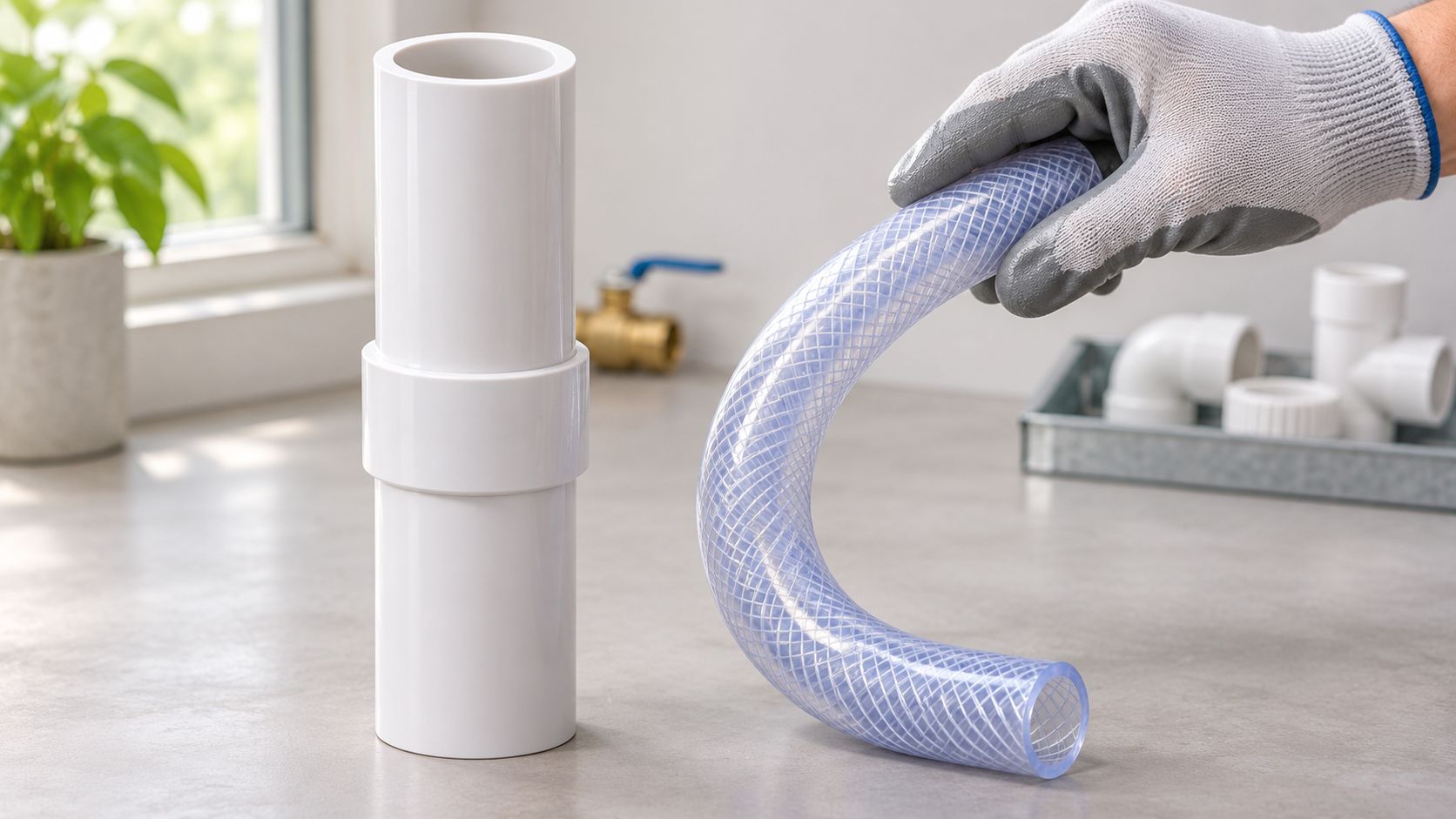
Say you're replacing a cold-water branch in a villa. A rigid pipe may look right, but you still need its pressure class, wall class, jointing system and certification. The Jernas Trading UAE plumbing guide identifies approximately 60°C as a commonly cited maximum service temperature for uPVC and distinguishes it from hot-water materials such as CPVC and PPR.
uPVC compared with other plastic pipe materials
| Material | Plasticizers | Typical service | Hot water? |
|---|---|---|---|
| uPVC | None added, rigid | Cold water, drainage, DWV, sewerage | No, check the stated service limit |
| Flexible PVC | Added for softness | Flexible hoses and tubing selected for the fluid | Only with an explicit product rating |
| CPVC | Not the defining distinction, chlorinated PVC | Hot and cold water | Yes, check rating |
| PPR | Not a PVC formulation | Hot and cold water supply | Yes, check rating |
For a buyer searching for uPVC pipe meaning, the practical answer therefore has two parts: what the material is, and which operating conditions the selected product can handle.
Why Plasticizer-Free PVC Behaves Differently
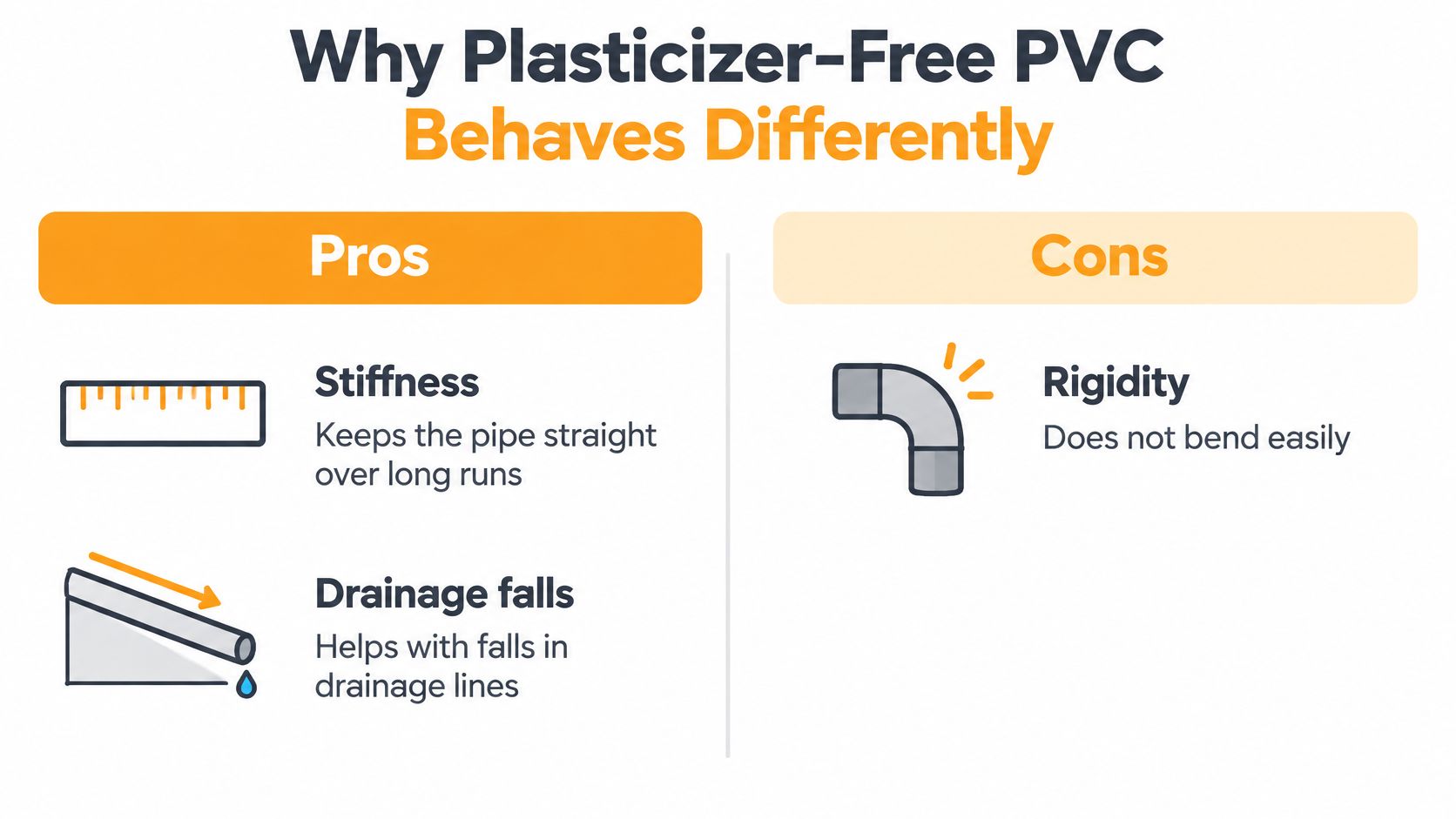
Stiffness helps an installer maintain a straight drainage run and its intended fall. It doesn't remove the need for supports, nor does it allow the installer to force a pipe around a misaligned connection.
This comparison shows the basic trade-off between keeping a straight line and accommodating movement.
Corrosion resistance makes uPVC useful in damp and buried locations because it doesn't rust like steel. Its resistance to many substances in domestic wastewater is valuable too, but that isn't permission to discharge an unidentified industrial chemical through it.
Low mass also makes lengths easier to carry and position than comparable metal alternatives. Installers must still protect sockets, support the run and avoid dragging sealing surfaces across rough ground.
The trade-offs on site
- Impact handling: Don't throw lengths from a vehicle or strike them into alignment. Rigid plastic can suffer impact damage, particularly in cold conditions.
- Movement: Provide the supports and movement provisions specified for the system rather than expecting the pipe to bend.
- Buried loading: Prepare even bedding and controlled backfill. Poor support can distort the pipe into an oval shape.
- Heat exposure: Select by the operating fluid and product rating, not by the assumption that suitability for UAE buildings means suitability for heated water.
Practical rule: A useful material property isn't a substitute for a properly installed system.
For an additional visual explanation of the material, use the video below.
Where uPVC Pipe Is Used and Where It Is Not
Match the application first, then the pipe. A supply line, a gravity drain and a compartment-wall penetration present different requirements, even when the pipe material looks identical.
uPVC pipe suitability by application
| Application | uPVC suitable? | What to check |
|---|---|---|
| Cold-water supply under pressure | Yes, if pressure-rated and approved | Pressure class, standard marking and authority acceptance |
| Hot-water supply | No for ordinary uPVC | Specify an appropriately rated CPVC or PPR system |
| Soil, waste and vent (DWV) lines | Yes | Drainage standard marking and joint system |
| Underground non-pressure sewerage | Yes | Applicable drainage standard, stiffness class and bedding |
| Rainwater drainage | Yes | Standard marking and wall class |
| Fire-rated wall or floor penetration | Only as part of a tested assembly | Tested fire-stop system and approval for the penetration |
The OPAR UAE drainage specification identifies EN 1401-1 with PVC-U pipes and fittings for non-pressure underground drainage and sewerage. That classification doesn't make a drainage pipe suitable for pressurised potable-water service.
Consider a contractor extending a buried sewer. A matching diameter isn't enough: the replacement must have the appropriate stiffness, compatible joints and suitable bedding. For a supply-line replacement, the contractor must instead establish pressure suitability and potable-water acceptance.
A pipe that fits the socket isn't necessarily a pipe that fits the specification.
Existing drainage problems also need diagnosis before replacement. Total Plumbing & Hot Water Systems' resource on blocked drain clearing services is relevant when deciding whether a restricted line needs clearing and investigation rather than an immediate material change.
For component identification, our guide to types of plumbing pipes and fittings helps distinguish the pipe from the elbows, branches and connectors needed to complete the system. Request conformity documents for the exact product, not merely a catalogue showing the same material name.
Reading Pressure Ratings Printed on the Pipe
PN is a nominal pressure designation, not a universal guarantee under every operating condition. The Gulf Eternit uPVC pressure-pipe catalogue describes pressure classes referenced to 20°C, with PN10 indicating approximately 10 bar on that basis.
As a preliminary selection guide, lower classes serve lower-pressure duties, intermediate classes cover suitable distribution systems, and higher classes may be needed for taller or mechanically pumped installations. The engineer's design sets the final choice, not the building description alone.
Say a booster pump supplies an upper-floor distribution line. The normal running pressure is only part of the calculation: the designer must also consider what happens when the pump stops or a valve closes quickly.
Check the whole pressure system
- Static head: Account for the elevation difference and resulting pressure at lower points.
- Pump shutoff pressure: Check the pressure the pump can produce when flow stops.
- Transient surge: Assess water hammer and valve-closing behaviour.
- Connected components: Confirm that fittings, valves and joints are compatible with the design conditions.
A higher pipe class won't correct poor supports, thermal movement or defective jointing. Our high-pressure PVC pipe guide provides further selection context.
For existing buildings, Heatwave Air Conditioning, Plumbing, & Electric's DIY fixes for excessive water pressure offers troubleshooting context, but building-wide pressure changes should remain under qualified control. Check markings on delivery and complete a documented hydrostatic test to the approved design before handover.
Misconceptions and the Eight Checks
Read the application decision in order: pressure supply, hot-water supply, DWV, underground sewerage, rainwater and fire-rated penetrations. Don't carry an approval from one category into another.
The Dubai Municipality certification document illustrates application-specific certification for non-pressure underground drainage under BS EN 13476-2:2018+A1:2020. It isn't blanket approval for every uPVC product or installation.
Likewise, the Homefix UAE plumbing installation guide helps distinguish temperature suitability from installation requirements. At a fire-rated penetration, assess the pipe, opening, surrounding construction and tested fire-stop arrangement together.
Eight checks before acceptance
- Confirm the application. Identify what the line carries and whether it operates under pressure.
- Read the printed standard. Match the actual pipe marking to the approved specification.
- Record the designation. Capture the pressure class or stiffness class, whichever applies.
- Pair diameter with wall class. Matching nominal size alone doesn't establish equivalence.
- Confirm operating temperature. For heated supply, select a suitable hot-water material.
- Verify joint compatibility. Check sockets, seals, fittings and jointing materials as a system.
- Approve the penetration assembly. Require the tested fire-stop arrangement for the actual construction and pipe.
- Collect acceptance documents. Obtain the technical sheet, conformity documents and authority acceptance for the exact size and use.
Acceptance boundary: Relabelling can't make an unsuitable pipe compliant.
A failed standard check requires a compliant replacement unless the engineer formally approves an equivalent. A failed fire-stop check requires a compliant penetration assembly, which may involve replacing the fire-stop rather than the pipe itself. Don't conceal either defect before inspection.
Confirm the Application Before You Order
If the project includes hot-water supply, don't order ordinary uPVC for that line. Specify CPVC or PPR with ratings that match the engineer's design.
PPR is specially designed for hot and cold water supply. Our technical team can recommend the right PPR pipe variant for your needs and help check the proposed specification against project and municipality requirements; the engineer retains responsibility for the final design.
Keep the purchase record complete
File the product technical sheet, conformity documents and municipality or utility approval letter for the exact diameter and use with the purchase record. Keep these accessible for inspection rather than relying on a photograph of an unmarked pipe or a generic supplier catalogue.
Before placing the order, send the proposed product documents and any substitution request to the engineer. Obtain confirmation of the final design and approval before releasing materials for installation.
We offer plumbing pipes and fittings, with technical support to help you select the appropriate specification. Visit Yasu Trading Co. LLC with your application details and approved project requirements so our team can help identify suitable materials, including PPR options for hot and cold water supply.