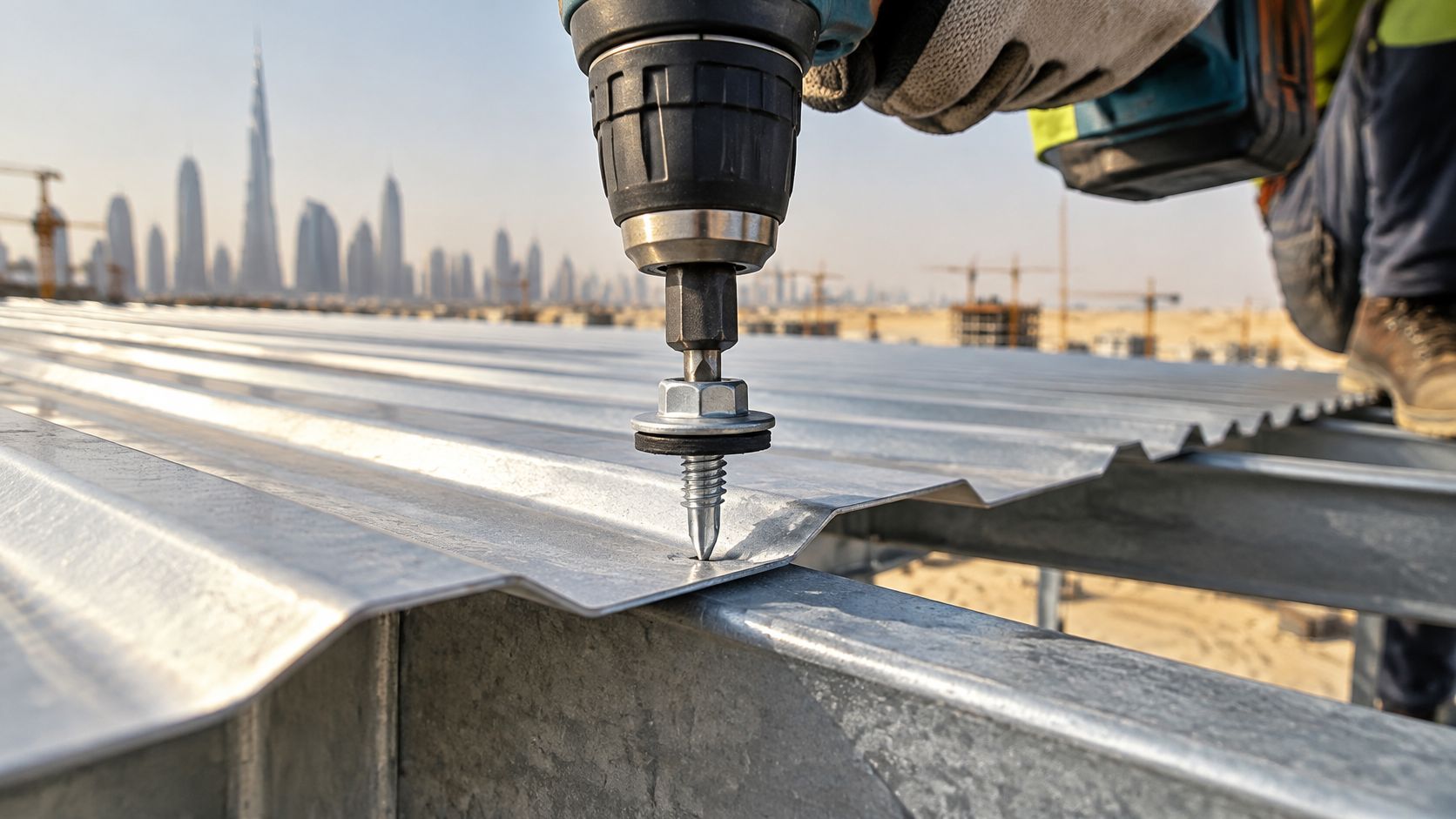
Wafer Head Self Drilling Screws for UAE Projects
The cartons have arrived, the driver bit fits, and the screw looks right against the approved sample. Then the installation crew hits a thicker support, a head spins in thin sheet, or a rooftop fixing starts showing corrosion. The replacement screw may cost little, but getting access, stopping work and repairing the assembly won't.
For UAE projects, wafer head self drilling screws are a connection-system choice, not just a diameter and length on a purchase order. Start with what the point must penetrate, what the threads must grip, how the head must clamp and which environment the finished connection must survive.
What Wafer Head Self-Drilling Screws Are and How They Work
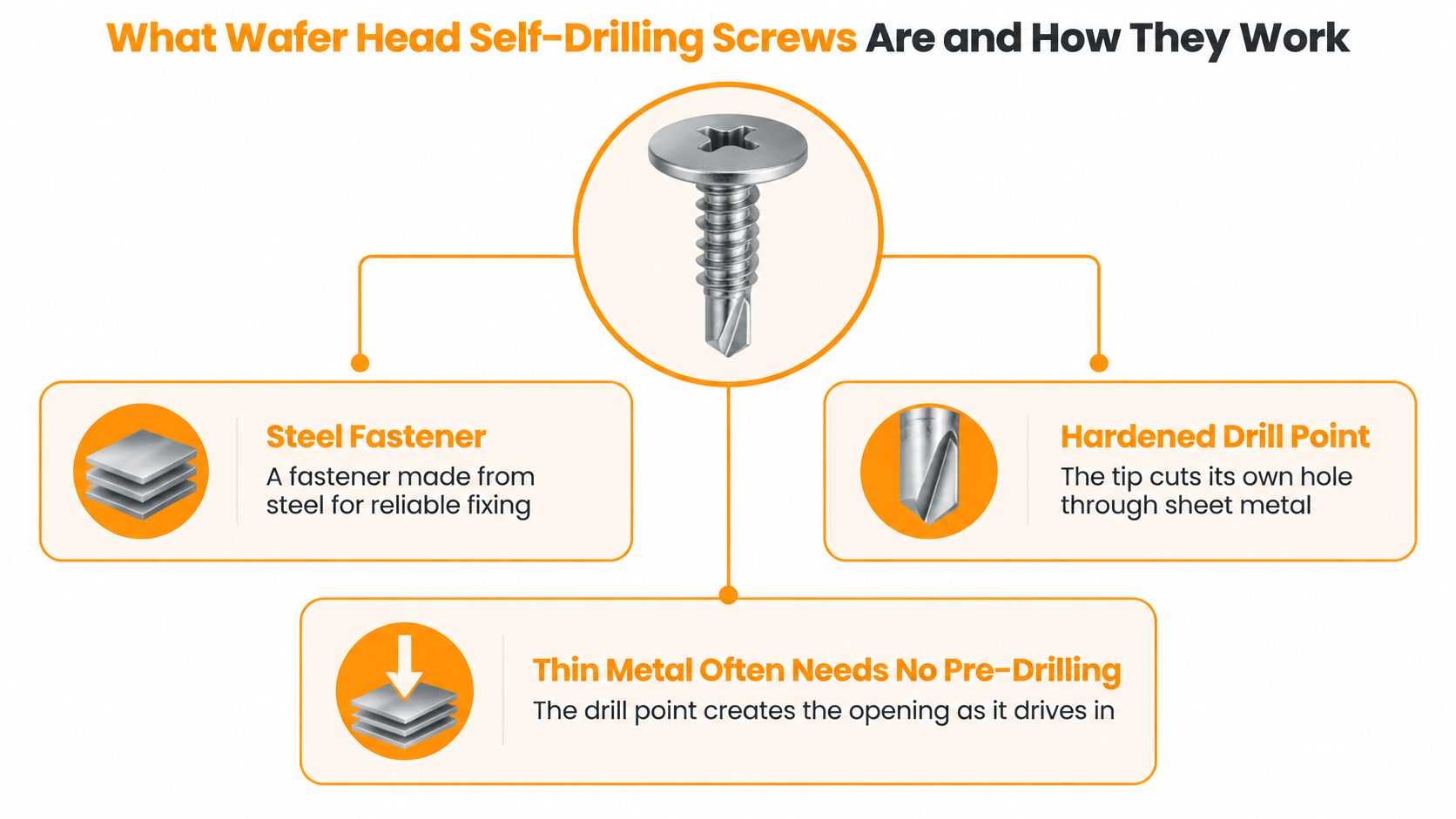
A wafer head self-drilling screw is a steel fastener with a hardened drill point that creates its own hole through compatible sheet metal. Think of a cordless drill followed immediately by a tapping screw: the tip opens the hole, then the threads engage the metal behind it. Thin metal often needs no separate pilot hole, provided the material falls within the product's drilling capacity.
The broad, shallow head distinguishes it from a countersunk screw. It bears against the surface rather than disappearing into a countersink, giving a low-profile connection without deliberately cutting a recess into the sheet.
Read the screw from head to tip
- Head: The wafer shape provides a broad bearing face with limited projection. A sealing washer is a separate specification choice, not something every wafer-head screw includes.
- Drive: Match the recess to the correct driver bit. Phillips-type recessed heads and external hexagon-washer heads aren't interchangeable descriptions, even when a supplier groups them together.
- Drill point: Check its rated material and drilling thickness. A sharp-looking point doesn't establish capacity.
- Thread: The tapping thread engages the receiving metal and develops the connection's grip. Drilling successfully doesn't prove that the thread connection is adequate.
- Shank and length: For this non-countersunk head, length is normally identified from beneath the head to the tip. Confirm the manufacturer's drawing, especially when washers or unusual head geometries are involved.
- Coating or material grade: This identifies the corrosion-protection strategy. Color alone isn't a reliable way to identify a finish.
The diagram shows how these features work together.
Separate the head description from the product standard
Wafer head describes geometry, not universal compliance. Don't accept a standard number on a quotation without checking whether its defined head form matches the offered product.
A useful product drawing should let the buyer identify the head diameter, drive, thread, drill point and under-head length without interpreting a catalogue photograph. Check the drill point first when penetration is uncertain; check the head and washer arrangement first when surface damage, clearance or sealing controls the choice.
Choosing Screw Size by Substrate Thickness and Drill Capacity
A wafer head screw fails as a system when any one variable is wrong. Drill capacity, clamp-up, coating and exposure zone have to match the connection. On a Dubai roof in August heat and salt air, a screw that looked correct in the box still shears a point, strips a thin purlin or rusts at the washer within months. The result is a callback, not a catalogue complaint.
Start with the full connection stack on paper. List each metal layer with material and thickness, plus coatings, insulation, facings, washers and any stand-off. Compressible insulation adds length but drills like air, so never count it as steel in a capacity calculation. For a hypothetical roof detail, add sheet thickness to purlin thickness to get the metal stack, then check that total against the chart for the exact product offered. Each screw's drilling capacity must be taken from the manufacturer's chart for the exact product offered.
Screw size and typical use
| Screw size | Typical use |
|---|---|
| ST2.9 | Light-gauge partitions, ceiling accessories |
| ST3.5 | Light framing, flashing, trims |
| ST3.9 | Roof sheet to purlin, sidelaps |
| ST4.2 | Cladding brackets, duct supports |
| ST4.8 | Heavier cladding rails, steel supports |
| ST6.3 | Heavy-gauge connections, engineer-checked |
Use this table to organise the enquiry. It does not assign a drilling thickness to a diameter.
The ST2.9 through ST6.3 dimensional reference comes from ISO 15480 covering steel hexagon-washer-head drilling screws with tapping screw threads, rather than every product sold as a wafer-head screw. That distinction matters at submittal. Ask the manufacturer to identify the applicable product standard for the offered head geometry instead of treating a trade description as proof of conformity.
Neither combined thickness limits nor pull-out values can be filled from diameter alone. A larger diameter is not automatically a higher capacity drill point. Buy against the exact manufacturer's product code, with its approved metal thickness range, steel suitability and connection test data added to the procurement matrix before release.
Length needs a separate check. The point must complete drilling and leave the required full thread engagement beyond the receiving metal. Short screws can penetrate yet leave the thread poorly positioned. Long screws cannot compensate for an unsuitable point, and excess length in thin sections increases stripping and wobble under a high speed driver.
Put each selection variable in its own field:
- Diameter and length: Include product code and dimensional drawing.
- Drill capacity: State approved thickness range and steel suitability.
- Substrate: Identify top material and receiving support.
- Head and drive: Record geometry, bearing needs and tool compatibility.
- Protection and sealing: Specify coating or material grade and washer arrangement.
- Installation controls: Obtain torque guidance and recommended tool.
I recommend written confirmation for stacks near the chart limit, high strength steel or separated layers. Trial feel proves little. Structural load paths need engineering verification, and a clean drilling demonstration is not structural approval.
Picking the Right Coating for UAE Exposure
A wafer head screw that drills cleanly in the morning can start bleeding rust at the head by the next maintenance cycle. Drill performance only describes entry. Coating or base metal grade, clamp-up and the exposure zone decide whether that connection survives Dubai humidity, salt air and roof heat without a callback.
Separate mild interior use from exposed outdoor applications and from marine or chloride-heavy environments before you compare products. That three-way split prevents the most common error, which is approving an interior plated screw for a roof or façade because the point size looked correct.
Coating options by UAE exposure
| Coating or grade | Best fit | Watch-out |
|---|---|---|
| Electro-zinc plated carbon steel | Dry, air-conditioned interiors | Not a default choice for exposed façades or coastal roofs |
| Zinc-flake coated steel | Outdoor, moderate exposure where supported by product evidence | Confirm corrosion-test evidence, coating thickness and application approval |
| Hot-dip galvanized base | Exposed external steelwork where the screw system is approved | Check coating thickness, drill-point performance and washer compatibility |
| Stainless A4 (316) | Coastal, marine and chloride-heavy sites | Higher cost; check connected-metal compatibility and drilling capability |
Treat this as an exposure shortlist, not a substitute for product approval. A finish name does not identify coating thickness, application quality or the durability evidence behind the supplied batch.
The comparison below illustrates why appearance alone is not a selection method.

A plant room shows how fast the wrong call fails. Condensation around chilled lines keeps heads damp for hours, and thin zinc goes first at the drive recess and under the head edge. I recommend treating any intermittently wet interior as an outdoor exposure for coating selection.
Check the installation zone point by point:
- Location: conditioned partition, above a suspended ceiling, outdoors or in a wet service area
- Coastal exposure: salt-laden air reaches sheltered surfaces that rain never washes
- Condensation and chemicals: chilled services, cleaning products or process emissions wet the fixing
- Connected metals: sheet, support, bracket and washer materials in direct contact
- Maintenance access: the facility team can inspect and replace without opening finished work
Galvanic compatibility needs its own decision. A plated carbon-steel screw joining aluminum sheet in a damp location creates a corrosion cell at the contact point. Local coating damage accelerates it, even though most of the screw still looks protected.
Where isolation is required, specify an approved isolating detail rather than adding an improvised washer that changes clamp-up or sealing. Our guide to fastener coatings for the UAE's coastal climate provides further context for comparing protection strategies.
Finally, verify the stainless product's actual drilling construction and substrate rating. Corrosion resistance does not establish structural capacity. A marine-suitable material designation does not prove its point can penetrate the specified support.
Matching Screws to Roofing, Cladding and Metal Framing
Choose the connection detail before choosing the screw. A low-profile head can be useful across roofing, cladding and framing, but those assemblies don't ask the fastener to do the same job.
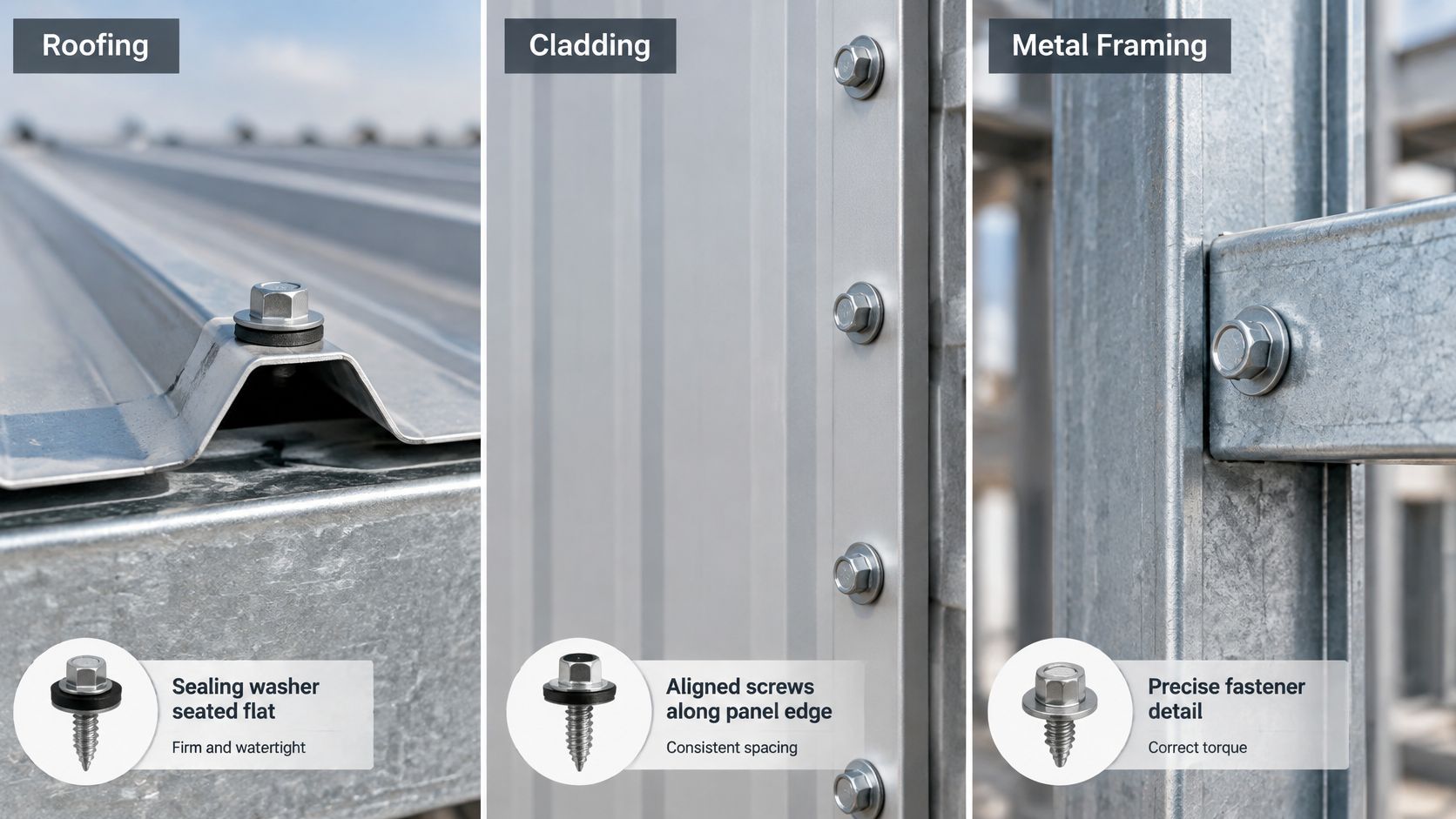
The application image highlights the different interfaces a procurement schedule needs to distinguish.
Roofing needs an approved weathering detail
Sheet-to-purlin connections need the roof-system designer's approved fastener, washer, location and spacing. A generic wafer head isn't automatically suitable for a primary weather-exposed roof fixing, even if it drills the sheet.
Record the sheet and purlin stack, roof exposure zone and sealing arrangement. Watch for washer distortion, unsupported sheet deformation and incorrect fixing positions. Sidelap fixings may perform a different function from the main support fixings, so don't combine them under a single purchase description.
For broader roof-system comparisons, Superior Home Improvement's guide to residential metal roofing options helps distinguish material choices. The project-specific fastening detail must still come from the selected roof system.
Cladding needs controlled bearing and restraint
Cladding rails, brackets and insulated panels require a head arrangement that suits the connected face. Excessive bearing pressure can damage a panel facing, while poor seating can leave the component inadequately restrained.
Specify the panel or bracket stack, external exposure classification and bearing or sealing requirement. Confirm whether the assembly needs movement accommodation, a particular washer or a proprietary fixing rather than substituting a visually similar screw.
The video provides an additional visual reference for screw application.
Metal framing needs reliable thread engagement
Light-gauge partitions, ceiling accessories and stud-to-track connections often favor a head with limited projection. The receiving sheet must still provide the tested grip required by the framing system.
Record the framing material and layer arrangement, the actual service environment and whether a washer is permitted or required. Don't introduce a washer that prevents board seating or substitute a screw into an acoustic or fire-rated detail without approval.
Rooftop MEP supports and façade attachments deserve an engineer's review whenever failure affects safety, weather resistance or supported services.
Installing Wafer Head Screws Without Stripping or Crushing
A sound fixing has completed penetration, proper thread engagement and a fully seated bearing face without damage to the connected material. Where a sealing washer is specified, it should compress evenly within the manufacturer's installation limits.
Seated doesn't mean buried. A wafer head normally remains above the surface; forcing it into sheet or board to make it disappear defeats its bearing function.
Set up and prove the installation
Confirm the connection before opening production packs. Match the screw code to the drawing, stack and approved installation zone. Check that the crew hasn't received a similar-looking screw intended for another substrate.
Fit the correct bit and establish the tool settings. Use an unworn bit in a variable-speed driver or the manufacturer's specified installation tool, beginning with a conservative clutch setting. Make a trial connection using representative offcuts, because free-running behavior tells you little about final seating.
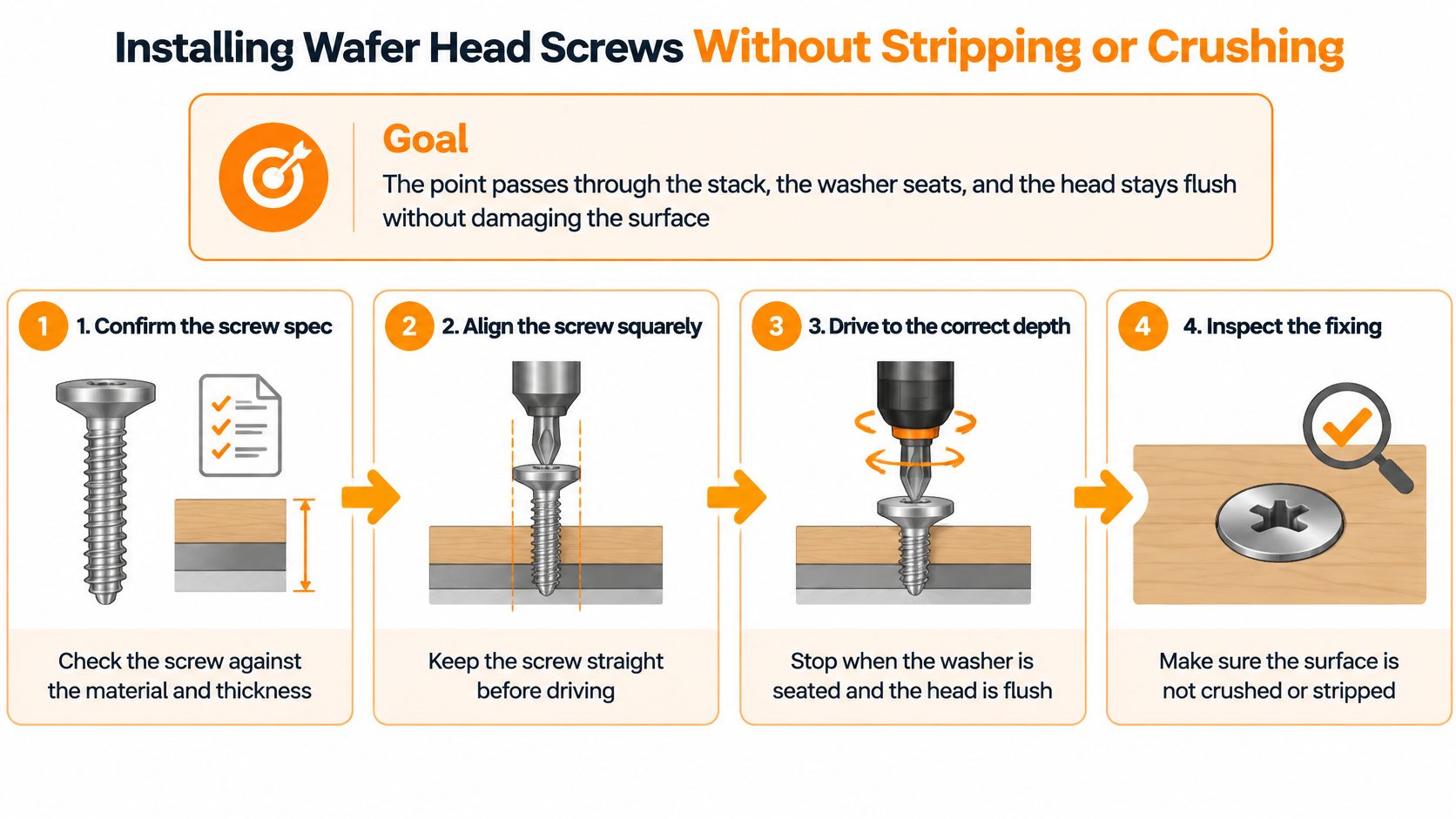
Support the materials and hold the screw square. Clamp loose layers where necessary, then apply steady axial pressure through the driver. An angled start can enlarge the entry hole and leave uneven head or washer contact.
Let the approved drill point do its work. Don't add a pilot hole to a connection designed for direct drilling unless the manufacturer approves that method. If the steel exceeds the product's capacity, select an approved alternative or a documented predrilled connection rather than forcing the screw.
The installation sequence below emphasizes alignment, seating and inspection.
Control the final seating operation
Reduce the driving effort as the head approaches the surface. Stop when the bearing face seats or the specified EPDM washer reaches its approved compression. Continuing to drive after seating can damage threads without producing a visibly dramatic warning.
Use the manufacturer's torque guidance with suitable equipment. Where a torque-controlled installation is required, use a calibrated tool and the approved verification procedure. Don't assume a clutch dial is a calibrated torque reading or tighten every completed fixing further as an inspection method.
Inspect the connection, not just the head. Look for tilted heads, displaced washers, damaged facings, loose sheets and signs that the screw has stripped. Remove defective fixings and repair the hole using the approved detail; another identical screw in the damaged hole may not recover capacity.
Record the installation evidence. Keep the batch identification, installation zone and required torque or seating checks with the inspection record. If the tool, substrate or screw batch changes, repeat the representative trial before continuing.
Stop the driver at the approved seating condition, not at the point where the tool can no longer turn the screw.
Keep drilling swarf off finished metalwork and clear debris from beneath washers before final acceptance. Loose metal particles can damage finishes, and trapped chips can interrupt sealing contact.
For an unwashed head, look for flat, stable bearing without a dished sheet. For a washer-equipped fixing, look for an even contact ring without extrusion or splitting. Neither appearance replaces the specified inspection procedure, but both help the installer recognize an obvious defect immediately.
Common Mistakes and How to Troubleshoot Them
Choosing by diameter alone is an expensive mistake because the screw can fit the tool yet fail at the connection. The crew may respond by pushing harder, driving faster or changing length, none of which establishes that the point and thread are suitable.
A broad head helps distribute clamp force, but the connection still needs verified pull-over and pull-out performance. Pull-over concerns the connected sheet passing over the head; pull-out concerns the threaded engagement failing in the receiving material.
Symptoms, causes and fixes for wafer head screws
| Symptom | Likely cause | Fix |
|---|---|---|
| Head spins without drilling | Excessive speed, weak axial pressure or a worn drill point | Check the approved speed, apply steady pressure and replace the damaged screw |
| Screw stalls at the sheet | Stack or steel hardness exceeds the drill-point rating | Select a suitable point using the manufacturer's chart, not diameter alone |
| Head pulls through or crushes the facing | Overdriving, inadequate bearing area or an incorrect washer | Use the approved bearing detail and stop at the specified seating condition |
| Loose fixing or rattle | Incomplete seating, insufficient length or damaged thread engagement | Inspect the hole and engagement before correcting torque or replacing the fixing |
| Rust streaks appear early | Unsuitable protection, coating damage or incompatible metals | Identify the corrosion mechanism, then replace and isolate materials as specified |
| Thread strips in the sheet | Excessive torque or an oversized hole | Apply the approved repair detail and correct the tool setting or drilling method |
Diagnose the failed interface
A screw that stops drilling needs a different investigation from a screw that drills successfully but won't tighten. For the first, inspect the point, chart rating and steel. For the second, inspect the hole, thread position and receiving sheet.
Don't repeatedly run a stalled point against the metal. Replace it and check the selection before continuing; heat and wear won't improve its drilling performance.
A rattling accessory also deserves more than another turn of the driver. Check whether the assembly has a gap, whether the receiving sheet has stripped and whether the accessory itself requires a vibration-resistant connection.
Repair warning: A fresh screw doesn't restore a damaged hole automatically. The approved repair may require relocation, a different fastening arrangement or replacement of the affected component.
Preserve the assembly's tested performance
The UAE's construction specifications addressing building acoustics emphasize control of external noise, mechanical-services noise, airborne sound and impact sound. A loose service attachment or altered partition connection therefore deserves attention beyond its appearance.
For acoustic partitions, fire-rated assemblies and proprietary façade systems, follow the tested connection detail. Changing the head, washer or fastening pattern can make the installed assembly different from the approved one.
Investigate corrosion at the interface, not only on the visible head. Rust staining may come from damaged protection, trapped debris or an incompatible connected component; changing every screw to stainless without checking compatibility isn't a complete diagnosis.
Before restarting work, close the investigation with the exact drill chart, the approved installation setting and the protection specified for that zone. Record the corrective action so the next crew doesn't repeat the original substitution.
Standards and Documents UAE Projects Require
The Dubai Building Code requires corrosion resistance for fasteners and affected structures, with protective systems considering durability, ultraviolet exposure, inspection, maintenance and expected coating life. For relevant Dubai work, protection is therefore a compliance consideration, not merely a preferred finish.
Apply the correct jurisdiction and project requirements elsewhere in the UAE. Don't assume that a Dubai document alone establishes approval for every municipality, client or specialist assembly.
Separate the approval responsibilities
The product standard defines the applicable fastener characteristics. Confirm that its scope matches the actual head and product offered.
The project engineering requirements establish connection resistance, load paths and any structural verification. The consultant or approval authority determines the evidence needed for the specific installation. A catalogue conformity statement doesn't replace either responsibility.
Use the coating selection process to identify a candidate protection system, then submit evidence for that exact system rather than a generic brochure covering unrelated finishes.
Build a traceable submittal package
- Product identification: Manufacturer, product code, drawing, applicable standard and any declared limitations.
- Protection specification: Base material, coating type and coating thickness.
- Corrosion evidence: Salt-spray or equivalent test documentation tied to the proposed finish, with the test method and acceptance basis.
- Compatibility statement: Suitability for the connected sheet, bracket and any EPDM sealing washer.
- Installation instructions: Tool compatibility, drilling guidance, seating criteria and torque requirements.
- Traceability and storage: Batch identification and measures to protect cartons and coatings before installation.
Keep test evidence in context. A corrosion-test result isn't, by itself, a guaranteed service life in a particular rooftop or coastal detail.
Our overview of fastener manufacturers and supplier selection in the UAE can help procurement teams frame their documentation enquiries. We specialize in municipal-compliant construction hardware, but the consultant must still approve the specific product and application.
At handover, record the installed screw grade, protection system, zones and replacement criteria. Include inspection access and relevant maintenance instructions, especially for concealed or difficult-to-reach connections. Confirm the required approval package before ordering, when substitutions are still manageable.
Lock the Specification Before You Order
Release the purchase order only when the connection schedule answers the questions the supplier and installer would otherwise resolve by guesswork. A description such as galvanized wafer-head screw leaves too much open: the point, coating system, bearing geometry and approved application may all remain unidentified.
Complete the order checklist
- Connection stack: Identify each material, metal thickness and nonmetal layer, including insulation or facings that affect length and seating.
- Exact screw selection: State the applicable standard, diameter, length and manufacturer-confirmed drill point.
- Head and tool interface: Specify the head geometry, drive type and approved driver bit.
- Washer requirement: Identify sealing, bearing and isolation components rather than writing washer included.
- Exposure assignment: Match each approved product code to its installation zone.
- Approval documents: Attach the product drawing, corrosion evidence, application data and installation guidance.
- Delivery schedule: Separate pack quantities by zone and identify the receiving location.
Ask for exceptions to be listed explicitly in the quotation. If the offered product differs from the approved code, hold the substitution for review instead of accepting equivalent as a complete technical explanation.
Protect the approved product through delivery
Require identifiable, intact packaging and keep cartons dry, covered and off wet floors. Don't seal moisture into packaging after delivery; quarantine damp or damaged cartons and inspect the contents before use.
Maintain labels when issuing screws to crews. Decanting different finishes or lengths into an unmarked site bin removes the traceability the submittal established and makes accidental substitution much easier.
Ask the quotation to state pack sizes, availability, lead times and delivery arrangements for that order. Don't build the installation program around assumed stock or assume that a partial delivery contains the same approved product as the balance.
Yasu Trading Co. LLC can support procurement and site delivery against a completed connection schedule. We stock construction supply categories under one roof in Deira, Dubai, which can help contractors coordinate related installation materials without changing the approved fastener specification.
Keep commercial comparison separate from technical acceptance. Compare prices only after the quotations identify the same protection, drilling performance, documentation and packing requirements.
Send the completed matrix and installation-zone list for confirmation, and obtain the manufacturer's supporting documents before authorizing the first delivery.
We supply fasteners, adhesives and sealants, with practical procurement support for UAE construction work. Visit Yasu Trading Co. LLC with your connection schedule, exposure zones and required delivery location so we can help identify the appropriate wafer-head screw variant and coordinate the supporting product information before you order.