
What is bill of quantities in construction: UAE Guide to Cost and Tendering
At its core, a Bill of Quantities (BOQ) is an itemized list that breaks down every single material, part, and labor cost needed to complete a construction project. Think of it as the ultimate recipe and shopping list rolled into one. It’s what ensures every contractor is bidding on the exact same scope of work, creating a level playing field for everyone involved.
This clarity is the backbone of accurate bidding, solid cost control, and effective project management from start to finish.
Understanding the Blueprint for Your Budget
Could you imagine trying to build a skyscraper without knowing exactly how much steel, concrete, or glass you'd need? The project would spiral into financial chaos almost immediately. A BOQ prevents this very problem by translating complex architectural drawings into a straightforward, standardized list of every task and material, from the first shovel of dirt for excavation to the final coat of paint.
In the fast-paced UAE construction market, where projects awarded between 2020 and August 2025 are valued at an estimated US$328.7 billion, the BOQ is the cornerstone of financial stability. It’s an essential tool for navigating the material and labor cost fluctuations that can easily lead to project overruns of 15-25% if not properly managed.
What Is the Primary Purpose of a BOQ?
The main purpose of a Bill of Quantities (BOQ) is to provide contractors with a clear and consistent basis for preparing their tenders. This ensures every bid is priced on a like-for-like basis, making the comparison process fair, transparent, and efficient.
For any contractor aiming to secure their next big project, a deep understanding of the BOQ is a critical step in winning a tender for construction.
This single document plays several key roles throughout a project's life:
- Tendering: It enables bidders to submit accurate and competitive prices.
- Procurement: A building materials distributor can use it to supply the precise quantities of products required, no more, no less.
- Cost Control: It sets a firm baseline, making it easier to track expenses and calculate payments for work completed.
For any project that needs to meet the strict UAE construction standards, a detailed BOQ isn't just good practice—it's absolutely essential. It gives everyone involved, from the general contractor in Dubai to a specialized supplier, a single source of truth to work from. This simple alignment minimizes disputes and keeps the project moving forward on time and on budget.
Why Is a BOQ Essential for UAE Construction Projects?
In the fast-paced, high-stakes construction market of the UAE, a Bill of Quantities isn't just another piece of paperwork. Think of it as the project's financial backbone—the one thing that brings stability and predictability to an otherwise complex process. It acts as a universal translator, turning intricate architectural designs into a straightforward, itemized list that everyone involved can understand and, crucially, put a price on.
This level of standardization is what fuels fair and transparent competition. When every contractor bids on the exact same scope of work, guesswork is taken out of the equation. It levels the playing field, ensuring project owners can compare bids on an apples-to-apples basis. The competition then shifts from who can best interpret ambiguous drawings to who can deliver the work most efficiently.
What Makes a BOQ a Financial Roadmap?
A Bill of Quantities serves as a project's financial roadmap by providing a detailed, itemized baseline for all costs. This allows project managers to effectively plan budgets, control spending, and track expenses against a clear benchmark from start to finish.
This control is the very foundation of successful construction cost management. For a supplier in Dubai, a detailed BOQ is just as critical. It's what allows them to give you a sharp, accurate quote for materials, whether it’s pipes, fittings, or electrical supplies. It also helps them sync their delivery schedules with the project’s timeline, making sure the right materials show up on-site exactly when they’re needed—a vital part of meeting the UAE's strict construction standards.
In Dubai's cutthroat construction scene, the BOQ is the unsung hero preventing the 15-25% cost overruns that plague so many projects. With awarded contracts soaring from $31 billion in 2022 to $87 billion in 2023, that precision is more critical than ever. As a detailed ledger of everything from materials to labor, it ensures a fair tender process for the UAE's most ambitious builds. You can read more about the UAE's construction market intelligence at JLL.com.
How Does a BOQ Minimize Financial Disputes?
A BOQ minimizes financial disputes by creating a transparent, agreed-upon framework for valuing work and managing changes. It serves as the basis for calculating interim payments and fairly pricing any variations to the original scope using pre-agreed rates.
The BOQ's job doesn't end once the contract is signed; it plays a central role in the day-to-day financial administration of the project. It’s the basis for valuing the work as it's completed, which is how interim payments to contractors are calculated. As each stage is finished, the corresponding items in the BOQ are measured and valued, creating a transparent and justifiable payment certificate.
This structured approach is also a lifesaver when it comes to managing variations. If the scope changes—and it often does—the rates already agreed upon in the BOQ can be used to value the new work fairly and consistently. This simple mechanism goes a long way in minimizing the kind of financial disputes that can derail even the largest developments, paving the way for a smoother relationship between the client and contractor.
You can dive deeper into these strategies in our guide on effective construction cost management.
Who Prepares a Bill of Quantities?
A Bill of Quantities is prepared by a specialized professional known as a Quantity Surveyor (QS). Their role is to meticulously interpret architectural and engineering drawings to create a detailed, itemized list of all materials and labor required for a project.
The QS is the crucial link between an architect's vision and the project's financial reality on the ground.
Their job is to painstakingly comb through every architectural, structural, and MEP (Mechanical, Electrical, and Plumbing) drawing. They translate these complex plans into an itemized, quantified list of every single task and material required for the job.
This isn't just about counting bricks or measuring floor space. It’s a very precise skill, guided by strict, standardized measurement rules. In this region, these rules align with UAE construction standards to ensure everyone is on the same page. It means that when a BOQ calls for a cubic meter of concrete, it's measured the exact same way, no matter who is bidding on the project. This consistency is what makes for fair and transparent tendering. The QS owns this entire process.
What Is a Quantity Surveyor?
A Quantity Surveyor is a construction professional who specializes in project costs and contracts. They are trained to measure and value all the work needed with incredible detail, from large-scale excavation to the exact number of light switches required.
On any given project, you'll actually find two types of QS professionals, each representing a different side of the table but both working from that same foundational BOQ.
- The Consultant's QS (or PQS): This QS works for the client or the developer. They are the ones who create the original BOQ that goes out with the tender documents. Their primary mission is to build a rock-solid, accurate document that lets contractors submit fair, competitive, and comparable bids.
- The Contractor's QS: Once a contractor wins the bid and the project kicks off, their own QS steps in. This expert uses the priced BOQ as their roadmap for managing all project finances. This includes everything from ordering materials through a trusted building materials distributor, to valuing the work done for progress payments, tracking costs against the budget, and pricing any changes or variations along the way.
The real magic is in how these two QS roles create a system of checks and balances. The consultant’s QS establishes the financial baseline, while the contractor’s QS manages the live financial pulse of the project, making sure everything stays on track from day one to handover.
Understanding this division of responsibility is key for anyone in the industry. For a general contractor or a developer, knowing who prepares the BOQ and who manages it brings a lot of clarity to the financial flow of a project. This knowledge is especially powerful for procurement teams sourcing materials. For a deeper dive into their world, check out our guide for procurement managers in Dubai.
What Are the Main Components of a BOQ?
To really get a handle on a Bill of Quantities, you have to look at what it’s made of. Think of it like a recipe book for a construction project—each section details a different part of the financial and physical build. For any contractor in Dubai, understanding this structure is key to reading a BOQ with confidence and nailing your procurement strategy.
The document usually kicks off with the preliminaries before diving into the nuts and bolts of the actual physical work. Every section has a job to do, guiding the process from the first price estimate all the way to the final project accounts.
This simple flowchart shows how a Quantity Surveyor (QS) turns architectural drawings into a clear, itemized BOQ.
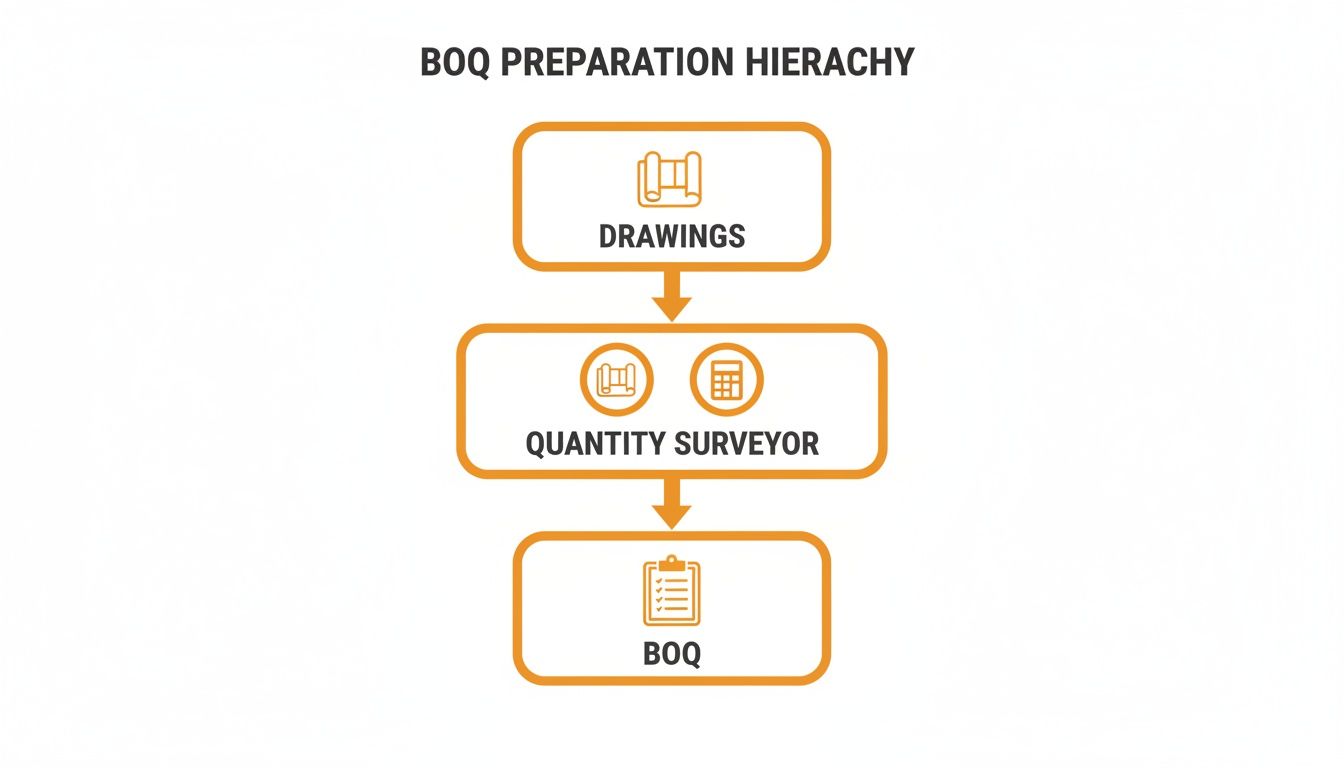
This process is fundamental—it’s how a visual design gets translated into a financial document that everyone can work from.
What Are Preliminaries in a BOQ?
Preliminaries in a BOQ are a section detailing the indirect project costs and general requirements necessary to execute the work. These are the essential running costs that aren't tied to physical materials but are crucial for site operations and management.
This section lays out all the overheads and general requirements needed to get the site up and running in line with UAE construction standards.
Common items you’ll find listed here include:
- Site setup costs like temporary offices, storage containers, and fencing.
- Health and safety management, from safety gear to emergency protocols.
- Salaries for project management and site supervision staff.
- Necessary paperwork like insurance, permits, and fees for local regulatory compliance.
What Is the Measured Works Section in a BOQ?
The measured works section is the core of the BOQ, containing a detailed, item-by-item breakdown of every task and material needed to construct the building. Each line item includes a precise description, unit of measurement, and the exact quantity required.
This is where a building materials distributor can see precisely what the project demands. For example, the list might specify:
- 500 linear meters of a certain type of drainage pipe.
- 250 square meters of a specific brand of ceramic tile.
- 75 units of sanitary ware from a manufacturer like Grohe.
A meticulously detailed measured works section is absolutely critical for accurate tendering. It leaves no room for guesswork and ensures every contractor is pricing the exact same scope of work. This is the foundation of fair competition on any Dubai project.
What Is a Provisional Sum in a BOQ?
A provisional sum is a financial allowance included in a contract for a specific item of work that is not yet fully designed or detailed. It acts as a placeholder to ensure the budget accommodates an anticipated cost, which is finalized later.
A classic example is a client including a provisional sum for a bespoke fire protection system. The final design isn't ready yet, but they know they'll need one. Once the design is approved, the work is properly priced, and the actual cost replaces the placeholder amount. A specialist supplier in Dubai would then be brought in to provide a firm quote based on the final specifications.
How Can Contractors Avoid Common BOQ Pitfalls?
For any contractor, a Bill of Quantities can be a double-edged sword. Get it right, and it's your roadmap to a profitable project. But an inaccurate BOQ? That's a fast track to financial trouble. To navigate these crucial documents, especially in a market as competitive as the UAE, you need diligence and a sharp strategy to sidestep the usual traps.
The single biggest mistake a contractor can make is blindly trusting the numbers on the page. Yes, the client's quantity surveyor prepared the BOQ, but the buck stops with you. It's your responsibility to check their work before you submit your tender. Always cross-reference the quantities listed against the project drawings and specs. You’d be surprised how often they don’t match up, and catching those errors early is what protects your profit margin.
How Should a Contractor Price BOQ Items in Dubai?
Contractors should price BOQ items by using up-to-date market rates for all materials, labor, and equipment specific to the local market like Dubai. This involves securing current quotes from suppliers and ensuring all direct and indirect costs, plus a reasonable profit margin, are included.
Accurate pricing isn’t just about pulling numbers out of a hat; it’s about reflecting the current market reality. Using last year's cost data is a surefire way to submit an unprofitable bid.
When you're putting together a tender based on a BOQ, your pricing model is everything. A deep dive into different approaches, like a cost-plus pricing strategy, gives you the financial framework to build a tender that's both competitive and sustainable. This is how you make sure all your costs—direct and indirect—are covered, with a healthy margin on top.
This is where a solid relationship with a reliable building materials distributor becomes a game-changer. A trusted supplier in Dubai, like Yasu Trading, gives you access to real-time, competitive pricing on all your essential items. Whether you need the latest costs for Makita power tools or Grohe pipes, that direct line to current market rates makes your bid sharper and more profitable.
A BOQ is not just a list to be priced; it's a contract document to be scrutinised. Your tender is a commitment based on its contents. Treat every line item with professional scepticism and verify everything before signing on the dotted line.
What Should You Do if You Find an Error in a BOQ?
If you find an error in a BOQ, you should document the discrepancy and immediately raise a formal Tender Query or Request for Information (RFI) to the client or their consultant. Do not make assumptions; instead, wait for an official clarification or addendum before submitting your tender.
Follow these steps to address any issues cleanly and professionally:
- Document Everything: Pinpoint the exact discrepancy. Note the specific BOQ item number and which drawing or spec it contradicts.
- Submit a Formal Query: Draft a written RFI to the client or their consultant. Politely ask for clarification on the quantity or the missing item.
- Await a Formal Response: Don't guess or make assumptions. Wait for the official addendum that clarifies the issue for all tendering contractors. This keeps the process fair, transparent, and in line with UAE construction standards.
Taking this proactive approach does more than just shield you from potential losses. It builds trust with the client and positions you as a thorough, reliable partner from day one.
Frequently Asked Questions About Bills of Quantities
When you're dealing with BOQs in the fast-paced UAE construction world, a few questions always seem to pop up. Whether you're a contractor, supplier, or developer, getting clear answers is key. Let's tackle some of the most common ones.
What Is the Difference Between a Firm and an Approximate BOQ?
A 'firm' BOQ means the quantities listed are guaranteed to be accurate, placing the risk of errors on the client. An 'approximate' BOQ uses estimated quantities, often because the design isn't finalized, and requires re-measurement of the completed work to determine the final cost.
While firm BOQs give you solid cost certainty, approximate BOQs are a common sight on fast-tracked Dubai projects. They let work start sooner, but they also bring a level of cost uncertainty that contractors need to keep a close eye on.
Can a BOQ Be Used After the Contract Is Awarded?
Yes, a BOQ becomes a critical contract document after it is awarded and priced. It serves as the financial roadmap for the project, used for valuing work for interim payments, pricing variations, and settling the final account.
The priced BOQ is the go-to document for:
- Preparing Interim Valuations: It’s how you calculate the value of work done for those crucial monthly or stage payments.
- Valuing Variations: When the client changes their mind or the scope shifts, the rates in the BOQ are used to price the extra (or reduced) work fairly.
- Final Account Settlement: At the very end, it’s the basis for settling up the final bill, making sure every last item is accounted for at the agreed-upon rates.
It's the financial guide that keeps things on track from day one all the way to handover.
How Does Modern Technology Affect BOQ Preparation?
Modern technology, especially Building Information Modeling (BIM) software, dramatically improves the speed and accuracy of BOQ preparation. BIM allows for the automatic extraction ("take-off") of quantities from a 3D model, significantly reducing the risk of human error compared to manual methods.
For a supplier in Dubai, this means getting much cleaner material lists from contractors. A building materials distributor can then turn around sharper quotes, manage their stock better, and keep the whole supply chain running smoothly.
The link between BIM and estimating software is a genuine game-changer, especially on complex UAE projects. It doesn't just cut down on BOQ errors; it gets designers, quantity surveyors, and contractors all working from the same playbook.
Are BOQs Mandatory for All Construction Projects in the UAE?
While not legally mandatory for every small project, a Bill of Quantities is standard practice and considered essential for any medium to large-scale development in the UAE. It is a fundamental component of the tendering process required by major developers to ensure fair bidding and maintain strict cost control.
Following this practice is a big part of upholding high UAE construction standards.
Simply put, if you're involved in any serious construction work here, a BOQ is just how business gets done.
At Yasu Trading Co. LLC, we know that a solid BOQ is the foundation of a profitable project. With our massive inventory of municipality-compliant building materials and transparent wholesale pricing, we give you the confidence to price your tenders accurately and source your supplies without a hitch. Team up with a supplier that's been supporting UAE contractors for over two decades. Explore our full range of products at https://yasutrading.com.